
 IUX
IUX
 Exness
 Vantage
 XM
XM
 ICMarkets
 LiteFinance
 Moneta
 Tickmill
 South Africa (9)
 India (9)
 Bangladesh (12)
 Germany (9)
 Thailand (10)
 Philippines (9)
 Nigeria (10)
 Vietnam (10)
 Malaysia (9)





Which Account Type is Best in XM?



Share:
Share:
Broker
10 min read
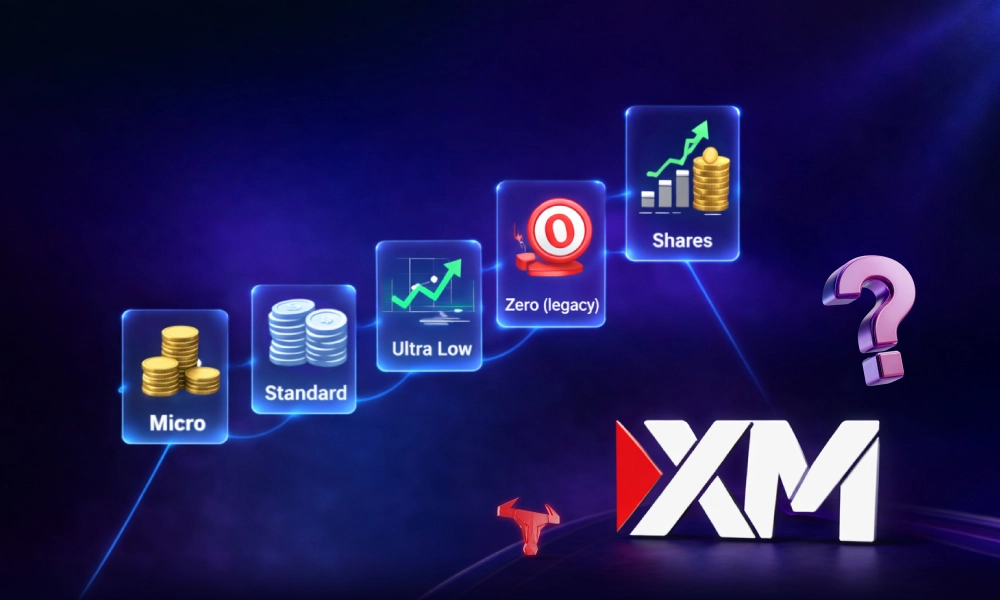
The best XM account type depends on how you trade, and that is not a cop-out answer. XM offers five account types, and each one is structured for a different kind of trader.
Pick the wrong one and you will either pay more than you need to in spreads, miss out on bonuses, or end up with conditions that do not suit your style at all.
This breakdown covers every XM account type, what each one actually costs in real trading, who it suits, and where the gaps are that most review sites skip over.
If you are new to XM entirely, the guide to XM for beginner investors is a good place to start before diving into the account comparison.
A Quick Look at XM's Account Lineup
Before going into each account, here is a side-by-side reference. Conditions can vary depending on which XM regulatory entity serves your country, so always verify on XM's official site.
For a full breakdown of XM's licences and which entity applies to your region, see the guide to is XM regulated.
| Account Type | Min. Deposit | Spreads From | Commission |
|---|---|---|---|
| Micro Account | $5 | 1.0 pip | None |
| Standard Account | $5 | 1.6 pips | None |
| Ultra Low Account | $5 | 0.6 pips | None |
| Zero (legacy) Account | $5 | 0.0 pips | $3.50/lot/side |
| Shares Account | $10,000 | Exchange rate | Varies by market |
| Note: Zero Account Status New Zero accounts are no longer being opened by XM. If you don't already have one, your main choices are Micro, Standard, Ultra Low, and Shares. Existing Zero account holders continue trading under their original terms. |
The Micro Account: Built for Small Positions
The Micro account is XM's entry-level option. Where a standard lot equals 100,000 units of currency, a micro lot equals just 1,000 units. That reduction means a single pip movement on EURUSD is worth roughly $0.10 instead of $10.
For someone building confidence with real money, that difference is enormous. You can hold a live position through a 30-pip swing against you and only lose $3. The same move on a Standard account costs $300.
The Micro account does not remove risk, but it scales it down to a level where a new trader can learn without wiping out an account on one bad session. For context on what $5 genuinely allows you to do, see the guide on can I trade with $5 on XM.
Spreads start from 1.0 pip. No commissions. Minimum deposit is $5. Both MT4 and MT5 are available. The Micro account is also eligible for XM's deposit bonuses and Loyalty Program, which is worth noting if those promotional credits matter to you.
| Expert Tip: The Micro account is particularly useful when testing a new strategy with real money. The cost of being wrong is low enough that you can run 20 to 30 test trades without meaningful damage to your capital. For risk-free practice before that stage, the guide on how to use the XM demo account covers how to get the most out of your practice time before switching to real funds. |
The Standard Account: XM's Most Popular Option
XM itself recommends the Standard account to new clients, and it is the one most traders open first. The appeal is straightforward: no commissions, full access to all instruments, bonus eligibility, and a $5 minimum deposit.
Spreads on the Standard account start from 1.6 pips on major pairs. That is wider than the Ultra Low, but the gap is smaller than it sounds in practice. For a trader placing five to ten trades a week with moderate position sizes, the extra spread cost across a month might amount to $20 to $40.
Compare that to what bonuses and the Loyalty Program can return, and the Standard account often works out well for traders who are not trading at high frequency.
The Standard account also has the broadest instrument availability and works well with Expert Advisors (EAs). Traders interested in automated strategies or copy trading should also review the guide to start copy trading with XM as a complementary option.
| Expert Tip: Standard and Micro accounts are the only two types fully eligible for XM's bonus promotions and Loyalty Program. If you are depositing $500 or less and XM is running a deposit bonus, that extra credit could meaningfully offset your spread costs early on. The XM broker deposit guide covers how to fund your account and what deposit methods qualify for bonus eligibility. |
The Ultra Low Account: Tighter Spreads, Same Low Entry
This is the account that stands out most on a cost-efficiency basis for active traders. The Ultra Low comes in two sub-types: Ultra Low Micro (for smaller lot sizes) and Ultra Low Standard (for regular lot sizes).
Both share the same core structure: spreads from 0.6 pips on major pairs, no commissions, and a $5 minimum deposit.
The math here is concrete. On EURUSD, the Ultra Low account typically costs around $8 per standard lot in spread at its average. The Standard account runs closer to $16 per lot.
If you are placing 50 standard lot trades per month, that difference adds up to roughly $400. At 100 lots, you are looking at $800 in savings monthly.
| Note: Islamic Trading on Ultra Low The Ultra Low account also supports swap-free (Islamic) trading. If you hold positions overnight and want to avoid swap charges for religious or strategic reasons, this account handles that without any markup on spreads. For full setup details, see the guide to open an Islamic account at XM. |
The catch is that the Ultra Low account is not eligible for XM's deposit bonuses or Loyalty Program. So for traders with small accounts placing infrequent trades, those bonuses might actually outweigh the spread savings.
For anyone trading with meaningful volume and frequency, Ultra Low wins on pure cost.
The Zero Account: For Existing Holders Only
XM stopped accepting new Zero account registrations. If you already have one, you know what you have. If you do not, this is not an option you can open today, so most traders reading this can move past it.
For reference, the Zero account offered spreads from 0.0 pips on major pairs, with a $3.50 commission charged per lot per side ($7 round-trip). The total cost on EURUSD worked out lower than even the Ultra Low account for high-volume traders.
For scalpers running tight entry-to-exit windows where spread determines whether a trade is viable, those near-zero spreads were the main draw.
If you have a Zero account, the conditions remain in effect. If not, the Ultra Low is the closest practical equivalent available to new clients today.
The Shares Account: Direct Stock Trading at a Different Level
The Shares account is a different product entirely from the CFD-based accounts above. It gives you direct access to real equities, not stock CFDs, but actual shares in companies across the US, UK, and German markets.
The minimum deposit is $10,000. That alone tells you this account is not for retail traders building their first funded account. It is for investors who want to hold actual stock positions under a regulated broker without going through a full stockbroker.
No leverage is offered on the Shares account. You are buying and holding at market price. Commission rates on the Shares account are: $0.04 per share for US stocks (minimum $1 per transaction), 0.10% per transaction for UK stocks (minimum $9), and 0.10% for German stocks (minimum $5).
These are competitive but not the cheapest available for pure equity trading. The Shares account is only available through the XM Global entity, which means availability depends on your country of residence. Verify directly with XM whether it is open in your country.
For a full breakdown of which XM entity covers which regions, see the guide to is XM regulated. If your goal is stock exposure but you do not have $10,000 to start, XM's Standard and Ultra Low accounts both offer stock CFDs with far lower deposit requirements.
You will not own the underlying shares, but you can trade price movements on hundreds of global stocks with micro lot sizing.
So, Which One Actually Is Best?
There is no single answer, but there is a clear pattern based on trading style and experience level.
| Trader Profile | Recommended Account | Key Reason |
|---|---|---|
| New or strategy-testing traders | Micro | Reduced pip value limits learning losses |
| Infrequent traders under 20 lots/month | Standard | Bonus eligibility offsets wider spreads |
| Active and scalping traders | Ultra Low | Lower spread cost compounds at volume |
| Automated EA traders | Ultra Low | Tighter spreads improve entry precision |
| Long-term equity investors ($10k+) | Shares | Direct stock ownership, no leverage |
- New traders or those testing strategies: Start with the Micro account. The reduced pip value means you can trade through learning mistakes without blowing through your capital. If the bonus program matters to you, stay on Micro or Standard. The guide to XM for beginner investors walks you through the full setup process.
- Traders placing fewer than 20 standard lot trades per month: The Standard account makes practical sense. You get full instrument access, bonus eligibility, and the Loyalty Program. The wider spreads relative to Ultra Low are unlikely to cost you more than the promotional benefits return.
- Active traders and scalpers placing regular volume: Ultra Low is the right call. The spread savings compound quickly at volume. Give up the bonuses and take the lower cost per trade. At sufficient frequency, the math strongly favors Ultra Low.
- Automated trading (EAs) on forex and gold: Ultra Low works well here too. The tighter spreads improve entry precision for EAs, and the commission-free structure keeps cost calculation simple. Traders interested in a managed copy approach should also explore start copy trading with XM.
- Long-term equity investors with significant capital: The Shares account, if available in your country, is the only XM option that gives you direct stock ownership. The $10,000 floor and no-leverage structure reflect that this account is for investors, not active CFD traders.
One Thing Worth Knowing Before You Open
You cannot switch account types at XM. If you open a Standard account and later decide you want Ultra Low, you will need to open a separate account. XM allows up to eight accounts per client, so there is no technical barrier to running multiple account types simultaneously.
Many traders do exactly that, keeping one account for strategy testing and another for live execution. The guide to opening an additional XM account covers how to set that up under your existing profile.
All accounts include negative balance protection, hedging capability, and an Islamic (swap-free) option regardless of which type you choose.
Both MT4 and MT5 are available on XM across all account types, and the same educational tools and customer support apply whether you are on a $5 Micro or a $10,000 Shares account.
| Inactivity Fee to Note XM applies a $5 monthly inactivity fee after 90 days of no account activity on standard retail accounts. Any trade, deposit, or withdrawal resets that clock. If you plan to leave an account idle for months, factor this cost into your planning. For full details on fees that apply when moving money out, see the guide to XM withdrawal process and fees. |
F. Nathan
Felix Nathan is a professional trader, market analyst, and business development executive with over a decade of experience in the forex and financial markets. Felix specializes in providing actionable market insights, trading strategies, and risk man...