 IUX
IUX
 Exness
 Vantage
 XM
XM
 ICMarkets
 LiteFinance
 Moneta
 Tickmill
 South Africa (9)
 India (9)
 Bangladesh (12)
 Germany (9)
 Thailand (10)
 Philippines (9)
 Nigeria (10)
 Vietnam (10)
 Malaysia (9)





What is a Good Lot Size for $20?



Share:
Share:
Broker
5 min read
Trying to trade forex with just $20 feels like showing up to a Formula 1 race on a bicycle.
But guess what? With the right lot size, risk management, and a pinch of patience, you can start small and build up your account, one smart trade at a time.
I will do my best to break down what lot size is best for a $20 account, how to calculate it, and how to avoid blowing your balance in one bad trade.
First, What’s a Lot in Forex Trading?
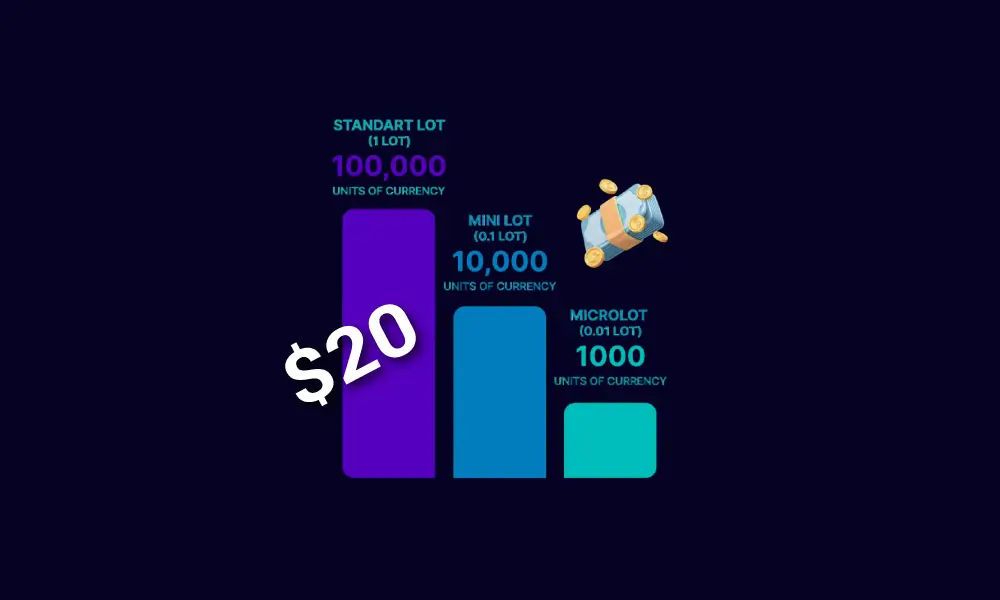
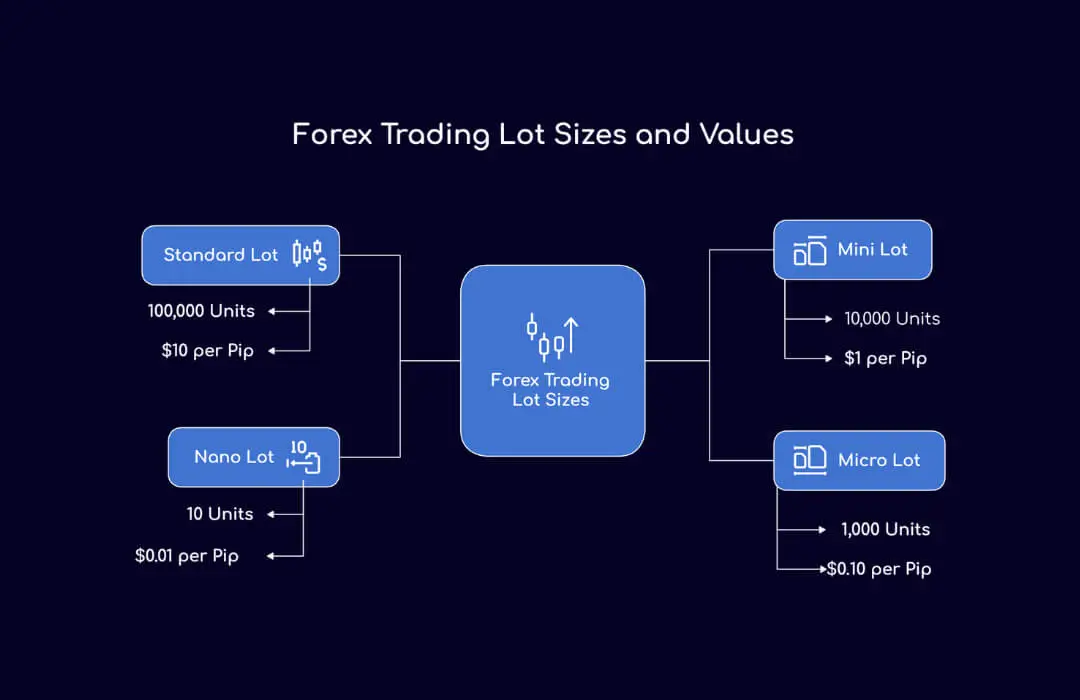
A lot refers to the number of currency units you buy or sell in a trade. Forex has four major lot sizes:
| Lot Size | Units | Value of 1 Pip (USD) |
|---|---|---|
| Standard lot | 100,000 | $10 |
| Mini lot | 10,000 | $1 |
| Micro lot | 1,000 | $0.10 |
| Nano lot | 10 | $0.01 |
So, if you're trading a micro lot, every pip the market moves earns or loses you 10 cents. That’s manageable for a small account, especially one with just $20.
Let’s Do the Math
What is the best lot size for $20?
Assume you want to risk 1% of your account per trade.
That’s 1% of $20 is $0.20 per trade.
Now, let’s say your stop-loss is 20 pips away.
You’d need a trade size where 20 pips is $0.20. That’s $0.01 per pip, which is only possible with a nano lot (0.001 lot).
If your broker doesn’t allow nano lots, then 0.01 lot (micro) is the absolute maximum you should use, but only if your stop-loss is tight, like 10 pips or less.
Avoid mini (0.1) or standard (1.0) lots on a $20 account. One wrong move could wipe out your entire balance.
Can You Trade Forex With $20?
Technically, yes. But it comes with serious risks.
$20 is a very small trading balance, so your margin for error is tiny. Every trade must be carefully calculated using solid risk management principles.
That’s why picking the right lot size is crucial.
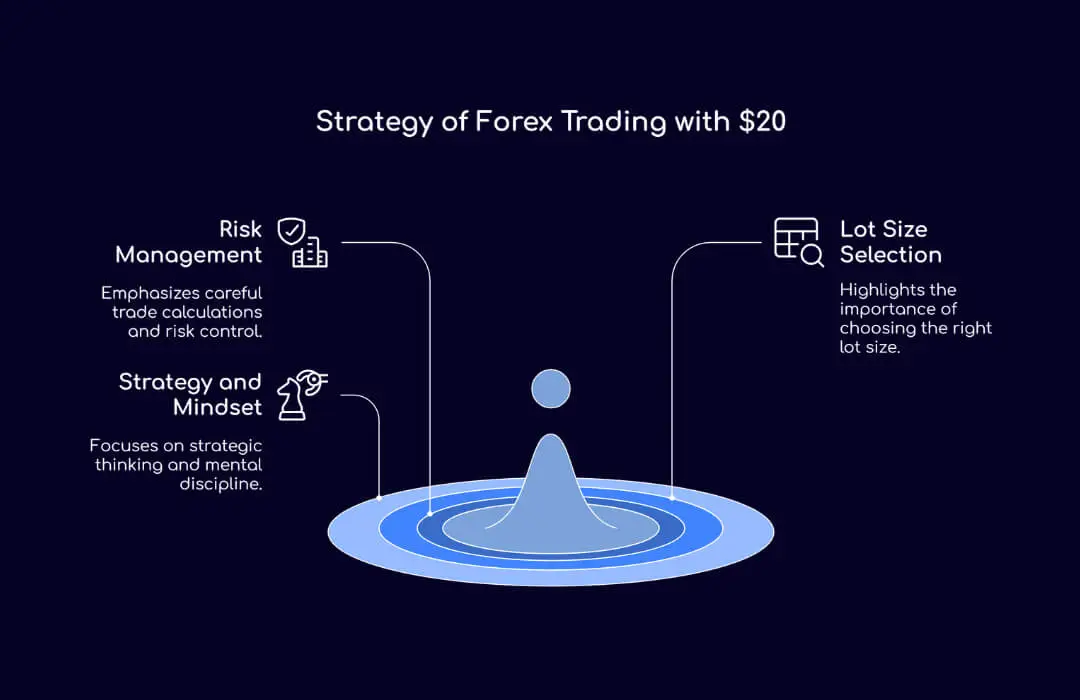
Here’s what you should keep in mind:
- Don’t risk more than 1–2% per trade ($0.20–$0.40).
- Use a position size calculator to get your exact lot size.
- Focus on strategy and mindset, especially with price action trading.
Learn to Calculate Your Ideal Lot Size
Here’s a simple formula for position sizing:
Lot Size = (Account balance × Risk %) / (Stop-loss × Pip Value)
For example:
Account balance = $20
Risk = 1% → $0.20
Stop-loss = 20 pips
Pip value = $0.10 (for micro lot)
(20 x 0.20) / (20 x 0.10) = 0.01
You’d need to trade 0.01 lot or less.
Let’s Be Honest. $20 Won’t Make You a Millionaire Overnight
But that doesn’t mean it’s useless. In fact, a small account can be one of your greatest teachers… if you approach it the right way.
Here’s how to make that $20 count:
Keep Stop-Losses Tight (But Strategic)
With limited capital, you can’t afford to give the market too much room to move against you.
That’s where tight, well-placed stop-losses come in. But don’t just slap them on randomly; your stops should be based on structure, such as recent highs/lows, support and resistance, or key price action levels.
Consider low-timeframe scalping strategies where the price doesn’t need to move much to hit your profit target. A 10–15 pip move could mean a lot when you’re risking just cents per trade.
Trade Micro or Nano Lots, Not Full Positions
This is where most beginners mess up. You see one good setup and think, “Let me go full lot size just this once.” That “once” can wipe your account clean.
Use micro or even nano lots (0.01 or smaller) so that your risk per trade stays tiny. This gives you more room to test setups and build experience, without blowing your capital.
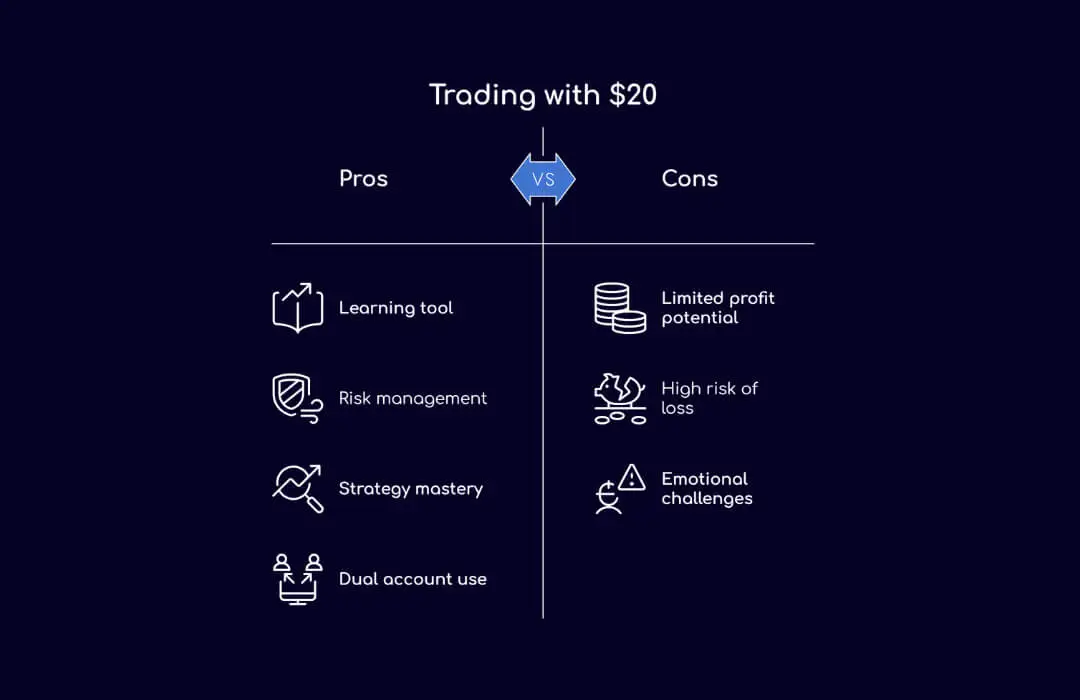
A $20 Account is Not a Cash Cow, It Is a Learning Tool
Focus more on learning than earning. Trading with your $20 will teach you discipline, emotional control, and how to follow your trading plan under pressure.
Use this time to refine your entries and exits, track setups that work for your style (scalping, day trading, swing), understand how different forex pairs behave, practice spotting chart patterns and candlestick formations in real time, and build habits like journaling, risk management, and patience.
Treat every trade like a study session. Whether you win or lose, you’re collecting data to improve your trading skills.
When Your Account is Small, You Don’t Need Multiple Strategies
You need one setup you understand inside and out. Master a simple, repeatable setup.
Maybe it’s a price action reversal at a key level, or a breakout from a tight consolidation zone. Whatever it is, master it. Study how it behaves in different market conditions and keep refining your execution.
Screenshot your trades. Label your entries, stop-loss, and take-profit. Review them weekly to spot patterns in your performance.
Why Limit Yourself to Just the $20 Live Account?
Use a demo account to experiment with new strategies or larger timeframes without pressure. Then apply what you’ve learned to your $20 account for real-world testing.
This dual approach gives you the best of both worlds: the freedom to experiment and the discipline of real risk.
It’s Not About the Money, Yet
Trading a $20 account isn't glamorous. It’s not about flashy profits. It is about becoming the kind of trader who can grow any account, whether $20 or $20,000.
Build the skills, respect the process, and treat every pip like it matters.
Because if you can manage $20 with discipline, you’re on the right path to managing much more.
F. Nathan
Felix Nathan is a professional trader, market analyst, and business development executive with over a decade of experience in the forex and financial markets. Felix specializes in providing actionable market insights, trading strategies, and risk man...