 IUX
IUX
 Exness
 Vantage
 XM
XM
 ICMarkets
 LiteFinance
 Moneta
 Tickmill
 South Africa (9)
 India (9)
 Bangladesh (12)
 Germany (9)
 Thailand (10)
 Philippines (9)
 Nigeria (10)
 Vietnam (10)
 Malaysia (9)





What is Swing Trading and How Does It Work in Forex?



Share:
Share:
Strategy
11 min read

You know those traders who remain glued to their screens all day? Yeah, those are not swing traders.
If you're wondering what swing trading is and how it works in forex, here's the truth: Swing trading is mostly about finding what is right and catching the wave, not riding on every high.
Unlike day trading, swing trading is a slower, more calculated approach. You enter trades, hold them for a few days, or even a couple of weeks, and exit when the market swings in your favor. Swing trading is strategic, it is smooth, and it might be exactly your vibe.
Here is Your First Lesson to Get You Started: Swing Trading 101
Swing trading is a forex strategy that captures short- to medium-term price movements over several days or weeks. Traders use technical and fundamental analysis to identify potential "swings" in currency pairs, afterwhich they buy low and sell high (or vice versa).
Unlike scalping or day trading, swing trading doesn't require you to stare at charts all day. You’re not looking to catch every tiny move, you’ll only be more interested in the bigger, more meaningful ones. This makes it ideal if you have a busy schedule but still want to be active in the market.
Swing traders often hold positions overnight or even over the weekend, so patience and planning are very important. You’ll rely on tools like trend lines, support/resistance zones, chart patterns, and economic news to time your entries and exits.
I like to think of it as a balanced style. It is not too fast nor too slow. It is just right for traders who want the action of trading without the chaos of making minute-by-minute decisions.
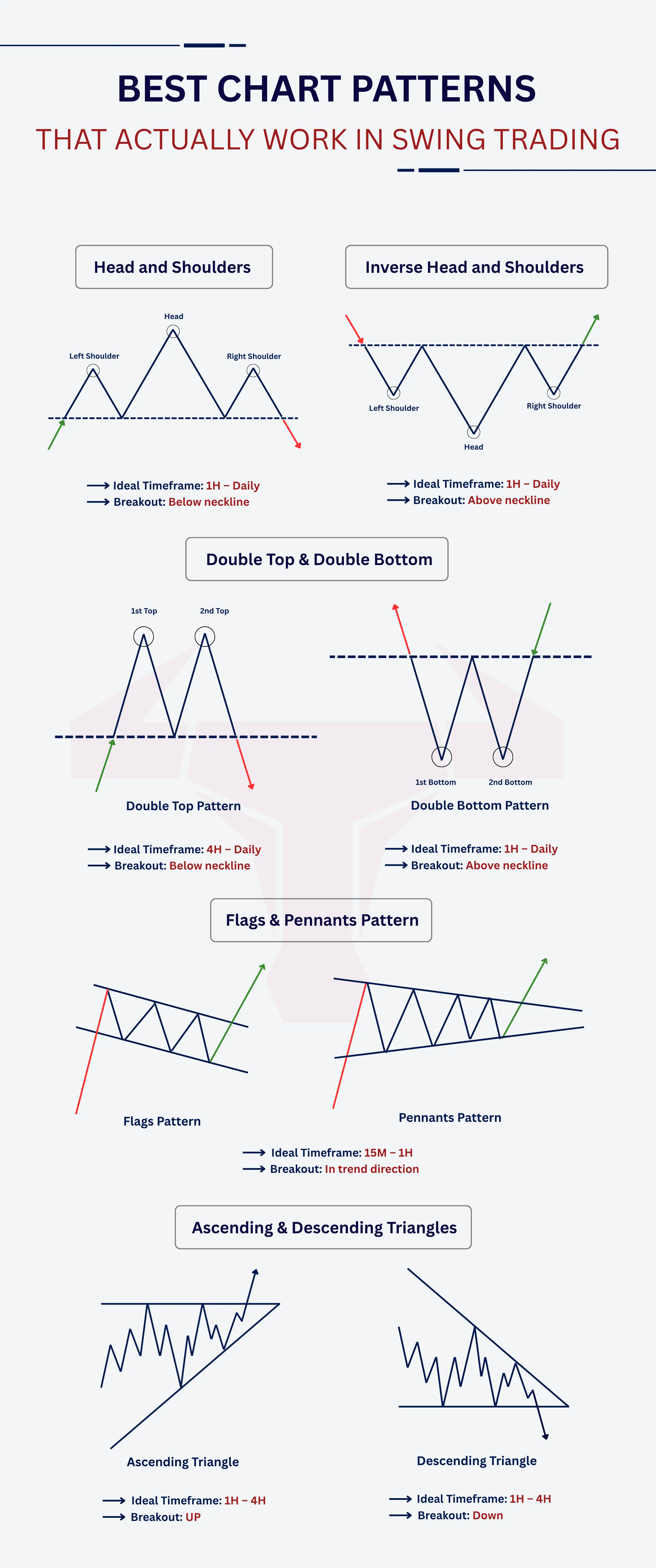
Before we go further, it’s important to get familiar with these key chart patterns. They will help you spot clear entry and exit points in swing trades, especially when you’re just starting out.
Now, to your second lesson: Blink and you’ll miss it…
This is How Swing Trading Works in Forex
Swing trading is more about precision than action, and here’s how you can be one step ahead (all the time):
Spot the Swing Before It Strikes
Ideally, it is at this stage the magic begins. Swing traders aren’t just clicking buttons, incase that is what you are thinking. They spotting the rhythm of the market, and their ultimate goal is to get a hold of the swing just as it’s turning.
Here’s how they do it:
- Trendlines and Channels:These help you see where price is headed and how strong the move is. If the price keeps bouncing off a trendline, that is a clue it may keep doing so, until it doesn’t.
- Support and Resistance Zones:Think of these as the market’s “speed bumps.” Support is where prices often bounce back up, and resistance is where they tend to stall or reverse. Swing traders watch these levels like hawks.
- Swing Highs and Lows: I call these guys the turning points. They are the little peaks and valleys on the chart. They help traders map out where price has been and where it might be going next.
- Momentum Shifts: Maybe the trend is slowing down… maybe buyers are getting tired… or just maybe a big reversal is brewing. Swing traders look for momentum shifts; thes signs, like weakening candles, divergence on indicators, or sudden spikes in volume show that a pivot could be near.
My rule of thumb for wing trading is to anticipate the swing, and not chase it. You're trying to catch the turn before the crowd, not after it's already happened.
Recognize These Entry Signals
Once a setup is confirmed, maybe a bullish engulfing candle, a breakout, or a bounce off a key level, you should enter the trade.
Swing trading indicators like RSI, MACD, or moving averages often guide these decisions. But let’s break that down a bit.
You’re not entering trades just because “the vibe feels right.” You’re waiting for confirmation, that is something concrete that tells you, “Okay, now’s the time”.
Here are a few common entry clues swing traders love to use:
- Bullish/Bearish Engulfing Candles: These candlestick patterns can signal a strong shift in momentum. A bullish engulfing candle at support? That’s a green light for many traders.
- Breakouts: When price breaks through a resistance level or a trendline with strong volume, it is often the start of a new move. But watch out for fakeouts, always confirm with indicators.
- Bounces: If price bounces cleanly off a support zone or moving average, that is another potential entry point, especially if momentum indicators like RSI or MACD back it up.
- Indicator Support:
- RSI (Relative Strength Index), which tells you if a pair is overbought or oversol. It is great for timing reversals.
- MACD is another great indicator. It helps spot changes in momentum and trend direction.
- Moving averages is also useful for identifying trend direction and dynamic support/resistance levels.
Know When to Exit a Trade
If you hit your target or the trend is weakening, it is time to cash in.
Swing traders set profit targets and stop-losses ahead of time to lock in gains and manage risk.
But here's the real deal is knowing when to leave the party. You don’t want to hang around too long and lose your edge, or your profits.
Here’s how seasoned swing traders make smart exits:
They Have Pre-Set Profit Targets
Before entering the trade, you should decide, “If price hits X, I’m out.” This could be based on previous highs/lows, Fibonacci levels, or risk-reward ratios (aim for 2x what you’re risking). When price hits that level, close the trade immediately.
They Use Stop-Loss Orders
You heard it here first, stop loss orders are your safety net. If the trade goes against you, the stop-loss limits your loss. Set it based on market structure, not just “how much you feel like losing.” For instance, you can set it below support for a buy trade, or above resistance for a sell.
Trailing Stops
This one is great if the trade is running in your favor. A trailing stop moves with price, locking in profits while giving the trade room to breathe. If the market reverses, you’re out with gains still in the bag.
Trend Weakness Clues
Maybe your indicators are flashing warning signs, RSI is overbought, MACD is crossing down, and the candles are losing strength.
Even if your target hasn’t been hit, those are hints that momentum might be fading. Better to take a decent profit than wait for a perfect one and get nothing.
A Huge Part of Swing Trading Success Lies in Tight Risk Control
This means 2:1 reward-to-risk ratio, position sizing, and never risking more than you can afford to lose.
Seriously, this is what separates the confident traders from the panic-clickers.
Here’s how swing traders protect their capital while staying on track:
Reward-to-Risk Ratio (R:R)
The golden rule here is to aim to make at least twice what you’re risking. So, if your stop-loss is 50 pips, your take-profit should be 100 pips. Why? Because even if you're right only 50% of the time, you still come out ahead.
Position Sizing
Don’t randomly decide how much to trade. Use a calculator or a formula based on your account size and stop-loss distance. Most swing traders risk 1–2% of their capital per trade. It sounds conservative, but that’s the point, small losses keep you sane.
Never Risk What You Can’t Afford to Lose
Even though this sounds obvious, but it’s where many beginners mess up. If you can’t sleep at night because of one trade, you’ve risked too much. Protect your peace, and your money.
Stay Disciplined
A solid risk management plan isn’t just for when things go well, it is also for when they don’t. Stick to your plan even when it’s tempting to “just give it a little more room” or “double down and hope for the best”.
These Timeframes are Best for Forex Swing Trading (Try Them and See)
Swing traders typically use the 4-hour, daily, or weekly charts for setups and the 1-hour or 4-hour charts for fine-tuning entries.
This lets them catch meaningful moves without obsessing over every tick.
Swing Strategies That Actually Work, and You Should Try
Breakout Trading
This is jumping in as price breaks a key level.
Imagine that price has been stuck under a resistance level for days. Then it smashes through with strong volume. That’s your cue.
Breakouts can signal the start of a new move, and swing traders love catching that early momentum. Just watch out for fakeouts, and always confirm with a retest or supporting indicator.
Trend Following (Basically Riding the Wave Until It Fades)
This one’s all about going with the flow. If price is clearly moving in one direction, why fight it? Swing traders jump in on pullbacks or minor consolidations and ride the trend until signs of exhaustion pop up. These are “buy the dips” in an uptrend or “sell the rallies” in a downtrend.
Pullback Entries
Here, you’ll enter when the price retraces during a trend.
Trends don’t move in straight lines; they breathe up and down. Prices pull back before continuing in the same direction.
Smart swing traders wait for these retracements, then enter when the trend resumes. It’s a safer entry than chasing the move, and your stop-loss can be tighter.
Reversal Plays
Catch market tops or bottoms, high risk, high reward.
This is for the brave. You're betting that a trend is about to end and reverse. It could be after a strong move up that starts to slow down, or when price forms a double top/bottom or divergence on indicators like RSI. This setup demands solid confirmation and a tight risk plan.
Of Course, There are Advantages and Disadvantages
The Upsides
You Don’t Have to Stare at Charts All Day
One of the best things about swing trading is that you’re not chained to your screen. You can set up your trades, check in once or twice a day, and go live your life. It is super perfect if you’ve got a 9–5 or just don’t want to become a chart zombie.
There’s Potential for Bigger Wins
Since you’re holding trades for days (sometimes weeks), you’re aiming to catch the big moves, not just tiny price fluctuations. That means more pips and, if done right, bigger profits per trade.
You Can Use Both Tech and News
Swing trading gives you room to mix technical analysis (like support/resistance, indicators, etc.) with news and economic data. So if you like watching both the charts and the headlines, this style works beautifully.
It’s Great for Beginners or Part-Time Traders
You don’t need lightning-fast reflexes or constant focus. With a solid plan and patience, swing trading can be a beginner-friendly way to build experience without burning out.
The Downside
You’re Exposed to Overnight Surprises
Because trades stay open for longer, you’re at the mercy of overnight news, price gaps, or surprise events that can shake up the market while you sleep. A well-placed stop-loss helps, but it’s still a risk.
Patience isn’t Optional
Some trades take days just to reach your entry point, and once you're in, it might be another few days (or more) before anything exciting happens. If you’re the impatient type, swing trading will test your nerves.
Stop-Losses Might be Wider Than You’d Like
Since you’re aiming for bigger moves, your stop-losses need to be roomy enough to avoid normal market noise. That can make trades feel riskier unless you manage your position size carefully.
Timing Matters a Lot
Getting in too early or exiting too late can make or break your trade. You’ve got to be comfortable analyzing the market and waiting for the right moment.
F. Nathan
Felix Nathan is a professional trader, market analyst, and business development executive with over a decade of experience in the forex and financial markets. Felix specializes in providing actionable market insights, trading strategies, and risk man...