 IUX
IUX
 Exness
 Vantage
 XM
XM
 ICMarkets
 LiteFinance
 Moneta
 Tickmill
 South Africa (9)
 India (9)
 Bangladesh (12)
 Germany (9)
 Thailand (10)
 Philippines (9)
 Nigeria (10)
 Vietnam (10)
 Malaysia (9)





Is Forex Trading Profitable For Beginners? Strategy To Be Rich



Share:
Share:
Strategy
8 min read

Yes, forex trading can be profitable, but it’s not a shortcut to easy money. Many people are drawn to forex because the market runs 24 hours a day, you can start with a small amount, and there’s real potential to grow your capital over time.
But the forex world isn’t easy like that.
Profitability depends less on luck and more on how well you understand the market, manage risk, and control your emotions. Some traders make consistent profits by following a clear strategy and staying disciplined.
But at the same time, there is 50% - 70% chance you might lose. Ok, then how can you have a 40% trading win rate? Let’s talk about that.
Is Forex Trading Profitable?
Yes, forex trading can be profitable. But only for traders who approach it with the right mindset, skills, and discipline.
It’s one of the largest financial markets in the world, with trillions of dollars traded daily, which creates plenty of opportunities. However, profitability in forex is not automatic, and it’s definitely not guaranteed.
That’s why how you trade matters more than where you trade.
Many beginners lose money because they jump in expecting fast profits. They overtrade, use high leverage, and ignore risk management. The secret rule is to understand/make the right strategy to make a profit.
Strategy is the king here. The wrong strategy can make you bankrupt in the blink of an eye.
Forex Trading Profitable Strategy
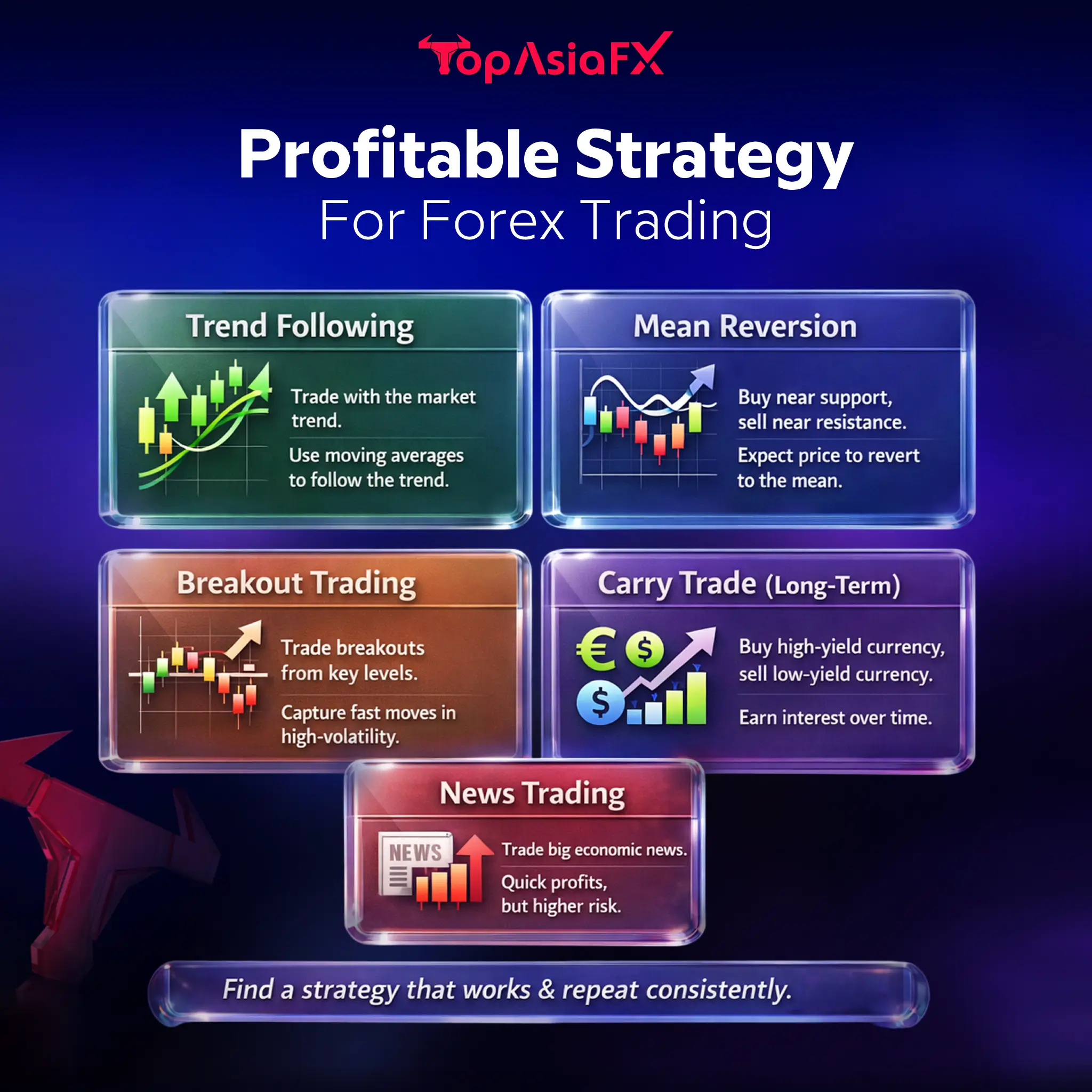
A profitable forex trading strategy combines one main trading style, clear entry and exit rules, and strict risk management. You don’t need to trade everything or trade all the time. You just need a setup that makes sense and repeat it consistently.
Trend Following
This is one of the most popular and beginner-friendly strategies. The idea is simple: trade in the direction the market is already moving. If the price is clearly rising, you look for buying opportunities.
If it’s going down, you look for sell setups. Traders often use tools like moving averages or EMAs to confirm the trend and stay in the trade while it’s working.
Mean Reversion
This strategy works on the belief that price doesn’t move in one direction forever. When the price moves too far away from its average, it often pulls back. Traders using this method buy near support and sell near resistance, expecting the price to return to a “normal” level. It works best in calm, range-bound markets.
Breakout Trading
Here, traders wait for the price to break above resistance or below support. The idea is that once the price breaks an important level, it can move fast in that direction. This strategy is common during high-volatility periods, such as market openings or major news events.
Carry Trade (Long-Term)
This is more of a long-term approach. Traders buy a currency with a high interest rate and sell one with a low interest rate. Over time, they earn interest on the difference while holding the trade. This strategy relies more on fundamental analysis than short-term charts.
News Trading
Some traders focus on major economic news like interest rate decisions, inflation reports, or employment data. These events can cause sharp market moves. While profits can be fast, risk is also higher, so strong risk control is essential.
Why Those Strategies Are Profitable?
No matter which strategy you choose, these parts matter more than the strategy itself:
- Risk Management Comes First: Most successful traders risk only 1–2% of their account on a single trade. This keeps losses small and emotions under control.
- Clear Rules: You should know exactly when to enter, when to exit, and when not to trade.
- Stop-Loss and Take-Profit Levels: These protect you from big losses and stop emotional decisions.
- Technical Tools for Timing: Indicators such as EMAs, RSI, Fibonacci, and simple support and resistance help with entries and exits.
- Fundamental Awareness: Knowing what’s happening in the economy helps you understand why the market is moving.
But basically, Many profitable traders don’t rely on just one method. They might use fundamentals to understand market direction and technical analysis to time entries. They also stay patient, wait for good setups, and avoid over-trading.
Most importantly, they practice on demo accounts first, accept losses as part of the game, and adjust their strategy as market conditions change.
In short, forex trading becomes profitable not because of a single perfect strategy, but because of consistency, discipline, and smart risk management.
Which Currency is Most Profitable in Forex?
There’s no single “most profitable” currency in forex. Profit depends on how a currency moves and your trading style.

The US Dollar (USD) is the backbone of the market, involved in over 80% of all trades. Pairs like EUR/USD, GBP/USD, and USD/JPY are favorites because they move well during major sessions and react strongly to economic news.
Traders love USD pairs for tight spreads, predictable reactions to announcements, and strong trends during rate changes.
In short, the most profitable currency is the one that matches your style:
- Scalpers → USD pairs with tight spreads.
- Swing Traders → EUR & JPY pairs for steady trends.
- Volatility Traders → GBP pairs for fast moves.
- Fundamental Traders → USD, CAD, AUD following news and commodities.
At the end of the day, forex profits come not from a magic currency but from liquidity, timing, discipline, and risk management. Focus on 1–2 pairs you understand well, and you’ll be far more consistent than chasing the “perfect” currency.
How Much Do Forex Traders Make a Month?
Most beginners don’t make money right away. In fact, around 90% of new traders lose money at the start. During this phase, earnings are often zero or very small because the focus is still on learning.
With a small account, profits are naturally limited. For example, if someone trades with $1,000 and makes a realistic 3% return, that’s only about $30 a month. Trying to make more often means taking too much risk, which often leads to losses rather than growth.
Once traders gain experience and become more disciplined, income becomes more stable. Many aim for 2–5% per month. It is considered realistic and sustainable.
At this level:
- A $10,000 account can generate around $200–$500 per month.
- As capital and confidence grow, monthly income can reach $500 to $2,000 or more.
The key here is consistency, not chasing huge wins.
Professional traders, including institutional and full-time retail traders, can earn $5,000 to $10,000+ per month, and sometimes much more. This level of income usually comes from:
- Managing large amounts of capital.
- Years of experience.
- Strong risk management and proven strategies.
Some institutional traders also earn bonuses on top of their trading income.
The moral of the story is that forex trading isn’t a get-rich-quick path. Most successful traders focus on small, consistent gains of 2–5% per month.
It will slowly grow their accounts over time. High monthly incomes are possible, but they usually come after years of experience and disciplined trading, not overnight.
Can I Become Rich By Trading Forex?
Yes, it’s possible to become rich through forex trading. But it can take years of experience, solid trading skills, strict risk management, and enough capital to survive losses. Successful traders approach it like a real business, with clear rules, patience, and emotional control, not like gambling.
While famous success stories exist, such as George Soros or a few highly skilled retail traders, they are rare exceptions.
In practice, around 70–90% of traders fail due to poor planning, lack of discipline, and overusing leverage. Forex can be profitable, but getting rich from it is a long, difficult road. Not the norm.
Successful Forex Traders in The World
I know it feel overwhelming and scary to start trading. But without taking risk you can’t gain anything. There are many people like that who took risks in forex & become successful for intense-
- George Soros.
- Stanley Druckenmiller.
- Paul Tudor Jones.
- Bill Lipschutz.
- Bruce Kovner.
- Andrew Kriege.
- HabbyFX.
If you are unsure, then read out their story a little bit. It will surely give you a boost.
Final Thoughts
Forex isn’t about shortcuts or “guaranteed profits.” It’s about learning, practicing, and managing risk. You don’t need huge amounts to start, but you do need patience, discipline, and smart strategies.
Start small, focus on a few currency pairs, and remember. The goal is consistent growth, not instant profits.
FAQs
Can You Win 100% in Forex?
No. Forex is risky, and no trader can win all the time. Profits come from good strategy, discipline, and risk management, not luck.
Do I Need $25k to Trade Forex?
Not necessarily. $25k is often mentioned for certain professional accounts, but you can start with much less using standard or mini accounts.
Can I Start Forex with $500?
Yes. Many brokers allow small accounts, and $500 is enough to start trading carefully with proper risk management.
What is 5 3 1 in Forex?
5-3-1 usually refers to a trading pattern or strategy, often connected to Elliott Wave or pivot points. It’s about spotting trends and pullbacks.
What is the Golden Rule of Forex?
The golden rule: “Don’t risk more than you can afford to lose.” Protect your capital, manage risk, and trade with discipline.
Can I Trade Forex with $20?
Yes, some brokers allow micro accounts, but $20 limits your flexibility. It’s mainly for practice or testing strategies, not serious profits.
F. Nathan
Felix Nathan is a professional trader, market analyst, and business development executive with over a decade of experience in the forex and financial markets. Felix specializes in providing actionable market insights, trading strategies, and risk man...