 IUX
IUX
 Exness
 Vantage
 XM
XM
 ICMarkets
 LiteFinance
 Moneta
 Tickmill
 South Africa (9)
 India (9)
 Bangladesh (12)
 Germany (9)
 Thailand (10)
 Philippines (9)
 Nigeria (10)
 Vietnam (10)
 Malaysia (9)





Risk Management Steps in Forex



Share:
Share:
Education
11 min read
Most traders think that only their strategy makes or breaks them. Well, here’s a little spoiler: it is not. Even the best setup means nothing without proper risk management.
Forex trading is fast, thrilling, and full of potential, but it’s also loaded with landmines. So, if you’re not managing your risk, you're not trading… you’re gambling.
Risk management only works when you apply it correctly. Many traders overlook how much to risk and how to size their trades. The following formula takes out the guesswork and helps you stay disciplined.
So let’s break down the Top 8 steps for solid risk management in forex, how to calculate risk, and what to avoid like the plague.
Top 8 Risk Management Steps to Take in Forex
Identify How Much You’re Willing to Risk Per Trade?
This is the number one rule of survival in forex, which too many beginners tend to ignore.
My golden rule is to never risk more than 1–2% of your total account on a single trade.
Imagine your trading account has $1,000. Your maximum risk per trade should be $10 to $20. That means if the trade goes against you, the most you lose is a small, manageable piece of your capital, not half your account or your sanity.
This is so important because losing streaks happen, even to the best traders. If you're risking 10% per trade, just a few losses in a row can wipe you out. But at 1–2%, you are giving yourself the breathing room to survive, learn, and bounce back.
This kind of risk discipline also helps you think clearly and detach emotionally from the outcome of any one trade. You're no longer obsessing over every pip. You’ve already done your math, placed your stop-loss, and managed your trades, the way you are supposed to.
Learn to Calculate Position Size
This step is sneakier than you’d think.
You can have the perfect strategy, a solid stop-loss, and still blow your account if your position size is too big. Especially when you’re trading with high leverage, it is way too easy to risk more than you meant to.
Let’s say your stop-loss is only 20 pips, but when you open a huge trade size? Suddenly, you're risking 10% of your account without even realizing it.
Here’s how to calculate position size in forex:
Position Size = (Account Balance × Risk %) / (Stop Loss in Pips × Pip Value)
It is okay if you are not a math fan. You can use a free tool
Just head over to free position size calculators like BabyPips Position Size Calculator or MyFXBook Calculator.
Always Use Stop-Losses (Never Forget)
I like to think of a stop-loss like a seatbelt. You may not notice it when things are going well, but the moment something goes wrong, you'll be so glad it’s there.
A stop-loss protects you from turning a small mistake into a major disaster. It’s your backup plan. It basically helps you to move on from losing trades, without you having to interfere at the moment of a price drop.
And no, it is not optional.
Some beginners think, “I’ll just watch the trade closely and close it manually if it goes bad.”
But that rarely ends well.
Without a stop-loss, emotions like hope, fear, and denial tend to take over, and before you know it, you’re holding onto a losing trade, praying it comes back... while your account bleeds.
Also, don’t just slap your stop-loss 20 pips away and call it a day. Make it make sense. Set it strategically:
- Use Support/Resistance Zones. Place stops just beyond key levels; if the price breaks through, your setup is likely invalid.
- Consider an ATR (Average True Range). Use this to measure recent volatility and give your trade enough breathing room.
- Try Swing Highs/Lows. Stops near recent extremes (where price has reversed before) often make the most technical sense.
Stick to a Solid Risk-Reward Ratio
This is one of the simplest rules in the book: always aim for at least a 1:2 risk-to-reward ratio.
That means for every dollar you risk, you’re aiming to make two more. If you’re risking $50, your potential reward should be $100. If you think about it, this type of ratio can totally shift the math in your favor.
Let’s say you take 10 trades and win just 5 of them, this means you lose 5 trades, so -5 × $50 = –$250. But if you win 5 trades, 5 × $100 = +$500
You’re up $250 even with a 50% win rate. That’s the power of a good risk-reward ratio; it gives you a cushion, even when you’re not right all the time (because let’s face it, no one is).
Use Leverage Carefully
Ah, leverage, the double-edged sword of forex trading. It can make you feel like a genius when things go right… and completely wreck your account when they don’t.
A lot of new traders see 1:500 leverage and think they’ve hit a. But the truth is that leverage isn’t free money; it is borrowed money. And borrowing that big with no plan is a fast way to get burned.
Yes, high leverage means small price moves can turn into big profits. But it also means those same moves can wipe you out just as fast. A tiny 10-pip loss with high leverage could be a major hit to your account.
But if you are overleveraged on a losing trade, you’ll be saying goodbye to your capital quickly.
Avoid Overexposing Across Correlated Pairs
Let’s say you open trades on EUR/USD and GBP/USD at the same time because both setups look good. Sounds smart, right? Well… not always.
Those two pairs are highly correlated. Meaning, they often move in the same direction, at the same time, for the same reasons (usually tied to USD strength or weakness).
So, if the U.S. dollar suddenly strengthens and your analysis was off, you’re not just taking one loss, you’re taking two.
When you stack trades across correlated pairs, you’re increasing your risk without realizing it. It’s like doubling down on the same bet; it might pay off big, but it could also wipe out more of your account than expected.
This doesn't mean you can’t trade multiple pairs; just be aware of their relationships.
Check correlation tables (sites like MyFXBook offer them) to see how pairs move together. Try to avoid opening multiple positions on pairs with 80 %+ correlation, unless you reduce position sizes to spread out risk.
And think about total exposure, not just individual trades. If three of your trades all depend on the dollar weakening, you’re making one big bet.
Plan for Drawdowns
Drawdowns happen. Even the best traders go through rough patches where nothing seems to work. Losses pile up, confidence takes a hit, and the urge to revenge trade creeps in.
The key difference between a pro and a panicked newbie is planning for it in advance.
A drawdown is simply the decline from your account’s peak to its lowest point during a losing streak. It could be 5%, 10%, or more. The question is: Can your trading account and your mindset handle it?
A 10% drawdown may not seem huge until you're in it. A 30% drawdown requires a 43% gain just to break even. Ouch.
The bigger the drawdown, the more pressure you feel, and the more likely you are to make emotional, reckless decisions.
What Can You Do?
- Use a drawdown calculator to simulate worst-case scenarios based on your win rate and risk per trade.
- Backtest your strategy to see how it would have performed during different market conditions; this helps set realistic expectations.
- Set a personal threshold: Know how much drawdown you can mentally and financially handle before you pause or adjust.
Review and Adapt Your Risk Management Plan
Your risk management plan isn’t a one-time thing. It’s not “set it and forget it.”
Markets change. You change. And your plan should grow with you.
Maybe your strategy worked great last month, but now your stop-losses feel too tight. Or maybe volatility picked up, and you're risking more per trade than you realized. That’s your cue to review and adjust.
How to Calculate Risk in Forex (Without Getting a Headache)?
Risk management doesn’t have to be complicated. If math isn’t your thing, don’t worry, I’ll walk you through it in four simple steps.
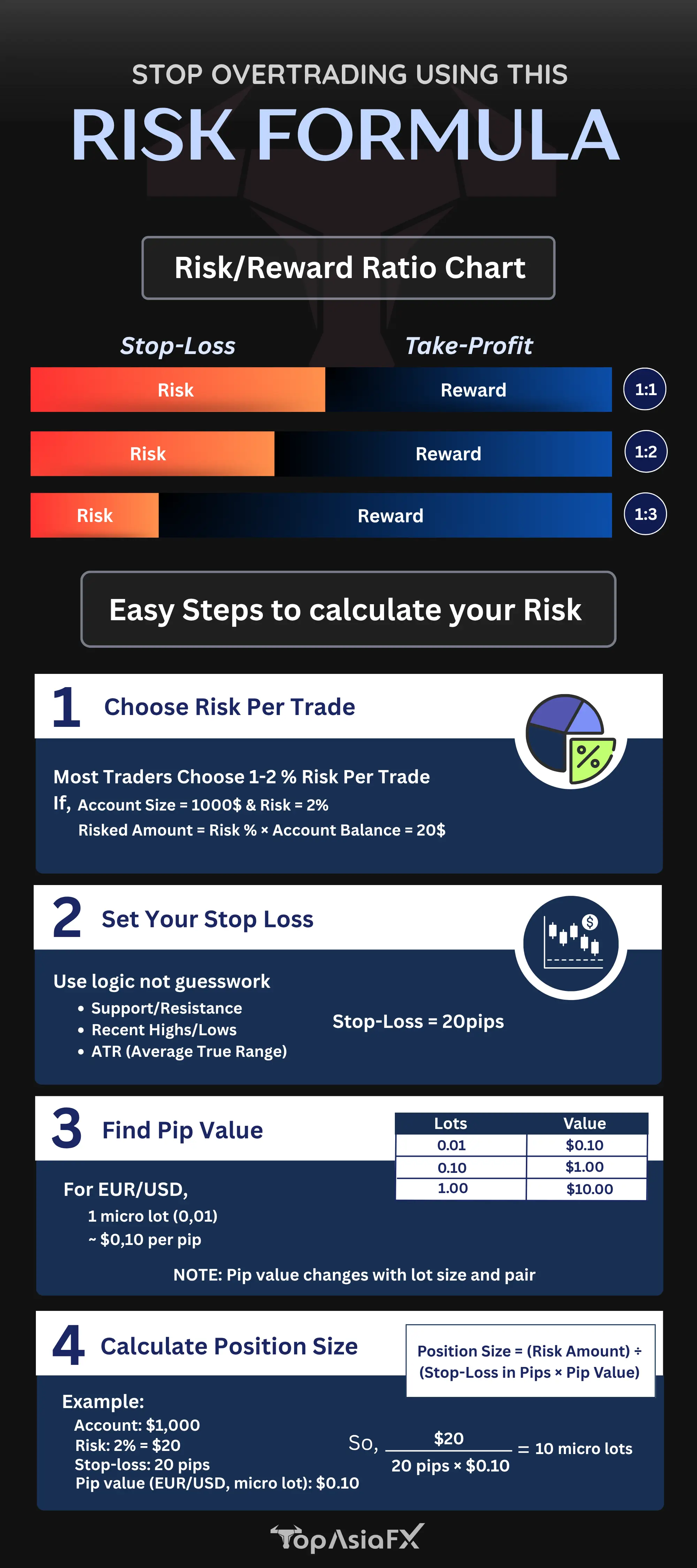
- Choose how much you’re willing to risk. Most traders go with 1–2% of their account per trade. So if you have $1,000 in your account and want to risk 2%, that’s $20 max for that trade.
- Set your stop-loss. Don’t guess, use logic. Check support/resistance zones, recent highs/lows, or ATR to decide how many pips your stop should be.
- Find the pip value for the currency pair you’re trading. For major pairs like EUR/USD, one micro lot (0.01) = roughly $0.10 per pip. This changes depending on the pair and lot size.
- Calculate your position size
Here’s the formula:
Position Size = (Risk Amount) ÷ (Stop-Loss in Pips × Pip Value)
Here’s a quick example:
Account: $1,000
Risk: 2% = $20
Stop-loss: 20 pips
Pip value (EUR/USD, micro lot): $0.10
So, $20 / (20 pips × $0.10) = 10 micro lots. That’s 0.10 position size.
If the result was 1, that would mean 1 micro lot (or 0.01).
What NOT to Do with Risk Management (Seriously, Don’t)?
Even if your strategy is rock solid, bad risk habits can blow up your account faster than a losing trade ever could.
So before you hit the “Buy” button, here’s a quick reality check on what not to do:
Don’t Move Your Stop-Loss Mid-Trade
You placed your stop-loss for a reason. Moving it just because you hope the trade will turn around is a trap.
Every time you shift your stop-loss further away, you’re increasing your risk and turning a small loss into a potential disaster. It’s like ignoring a fire alarm and hoping the smoke clears on its own.
The solution is to set your stop based on logic (market structure, ATR, support/resistance) and stick to it.
Don’t Risk More After a Loss Just to “Win it Back!”
This is called revenge trading, and it’s a fast track to blowing your account.
After a loss, your confidence takes a hit. So what do most beginners do? They double their position size on the next trade, thinking, “I just need one big win.” That big win rarely comes. And now you're deeper in the hole.
A solid way to step back. Breathe. Review what went wrong. Then return with your normal risk level, not emotional bets.
Don’t Ignore Correlated Trades
Trading EUR/USD and GBP/USD at the same time is basically one big trade against the dollar.
If USD moves unexpectedly, both trades could sink together. You just doubled your risk without realizing it.
In a situation like this, use a correlation matrix or simply ask yourself: “Do these pairs usually move the same way?” If yes, then try to cut back on size or choose just one.
Don’t Overleverage Just Because You Can
Yes, your broker might let you trade with 1:500 leverage, but that doesn’t mean you should engage in it. The issue is that leverage magnifies everything, your wins and your losses inclusive.
A high leverage with no real plan is like driving a Ferrari blindfolded. It looks really cool until you crash. Instead, keep leverage moderate (1:10 to 1:100 is plenty for most traders), and focus on proper position sizing.
Don’t Bet the Entire on One “Perfect” Setup
There’s no such thing as a guaranteed trade. Ever. Even if everything lines up, chart pattern, news, indicators, it can still go south.
That’s just how markets work. If you throw your whole account at one setup, hoping it’ll “change everything”.
Follow your risk-per-trade rule no matter how good the trade looks. There will always be another opportunity.
Every professional trader knows that risk management is not optional; it is absolutely essential. As a forex trader, you may not be able to control the market, but you can control your exposure to it.
F. Nathan
Felix Nathan is a professional trader, market analyst, and business development executive with over a decade of experience in the forex and financial markets. Felix specializes in providing actionable market insights, trading strategies, and risk man...