 IUX
IUX
 Exness
 Vantage
 XM
XM
 ICMarkets
 LiteFinance
 Moneta
 Tickmill
 South Africa (9)
 India (9)
 Bangladesh (12)
 Germany (9)
 Thailand (10)
 Philippines (9)
 Nigeria (10)
 Vietnam (10)
 Malaysia (9)





Complete Forex Trading VPS Guide for Faster and Safer Trading



Share:
Share:
Education
17 min read
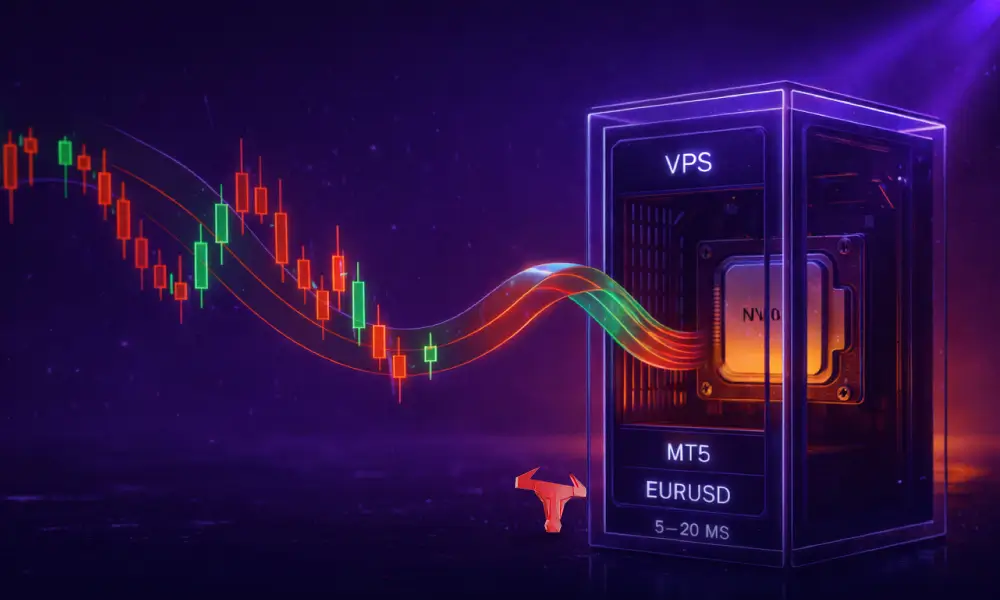
A Forex Trading VPS is a remote computer that runs your trading platform nonstop. Even if your laptop shuts down or your internet drops, your trades stay live. You connect to it online, but the system itself keeps working 24 hours a day.
Serious traders use a VPS for one reason: control. In real trading, minor technical issues lead to real losses. A short power cut can delay a stop loss. Slow internet can cause slippage during the news. These things happen more often than people admit.
A VPS removes those risks. Your platform stays online, latency drops because the server sits closer to the broker, and orders reach the market faster. Execution becomes more stable, especially during volatile sessions.
This does not fix a bad strategy. But it fixes technical problems you cannot afford to ignore. That is why many top brokers now offer free VPS access to active traders. Stability matters when money is on the line.
What is a Forex Trading VPS?
A Forex trading VPS is a remote server that runs your trading platform all the time. You log into it from your device, but the system itself stays online day and night. In simple terms, your trades do not depend on your home internet, electricity, or computer health.
The main difference between a VPS and a normal home PC is reliability. A home PC shuts down. Internet drops. Power cuts happen. A VPS does not face those problems. It runs in a professional data center with stable power and fast connections.
Because of that, your trading platform stays active 24 hours a day. Expert Advisors keep running. Pending orders stay live. Stops and limits remain protected.
If you are asking what Forex VPS is, this is the clear answer.
It is not about convenience. It is about keeping your trading connected when your own setup cannot.
How Does a Forex Trading VPS Work?
A Forex VPS is a virtual private server designed specifically for traders who run automated strategies or need constant market access. It keeps your trading platform online 24 hours a day, even when your home computer is off or your internet connection drops.
Speed matters in forex. A VPS located near your broker's servers can shave milliseconds off order execution. For traders using expert advisors or algorithmic systems, that difference adds up over hundreds of trades.
Why Forex Traders Use a VPS?
Forex traders use a VPS because trading does not forgive technical mistakes. Price moves do not wait for your internet to reconnect or your laptop to restart. A VPS removes those weak points and keeps your trading running under all conditions. Below are the real reasons traders rely on it, not theory.
24/7 Trading Without Interruptions
The biggest reason traders use a Forex VPS is uninterrupted trading. Power cuts are common in many regions. Even in developed areas, routers fail, networks drop, and devices freeze. When that happens on a home PC, your platform goes offline instantly.
A VPS does not face these problems. It runs inside a data center with backup power, redundant internet lines, and constant monitoring. Your MT4 or MT5 stays online all day and night.
This matters most when trades are open. A stop loss delayed by even a few seconds can change the result of a trade. With a VPS, your orders remain active whether you are asleep, traveling, or offline. This alone explains why I use Forex VPS for serious trading.
Faster Trade Execution (Low Latency)
Execution speed affects results more than many traders admit. When your platform is far from the broker’s server, orders take longer to reach the market. During fast moves, that delay can cause slippage.
A Forex VPS is usually located close to broker servers, often in the same data center or region. This short distance reduces latency. Orders travel faster, so entries and exits happen closer to the intended price.
For example, during a news release, the price can move several pips in a second.
A slow connection may cause your order to be filled. A VPS reduces that risk. This is one of the most practical benefits of a Forex VPS, especially for short-term strategies.
Ideal for Expert Advisors (EAs)
Expert Advisors need constant uptime. They scan the market, calculate conditions, and place trades automatically. If your platform shuts down, the EA stops working. That can mean missed trades or unmanaged positions.
A VPS solves this by keeping the platform running nonstop. Your EA continues to operate without interruption. It opens trades, closes them, and manages risk precisely as programmed.
Many traders learn this the hard way.
One internet outage during a strong setup can cancel weeks of planning.
A VPS removes that dependency on personal hardware.
Stability During High-Volatility Events
High-impact news exposes weak setups. Spreads widen, prices jump, and execution becomes unstable. Home internet connections often struggle at these moments.
A VPS provides more stable performance during volatility. Since it connects directly to professional networks, it handles sudden activity better than home systems. News traders benefit the most here.
Who Really Needs a Forex Trading VPS?
Not every trader needs a VPS. But for some, trading without one is a clear disadvantage. If execution speed, uptime, or automation matters in your strategy, a VPS is not optional.
EA and bot traders rely on nonstop operation. Expert Advisors monitor price conditions every second. If your platform goes offline, the system stops working. Trades do not open. Risk rules do not apply. A VPS keeps the platform running 24/7, so automation stays consistent.
Scalpers need fast and stable execution. They enter and exit trades within seconds. Even small delays can turn a profitable trade into a loss. A VPS located near broker servers reduces latency and improves order timing. That difference adds up over many trades.
News traders face extreme volatility. Prices jump, spreads widen, and execution pressure increases. Home internet connections often fail at the worst moment. A VPS provides more stability during high-impact releases, so orders reach the market when timing matters most.
High-frequency traders place many trades in short periods. Speed and consistency are critical. Any interruption breaks the strategy flow. A VPS supports continuous execution without relying on personal devices.
Traders in areas with unstable internet need a VPS more than anyone else. Power cuts, slow networks, and random disconnections create constant risk. A VPS removes local infrastructure from the equation and keeps trading active even when your connection fails.
If your strategy depends on precision, uptime, or automation, the question is not whether a Forex trading VPS helps. The question is how long you can trade without one.
Forex VPS vs Trading on Your Home Computer
The difference between a Forex VPS and a home computer comes down to reliability and execution. Both can place trades, but how they perform under pressure is very different. Below is a clear breakdown so you can judge what actually fits your trading.
| Factor | Forex Trading VPS | Home Computer |
|---|---|---|
| Uptime | Runs 24/7 in a data center with backup power and internet | Depends on local power, internet, and device stability |
| Internet reliability | Enterprise-grade, stable connection | Prone to disconnections and slowdowns |
| Speed and latency | Low latency due to proximity to broker servers | Higher latency due to distance and public networks |
| Trade execution | Faster and more consistent | Slower and inconsistent during volatility |
| Expert Advisors (EAs) | Run continuously without interruption | Stop working if device shuts down |
| News trading | More stable during high-impact events | Higher risk of freezes and delays |
Note: If you trade casually, a home computer may be enough. If execution matters, the Forex VPS vs home computer debate is simple. One is convenient. The other is built for trading.
Key Features to Look for in a Forex Trading VPS
Not all VPS services are built for trading. Some look good on paper but fail when markets move fast. If you want consistent execution, these are the Forex VPS features that actually matter.
Low Latency
Latency decides how fast your orders reach the broker. The shorter the distance between the VPS and the broker’s server, the lower the delay. A VPS hosted in the same region or data center performs better than one on another continent.
For example, a VPS in London works well with brokers using London servers. A VPS in New York suits US-based brokers. This is one of the most important features of a Forex VPS, especially for scalpers and EA users.
Uptime Guarantee
A trading VPS must stay online. Look for a minimum uptime guarantee of 99.9%. That level means only a few minutes of downtime per month. Anything lower increases the risk of disconnected trades.
An uptime promise only matters if the provider backs it with real infrastructure. Data centers with backup power and multiple network routes offer better reliability than cheap shared systems.
RAM and CPU Requirements
System resources affect how smoothly your platform runs. Beginners using one MT4 or MT5 terminal usually need at least 2GB of RAM. This handles basic trading and light indicators without freezing.
EA traders need more. Automated strategies process data constantly. For stable performance, 4 to 8GB of RAM is safer, especially if you run multiple charts or platforms. Weak hardware leads to slow execution and missed signals.
Operating System
Most trading platforms require Windows. A Forex VPS should support Windows Server and work smoothly with MT4 and MT5. This avoids compatibility issues and setup problems.
Security and Backup
Trading servers attract attention during volatile periods. DDoS protection helps keep the VPS online when traffic spikes. Automatic backups protect your setup if something fails.
These features do not guarantee profits. But without them, even a good strategy struggles to execute correctly.
Best VPS Location for Forex Trading
VPS location matters because it affects how fast your trades reach the broker. The shorter the distance between your VPS and the broker’s server, the lower the latency. Lower latency means faster execution and fewer price differences during entry and exit.
Forex brokers host their servers in specific financial hubs. If your VPS is far from those hubs, orders will take longer to reach it. That delay may look small on paper, but during fast markets, it causes slippage and missed fills.
London is one of the most popular locations for VPS hosting for Forex trading. Many major brokers host their servers there because London is a global FX center. If your broker uses London infrastructure, a VPS in or near London usually offers strong performance.
New York is another key location. Brokers serving US clients often operate from data centers in New York. A VPS in this region works well for traders focused on US sessions and dollar-based pairs.
Amsterdam is also common. Several European brokers use servers there due to strong connectivity and stable infrastructure. It often provides good execution for traders using EU-based brokers.
The best VPS location for Forex trading is the one that matches your broker’s server location. Some brokers publish this information. Others confirm it through support. Choosing a nearby VPS reduces latency more effectively than buying extra resources.
Forex Brokers That Offer Free VPS
Many traders hesitate to pay for a VPS. Brokers know this. That is why several major Forex brokers now offer free VPS access if you meet basic trading activity requirements.
These services are designed to support serious trading, not casual use. Below are Forex brokers with VPS options that actually make sense in real trading.
Exness Forex VPS
Exness offers a free Forex VPS for active traders who meet minimum trading volume conditions. The setup is straightforward and works smoothly with MT4 and MT5. Once activated, the VPS stays online without manual intervention.
Execution is stable, which makes it suitable for scalping and Expert Advisors. Traders who rely on automation benefit from consistent uptime and low interruptions. The VPS is hosted close to Exness servers, which helps reduce latency. This is a practical option if you trade frequently and want a simple, built-in solution.
IC Markets VPS
IC Markets focuses heavily on execution quality, and its VPS offering reflects that. The environment is optimized for low latency, which matters for automated strategies and high-speed trading.
This VPS works exceptionally well with ECN accounts, where fast order routing is critical. Traders running EAs or multiple charts notice smoother performance compared to home setups.
IC Markets does not promote this as a bonus feature. It exists to support serious trading infrastructure.
Pepperstone VPS
Pepperstone provides VPS access through approved partners rather than directly hosting it. This gives traders flexibility to choose setups that match their strategy.
The VPS performs well with MT4 and MT5 and is also a strong option for TradingView users who route execution through supported platforms.
Execution remains stable during volatile sessions, which helps active traders manage risk more effectively. This setup suits traders who want choice without locking into a single VPS provider.
XM Forex VPS
XM offers a free VPS based on trading volume, making it accessible for newer traders who are becoming more active. The setup process is simple, and the platform works smoothly with MT4 and MT5.
This VPS is beginner-friendly. It removes common technical issues like disconnections and platform shutdowns.
While it may not target ultra-high-frequency trading, it reliably handles standard strategies and light automation. For many traders, this is an easy first step toward using a VPS.
How to Set Up a Forex Trading VPS (Step-by-Step)
Setting up a Forex trading VPS is simpler than most traders expect. You do not need technical skills. You just need to follow the steps in order.
Choose a VPS
Start by selecting a Forex trading VPS that fits your needs. You can use a paid VPS or a free one offered by your broker if you meet their trading volume requirements. Make sure it supports Windows and has enough RAM for your platform and strategies.
Get Your Login Credentials
After signing up, you receive your VPS login details. This usually includes an IP address, a username, and a password. You need these to access the remote server.
Connect via Remote Desktop
Open Remote Desktop Connection on your computer. Enter the VPS IP address, then log in using the credentials provided. Once connected, the VPS looks and works like a standard Windows PC.
Install MT4 or MT5
Download MT4 or MT5 from your broker’s website and install it on the VPS. Log in to your trading account and make sure the platform connects properly.
Upload EAs or Indicators
Copy your Expert Advisors or indicators into the correct platform folders. Restart MT4 or MT5 and confirm that your tools are active and running.
Test Execution
Place small test trades and watch how orders execute. Check connection stability and latency. Let the VPS run while your own device is turned off to confirm everything works as expected.
Can You Trade Manually on a Forex VPS?
Yes, you can trade manually on a Forex VPS. It works like a normal computer, so you can open MT4 or MT5, place trades, and manage positions yourself. Nothing stops you from clicking buy or sell the same way you would on your home PC.
That said, manual trading is not the main reason people use a VPS. A VPS makes the most significant difference when your platform needs to stay online all the time. Automation benefits the most. Expert Advisors, trade managers, and scripts rely on nonstop execution. A home setup struggles to deliver that consistently.
Manual trading on a VPS makes sense in a few cases. If your internet connection is unstable, a VPS provides a safer environment for managing trades. If you travel often, you can log in from any device and still access your platform. Some traders also use a VPS during news events to reduce execution delays while placing trades manually.
Still, if you trade manually during fixed hours and have a stable internet connection, a VPS is optional. It adds convenience, not a direct edge. A Forex VPS shines when trading continues without you watching the screen. That is where it earns its value.
Is Forex Trading VPS Safe?
A Forex trading VPS is generally safe when it is used properly. Most VPS servers run inside professional data centers with physical security, backup power, and controlled network access. These facilities are designed to keep systems online and protected, not just for trading but for enterprise use.
Data center security is stronger than what most home setups offer. Servers sit behind firewalls and are monitored on monitored networks. Power and internet connections have backups.
This reduces the risk of sudden shutdowns and forced disconnections that can expose open trades.
Account safety still depends on how you manage access. Use strong, unique passwords for both the VPS login and your trading account.
Do not reuse passwords from email or social media.
Change them periodically, especially if you access the VPS from public networks.
How Much Does a Forex VPS Cost?
Forex VPS cost depends on where you get it and how you trade. There is no single price that fits everyone. Some traders pay nothing. Others choose paid plans for more control.
Many brokers offer a free Forex VPS if you meet trading volume requirements. This usually means maintaining a certain account balance or monthly lot size. For active traders, this cost is effectively zero. You trade as usual and get the VPS included.
Paid VPS services are available if you do not qualify for a broker offer or want more flexibility.
Entry-level plans usually start around 10 to 15 dollars per month. These plans often include 2GB of RAM, which is enough for one platform and light automation. Mid-range plans with 4 to 8GB of RAM can cost $20 to $40 per month.
Higher-end setups cost more but are rarely necessary for most retail traders.
Final Words
A Forex trading VPS is not a luxury for serious traders. It solves real problems like downtime, slow execution, and unstable connections. If you use Expert Advisors or scalp, a VPS is vital because your strategy depends on speed and uptime.
Many brokers now offer free VPS access, which is a good way to get started without extra cost. Paid VPS options give you more control and flexibility when your trading grows. The right choice depends on how you trade. Focus on your strategy and execution needs, not hype or promises.
FAQs
Is a Forex VPS Worth It for Beginners?
Beginners do not strictly need a VPS if they trade manually and have a stable internet connection. It becomes useful once you start using Expert Advisors, trading during news events, or experiencing frequent disconnections. A free broker VPS is often a safe first step.
Can I Run MT4 and MT5 on a Forex VPS?
Yes, you can run both MT4 and MT5 on a Forex VPS. A VPS works like a standard Windows computer, so you can install and run multiple platforms at the same time. Just make sure the VPS has enough RAM and CPU to handle them smoothly, especially if you use Expert Advisors or have many charts open.
Does a VPS Improve Execution Speed in Forex Trading?
A VPS can improve execution speed in Forex trading, but only in specific ways. It reduces latency when the VPS is located close to your broker’s servers. Orders reach the broker faster and with more consistency. This helps reduce slippage, especially during fast markets. It does not change spreads or market conditions.
F. Nathan
Felix Nathan is a professional trader, market analyst, and business development executive with over a decade of experience in the forex and financial markets. Felix specializes in providing actionable market insights, trading strategies, and risk man...