 IUX
IUX
 Exness
 Vantage
 XM
XM
 ICMarkets
 LiteFinance
 Moneta
 Tickmill
 South Africa (9)
 India (9)
 Bangladesh (12)
 Germany (9)
 Thailand (10)
 Philippines (9)
 Nigeria (10)
 Vietnam (10)
 Malaysia (9)





Successful Day Trading Pattern: Why the Double Bottom Works Intraday?



Share:
Share:
Strategy
15 min read
Most traders search for a successful day trading pattern the same way they search for indicators. They assume the right setup will resolve inconsistencies, reduce losses, and ultimately make trading feel more predictable.
That belief sends them through endless lists of flags, wedges, breakouts, and reversals, each promising reliability if traded “correctly.” Over time, the problem becomes obvious. The patterns look clean in hindsight, but behave very differently once real risk and time pressure are involved.
Instead of ranking dozens of setups, it focuses on one pattern that aligns better with how intraday markets actually behave.
If most patterns feel unreliable in real trading, there’s a structural reason for that, and it’s worth understanding before searching for another setup.
Why Do Most Day Trading Patterns Fail in Real Markets?
You will find that nearly all day trading patterns fail, not because they are useless, but because they are applied without regard for context. Short-term markets move faster, attract different participants, and punish delayed decision-making.
The Problem with Textbook Patterns
Almost all classic patterns are designed to be teachable rather than executable under pressure. They appear clean and symmetrical—usually only after the move has already resolved. In real-time markets, price does not wait for confirmation or respect a perfect structure.
I’ve seen patterns that looked flawless in backtests fail instantly when traded live, not because the pattern was “wrong,” but because the market environment had changed.
A common example is the classic bull flag.
On historical charts, it breaks cleanly and runs. Live, that same flag often forms during low-volume periods or inside broader ranges. Price pokes above the flag, stalls, and reverses just far enough to stop anyone from trading it mechanically.
The pattern technically “worked,” but only if you ignore execution friction and the absence of real buying urgency.
Unfortunately, some educational material skips this part. It teaches recognition, not decision-making under pressure.
End result?
Traders memorize shapes but never learn how those shapes behave when liquidity is thin, volatility spikes, or larger participants fade obvious levels. That gap between theory and execution is where frustration starts.
Market Conditions Patterns Don’t Adapt To
Patterns don’t adapt. Markets do.
Price action constantly shifts between trend, range, and rotational chop, sometimes within the same hour. Many patterns only function in one of those states. When traders apply them universally, failure feels random even though it isn’t.
Choppy markets are especially unforgiving. Breakout patterns trigger entries right into liquidity traps, where larger players use obvious levels to fill orders.
According to research from the CFA Institute on short-term price behavior, much of intraday movement is driven by order flow needs rather than technical signals. Retail traders often have liquidity.
Retail crowd behavior makes this worse.
When too many traders see the same pattern, entries cluster at predictable points. Stops sit in obvious places. Price moves just far enough to trigger participation, then snaps back. The setup wasn’t broken—the surrounding conditions made it fragile.
The myth is that there is a best trading pattern that works everywhere. The reality is simpler and less comforting. Patterns that work in calm, trending conditions often fail in fast, noisy sessions. Until that is understood, switching patterns just repeats the same mistake in a different shape.
What Actually Defines a Successful Day Trading Pattern?
A successful day trading pattern is not defined by how often it appears or how impressive its win rate looks on a chart. Professionals evaluate patterns based on how they behave under pressure, how clearly they expose risk, and whether they align with real intraday market mechanics rather than idealized outcomes. And risk management tools play a prominent role.
The Three Criteria That Matter
Instead of asking whether a pattern “works,” experienced traders ask why it should work at all. These three criteria are what separate patterns that feel reliable from those that only look good in hindsight.
Liquidity Interaction
Every intraday move is shaped by liquidity. A pattern becomes relevant only when it interacts with areas where orders are likely clustered.
This includes obvious highs and lows, failed breakdowns, and zones where traders are forced to act. Patterns that ignore liquidity rely on hope. Patterns that exploit it align with how markets actually clear orders.
Repeatable Trader Behavior
Markets are driven by people making similar mistakes over and over. Reliable patterns reflect common behavior such as late entries, emotional exits, or forced covering. If a pattern depends on perfect execution or rare conditions, it is fragile. If it depends on predictable human reactions, it is more likely to repeat.
Asymmetric risk
Risk asymmetry matters more than win rate. A pattern is viable when it proves you wrong quickly and cheaply. Patterns with clear invalidation points reduce that bias and protect decision-making under stress.
Win rate alone is misleading because it hides the cost of being wrong. A pattern that wins 65 percent of the time but loses twice as much when it fails creates emotional and financial drag.
Simpler patterns often outperform more complex ones because they reduce the need for interpretation. Fewer rules mean fewer excuses to hesitate or override risk.
Adaptability matters more than signals. Intraday conditions change fast. A pattern that only works in one market state forces constant switching. A pattern that adapts across environments supports consistency.
The Double Bottom Pattern — When It Works and When It Doesn’t?
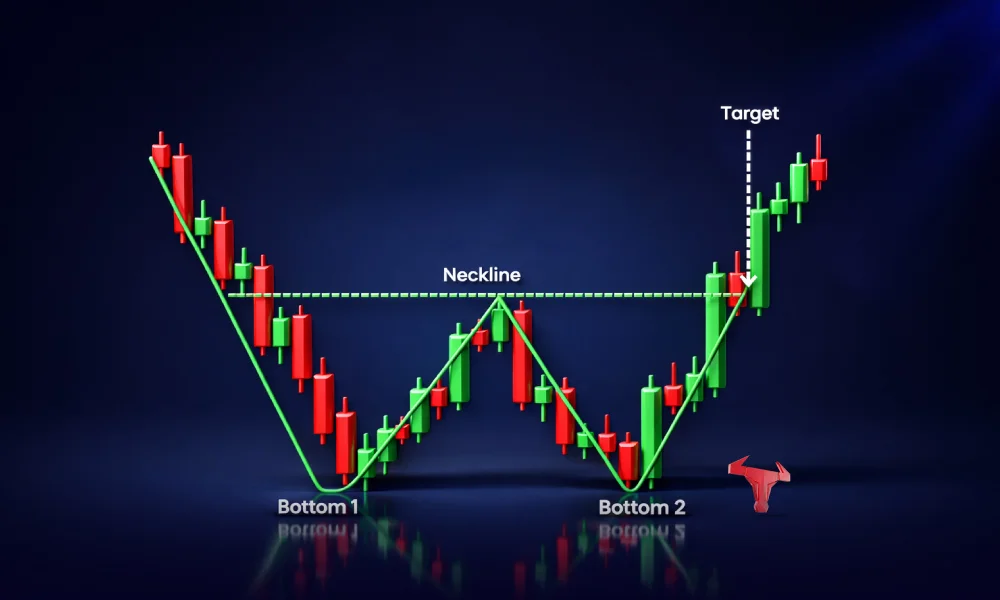
The double bottom attracts attention because it aligns with how intraday markets actually reverse, not how textbooks describe reversals. Maximum content over-promotes the pattern without explaining its limits. Understanding when it works, and more importantly, when it fails, is what turns it from a hopeful setup into a usable tool for double bottom day trading.
Structural Anatomy (Not Textbook Definition)
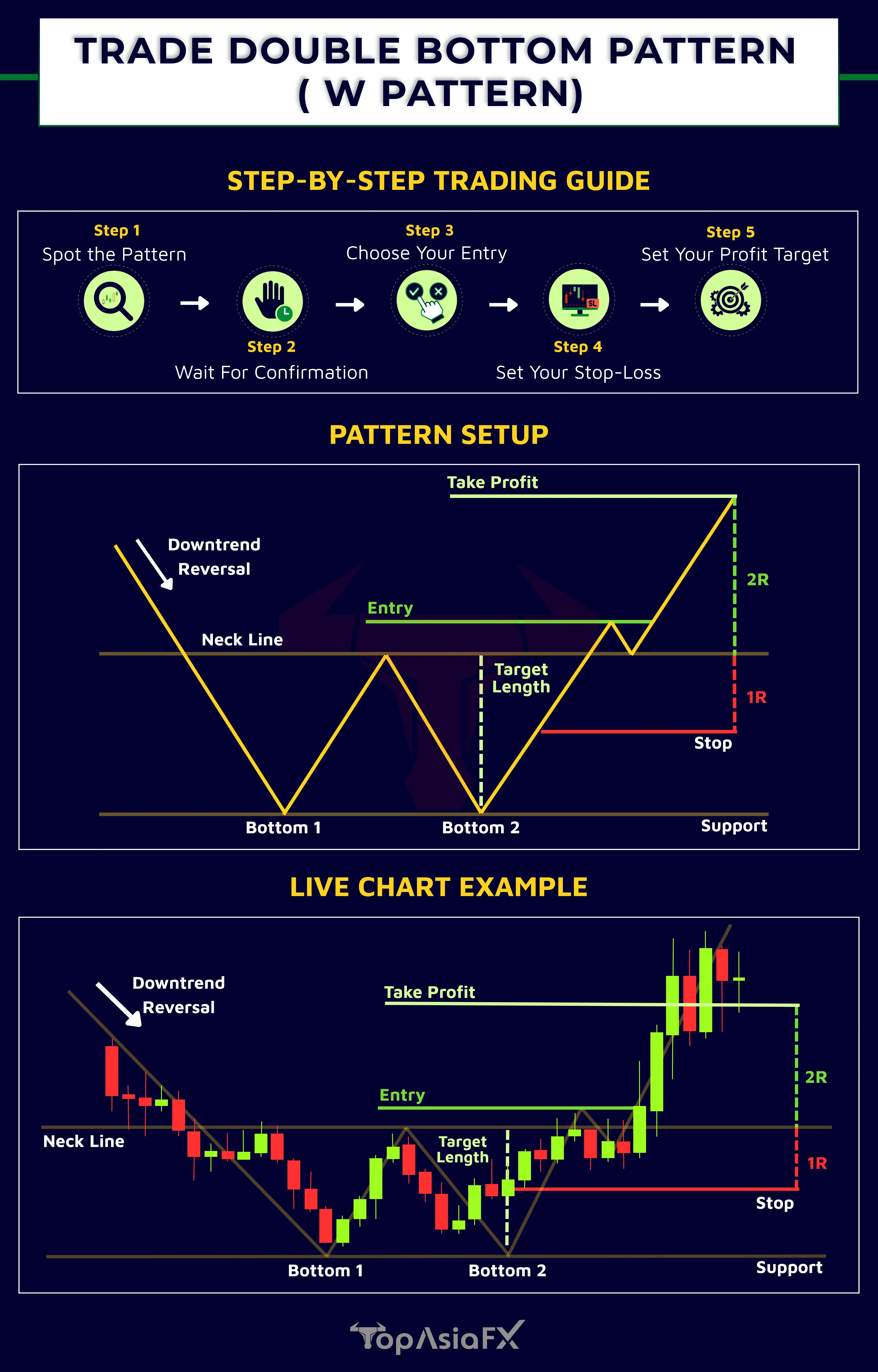
The majority of descriptions reduce the double bottom to a simple W shape. That misses the point. Symmetry and visual neatness are irrelevant; the second law's behavior is what matters. The pattern becomes meaningful only when sellers try to push prices lower and fail to attract new participants.
In strong setups, the first law is emotional. Stops get hit. Late sellers enter. The bounce that follows is not important by itself. The key moment is the second test. If price returns to the same area and selling pressure weakens, something has changed. Volume often contracts. Downward pushes stall faster. The market is no longer accepting lower prices.
“It’s not the pattern — it’s the second low behavior.”
A reliable reversal pattern indicates absorption. The double bottom visually reflects that process, but only when the second low shows hesitation rather than aggression.
Market Conditions That Invalidate It
The double bottom does not work in every environment, and pretending otherwise is why many traders get hurt. Strong prior trend strength is the most common invalidator. If price has been trending aggressively with expanding volume, failed bounces are more likely to roll over than reverse. In those conditions, the second law often breaks cleanly.
Time of day also matters. Early-session volatility, particularly in the first 90 minutes, produces clearer signals. Liquidity is high.
Participation is broad. Late-session or lunchtime double bottoms frequently fail because volume dries up and small orders move price disproportionately.
Volume behavior is non-negotiable. If volume expands on the second push down, that is not exhaustion. That is a continuation.
Treating it as a reversal simply because it looks right is the cost of prioritizing shape over participation.
Do not trade the double bottom if:
- The broader market is trending strongly in the same direction.
- Volume expands aggressively into the second low.
- The pattern forms during low-liquidity hours.
- The second test slices through the first layer without hesitation.
Why Does It Outperform Other Reversal Patterns Intraday?
Most reversal patterns demand patience; intraday markets rarely reward. Head-and-shoulders setups require distribution over time. By the time confirmation appears, the best risk is gone. Rounded bottoms need sustained participation that day traders cannot wait for.
The double bottom is different because it answers one question quickly. Did sellers fail twice? That immediacy matters. Intraday trading is constrained by time, volatility, and emotional bandwidth. A pattern that resolves quickly—right or wrong—supports consistent decision-making.
Risk definition is another advantage. The invalidation point is obvious. If the second low breaks with acceptance, the idea is wrong. That clarity supports disciplined risk management and reduces hesitation.
This does not guarantee the double bottom. A reliable reversal pattern occurs only when context, volume, and behavior align. Its strength is not a high win rate, but fast feedback.
When it works, it often moves cleanly. When it’s wrong, that becomes obvious fast. That trade-off is exactly what intraday traders need to build consistency without overcomplicating their process.
A Realistic Execution Framework for Day Traders
Most traders fail not because they pick the wrong pattern, but because they lack a repeatable execution process. Trading a double bottom intraday requires more than recognizing structure.
It requires a framework that filters context, defines risk before entry, and treats each trade as a test rather than a prediction.
Context Filter Before the Pattern Matters
Before looking for any setup, you need to decide whether the market environment even allows a reversal to work. This step is where many people run into trouble because it feels indirect and easy to skip.
Context starts with the broader market. Is the overall session trending hard, or has the price been rotating? Strong directional days reduce the odds of clean reversals. Balanced or slowing conditions increase them.
Time of day is part of context, not a side note. Early sessions provide the best mix of liquidity and volatility. Midday patterns require more skepticism. Late-session setups often fail unless volume returns. Ignoring time filters is one of the fastest ways to turn a good idea into a low-quality trade.
Entry Logic Beyond Pattern Recognition
Entry should not be automatic. A double bottom is a hypothesis that sellers may be exhausted, not proof that buyers are in control. The entry trigger should confirm that buyers are actually willing to act.
That usually shows up as acceptance above a key level rather than a single fast spike.
For example, a brief push above the bounce high followed by immediate stalling is weak. A shallow pullback that holds and then continues higher suggests participation. This distinction matters because it keeps you from entering on noise and getting chopped out repeatedly.
Invalidation Point and Risk Definition
Risk must be defined before the trade is placed. The invalidation point for a double bottom is not emotional. It is structural. If the second low breaks with acceptance, the premise is wrong. That level should not be negotiated.
This is why day trading risk management is not optional. Position size should be calculated so that a stop at invalidation represents a small, predefined percentage of capital. If the stop feels too wide, the trade is too big or not worth taking.
Trade Management After Entry
Once in the trade, management should be simple. Over-management often destroys otherwise good trades. Partial exits can reduce emotional pressure, but only if planned in advance. Moving stops impulsively because price hesitations usually lead to unnecessary losses.
The goal is not to extract the maximum possible profit. It is to execute the plan consistently. Some trades will underperform. Others will exceed expectations. Process consistency is what allows results to average out over time.
Treating the pattern as a hypothesis keeps expectations grounded. Every trade answers a question rather than proves a belief. That mindset shift is what separates traders who survive from those who keep searching for a better signal instead of building a better process.
Comparing the Double Bottom to Other Patterns
Comparing patterns matters because many traders rotate setups rather than fix execution errors. The focus here is intraday reliability rather than popularity. Seeing them side by side exposes why some feel inconsistent even when traded “by the book.”
Many comparison articles dilute insight by listing too many setups without addressing execution reality. That creates the illusion of choice without clarity.
A better approach is to compare only patterns that traders actually rotate between during live sessions and evaluate how they behave under time pressure, uneven liquidity, and emotional decision-making.
How do Intraday Conditions Change Pattern Performance?
Intraday markets compress decision windows. Trades must resolve quickly, risk must be defined clearly, and hesitation is punished. Patterns that require extended development or ideal conditions struggle in this environment. This is why the idea of a single best day trading pattern is misleading. Reliability is conditional.
Flags, triangles, and head-and-shoulder patterns all have theoretical merit. The problem is how often their requirements clash with real intraday behavior. Flags depend on momentum continuation.
Triangles depend on compression and patience. Head-and-shoulders patterns depend on slow distribution. Intraday markets rarely cooperate long enough for all of that to play out cleanly.
The double bottom behaves differently. It is not a continuation or distribution pattern. It is a failure pattern. It asks a simpler question and takes less time to answer. That difference is why traders often experience better consistency once they stop rotating patterns and start understanding behavior.
| Pattern | What It Relies On | Why It Struggles Intraday | Risk Clarity | Intraday Reliability |
|---|---|---|---|---|
| Bull / Bear Flag | Momentum continuation after an impulse move | Requires sustained participation; often forms during low-volume pauses where breakouts become liquidity traps | Moderate – stops are often obvious and crowded | Inconsistent, especially in choppy or rotational markets |
| Triangle (Ascending / Descending / Symmetrical) | Price compression followed by expansion | Needs patience and clean resolution; intraday volatility often resolves compression prematurely or falsely | Low – invalidation is often unclear until after damage | Low to moderate, highly dependent on market state |
| Head and Shoulders | Slow distribution and role reversal | Takes too long to develop; confirmation often comes after the optimal risk is gone | Low – neckline breaks can be messy and prone to retests | Low intraday, better suited for higher timeframes |
| Rounded Bottom / Top | Gradual participation shift over time | Requires sustained order flow and time that day trading does not allow | Very low – no clear failure point early | Poor for intraday use |
| Double Bottom | Failed selling and exhaustion at a known level | Fails when context is wrong, but resolves either way | High – second low provides a clear structural invalidation | High when context, volume, and timing align |
Why Traders Rotate Patterns Incorrectly?
Pattern rotation usually begins after a loss. A flag fails, so the trader looks for a triangle. The triangle chops, so they wait for a head-and-shoulders setup. Each switch feels rational, but it resets the learning curve before failure modes are ever understood.
This is where double bottom vs flag comparisons become useful. Flags often fail in choppy conditions, but traders keep taking them because they look familiar. When they stop working, traders blame the pattern instead of recognizing the environment. The same mistake repeats with triangles and head-and-shoulder patterns.
The double bottom tends to shorten this cycle by providing faster feedback. When it fails, it fails clearly. The second law breaks, and the idea is invalid. That clarity limits emotional attachment and discourages endless tweaking.
Final Perspective: Consistency Beats Pattern Variety
Most traders don’t fail because they chose the wrong pattern. They fail because they keep searching for certainty in a business built on probability. The double bottom is not valuable because it wins more often than any other strategy. It’s valuable because it forces clarity. Clear invalidation. Clear context requirements. Clear feedback when you’re wrong.
That clarity reduces emotional decision-making, which is where most losses actually come from. Pattern variety feels productive, but it often masks avoidance. Avoidance of tracking mistakes. Avoidance of sitting through drawdowns. Avoid doing fewer trades better.
A reliable process beats an impressive toolkit. When you stop asking which pattern is best and start asking whether the conditions justify the trade, consistency becomes less mysterious and more mechanical.
FAQs
Is One Pattern Enough to Be Profitable?
Yes, one pattern can be enough if it is traded with consistent rules, proper risk limits, and sufficient repetition. Profitability comes from execution quality, not variety. Many traders improve their results by narrowing their focus rather than rotating patterns after short-term losses.
Does the Double Bottom Work in Forex and Stocks?
The double bottom can work in both forex and stocks because it reflects order flow behavior rather than asset-specific mechanics. Reliability depends on liquidity and session structure. Markets with thin volume or overlapping sessions tend to produce clearer signals than quiet or fragmented trading hours.
What Is the Best Timeframe for Intraday Use?
Most intraday traders find five- to fifteen-minute charts provide the best balance between signal clarity and execution speed. Lower timeframes introduce noise and false signals, while higher timeframes reduce trade frequency and limit risk control within a single session.
Can Beginners Trade This Pattern Effectively?
Beginners can trade the double bottom, but only with strict risk controls and realistic expectations. The pattern should be treated as practice in execution, not income generation. Paper trading and small size help beginners learn failure conditions without emotional pressure or financial damage.
Why Does the Double Bottom Stop Working Sometimes?
It usually stops working when the context changes. Strong trends, expanding volume into lows, or low-liquidity periods reduce reversal odds. The pattern itself hasn’t broken. The environment no longer supports exhaustion, and continuation becomes the higher-probability outcome.
Is a High Win Rate Necessary for a Pattern to Be Successful?
No, a high win rate is not required. Many successful traders operate with moderate win rates and strong risk control. What matters is asymmetric outcomes, where losing trades are small, and winners have room to develop without constant intervention.
How Long Should It Take for the Pattern to Play Out?
Intraday double bottoms should resolve relatively quickly after entry. Prolonged sideways movement often signals weak participation. If the price does not move as expected within a reasonable time window, the premise may be wrong, or conditions may have shifted.
F. Nathan
Felix Nathan is a professional trader, market analyst, and business development executive with over a decade of experience in the forex and financial markets. Felix specializes in providing actionable market insights, trading strategies, and risk man...