
 IUX
IUX
 Exness
 Vantage
 XM
XM
 ICMarkets
 LiteFinance
 Moneta
 Tickmill
 South Africa (9)
 India (9)
 Bangladesh (12)
 Germany (9)
 Thailand (10)
 Philippines (9)
 Nigeria (10)
 Vietnam (10)
 Malaysia (9)





What is Liquidity in Forex?



Share:
Share:
Markets
6 min read

Have you ever tried to sell something, maybe a used laptop or a concert ticket, only to find out that no one wants to buy it?
That’s what a lack of liquidity feels like.
In forex, liquidity is what keeps things flowing. It’s the lifeblood of the market. It determines how easily you can enter and exit trades without causing wild price swings.
Learn more about forex market structure.
Forex is Nothing Without Liquidity
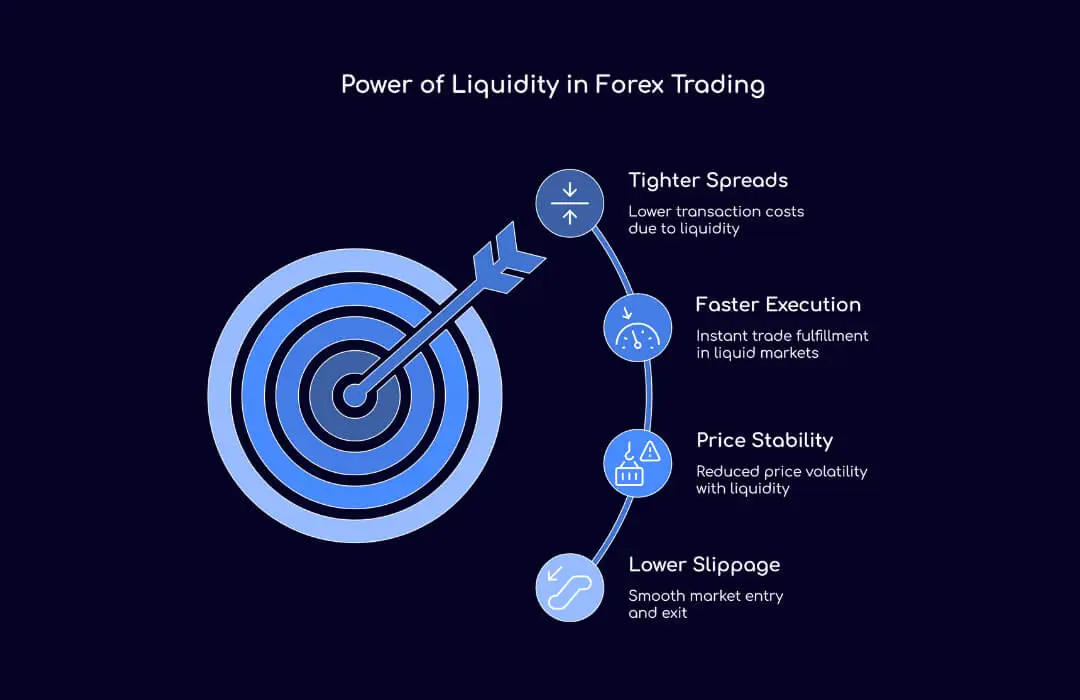
Imagine placing a trade and having it filled instantly, at the exact price you wanted. That’s high liquidity at work.
On the other hand, if the trade is only filled several pips away from your target price, that’s a liquidity problem.
With liquidity in Forex, there are:
- Tighter spreads: In liquid markets, the bid-ask spread is narrower, which means there are lower transaction costs.
- Faster execution: Your trades will get filled almost instantly during high liquidity periods.
- Price stability: Liquidity helps reduce the frequency of random price spikes.
- Lower slippage: The more buyers and sellers are available, the smoother your entry and exit into and out of the market.
High vs. Low Liquidity in Forex
Major currency pairs like EUR/USD, USD/JPY, GBP/USD, and USD/CHF are known as high liquidity forex pairs.
These pairs run the market as they have a high trading volume and are backed by strong economies, such as the USA, Japan, Britain, etc.
On the flip side, exotic pairs like USD/TRY or ZAR/JPY tend to show low liquidity, especially outside peak trading hours.
Here’s a quick overview of why these two are so different:
| High Liquidity Forex Pairs | Low Liquidity Forex Pairs |
|---|---|
| High trading volumes | Harder to execute large trades in |
| Low spreads | Have wider spreads and higher risk |
| Minimal slippage | Experience sharp price swings |
| Better technical analysis performance |
Liquidity in The Currency Market Isn’t Static
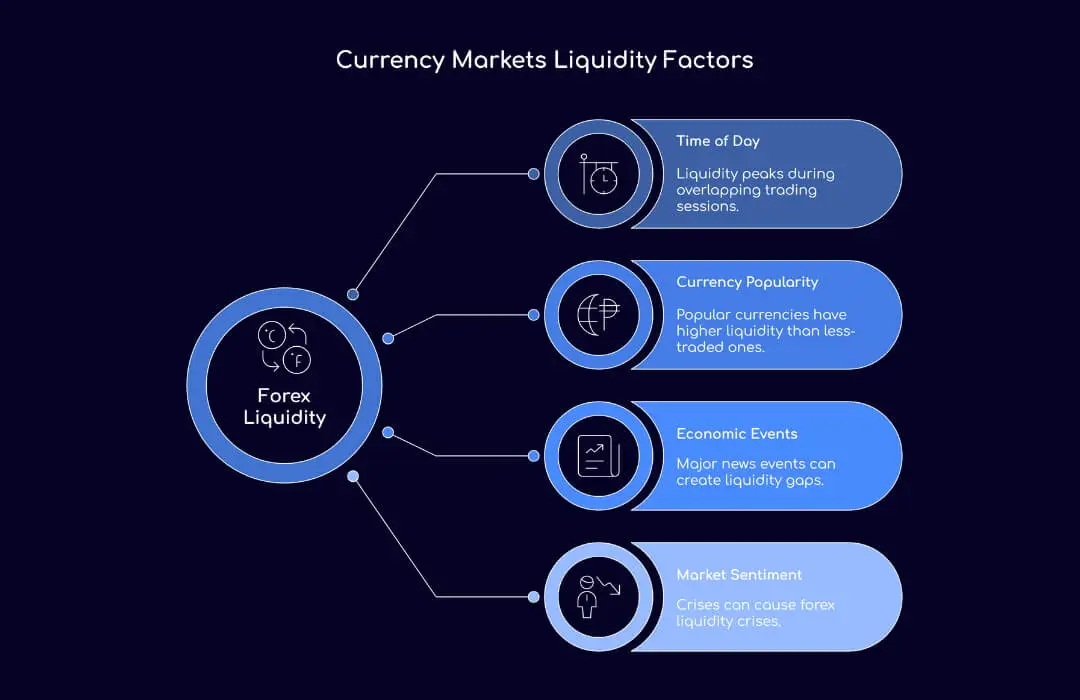
It fluctuates based on these factors:
The Time of The Day
Liquidity peaks during overlapping trading sessions, especially the London-New York overlap. It is best to avoid trading during quiet times like the Asian session’s close (Tokyo session).
How Popular The Currency is?
The most liquid forex pairs are those with global demand, like USD, EUR, and JPY. Less-traded pairs like the South African Rand, for instance, are less liquid
Economic Events
Major news like NFP, FOMC announcements, or interest rate decisions can create liquidity gaps. These are gaps where price jumps with little to no trades in between.
The Market Sentiment
During crises or uncertain times (like in 2008 or 2020), traders tend to pull back.
This can lead to a forex liquidity crisis, which is a situation where spreads widen, slippage increases, and price action becomes erratic.
Where Does Liquidity Come From in The Forex Market?
At the heart of it all are the liquidity providers, like banks, hedge funds, financial institutions, and market makers that ensure there's always a two-way price (bid and ask) in the market.
There are also institutional forex liquidity providers (like JPMorgan or Citibank), retail brokers who aggregate liquidity from multiple sources, and the interbank market, which is the backbone of global currency exchange.
These sects make sure that forex stays a liquid market, but they step back during extreme events, which can trigger liquidity traps.
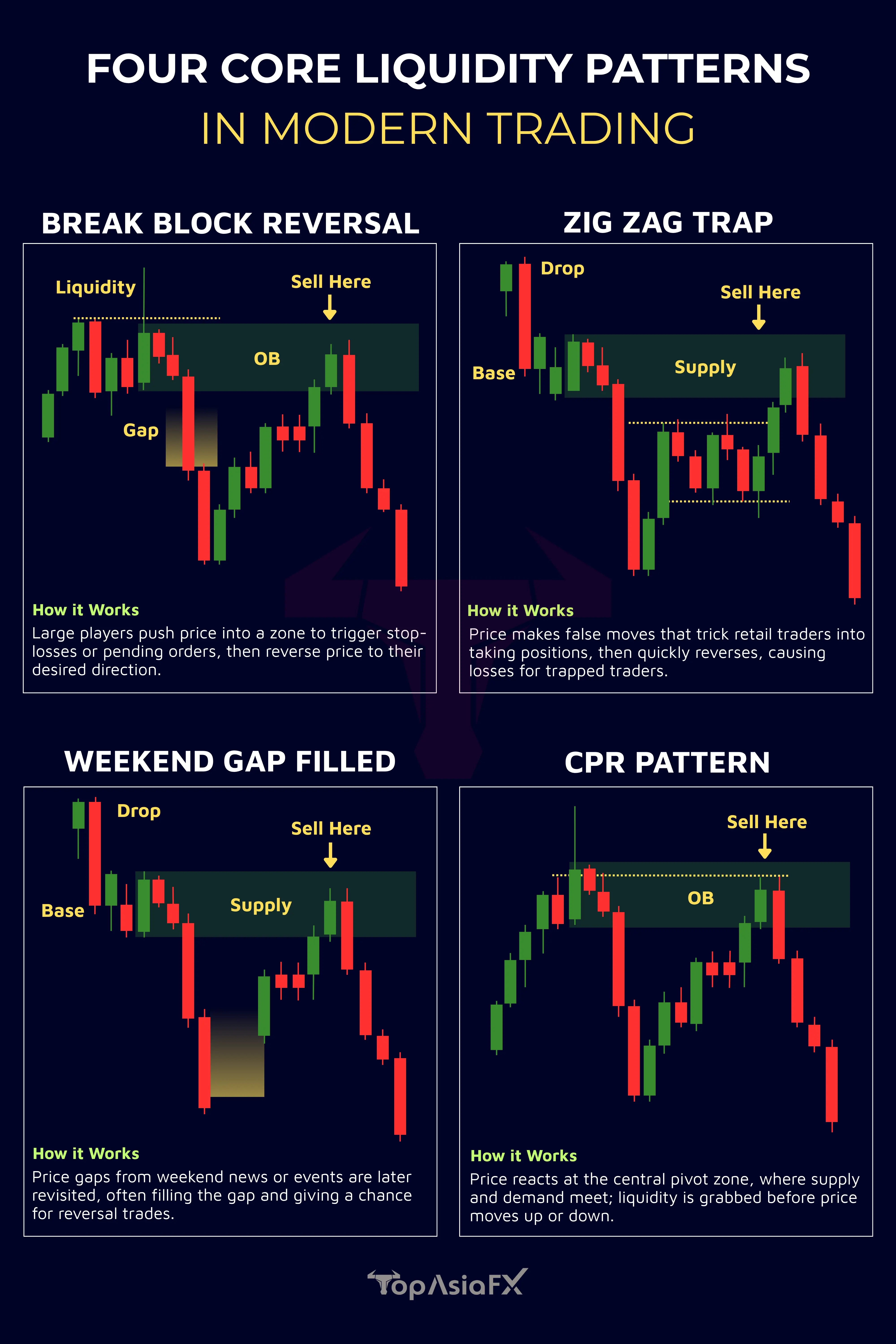
To better understand how liquidity behaves in real trading conditions, it’s helpful to look at the four core liquidity patterns that shape price movement in the forex market.
These patterns reveal where large orders tend to cluster, how institutions manage entries and exits, and why liquidity shifts during different market phases.
What Causes Illiquidity?
Illiquidity occurs when assets cannot be easily bought or sold without significantly affecting their price. Several key factors cause this:
- Market structure issues create the foundation for illiquidity. Thin markets with few participants mean there aren't enough buyers and sellers to facilitate smooth trading. When bid-ask spreads are wide, the cost of transacting becomes prohibitive for many market participants.
- Information asymmetries play a major role. When some market participants have significantly more information than others, those with less information become reluctant to trade, fearing they're at a disadvantage. This reduces overall trading activity and market depth.
- Asset characteristics inherently affect liquidity. Complex financial instruments, real estate, collectibles, and specialized assets naturally have smaller pools of potential buyers. Assets with uncertain valuations or those requiring specialized knowledge to evaluate tend to trade less frequently.
- Market conditions can trigger liquidity crises. During periods of high volatility or uncertainty, market participants often retreat to the sidelines, waiting for conditions to stabilize. Credit crunches reduce the capital available for market making and trading.
- Regulatory and institutional factors also matter. Heavy transaction costs, complex regulatory requirements, or restrictions on who can trade certain assets all reduce market participation. Settlement delays and operational inefficiencies can further discourage trading.
- Behavioral factors amplify these effects. During market stress, herding behavior can cause widespread withdrawal from markets simultaneously. Risk aversion spikes during uncertain times, causing investors to prefer holding cash over less liquid assets.
Do You Know How to Use Liquidity Zones?
Many traders use liquidity zones on the chart.
These zones are areas where prices previously saw strong activity. They use the areas to predict future moves.
These are often demand zones, typically where buyers stepped in, or supply zones, where sellers took control
For guidance, see trading forex during sessions.
Are Liquidity And Volatility The Same?
No, liquidity and volatility are two sides of the same coin
While liquidity smooths out the market, volatility stirs it up. But here’s the twist; low liquidity often creates volatility.
High liquidity means controlled price moves and predictable trends, while low liquidity leads to wild swings, higher risk, and potential for slippage.
Low liquidity often creates volatility, so as a day trader, you’ll likely want to trade when both are balanced (tips for forex trading).
You Can’t See Liquidity Directly, But You Can Measure It
Use these tools to measure liquidity:
- Volume indicators. These show how active the market is.
- Order book data (Level 2), reveals real-time bid/ask depth.
- Forex liquidity indicators: Some forex platforms offer this flow measurement tool.
- Volatility overlays help assess how smooth price movements are.
Some traders also use price action analysis and stop-loss hunting zones to identify where liquidity might be resting.
The Dark Side of No Liquidity
In illiquid markets, traders will face, wider spreads, slippage, increased margin requirements, flash crashes, and liquidity traps where price fakes out and reverses violently.
Timing Is Everything
To trade effectively, you need more than just a strategy. You need market conditions on your side
You should:
- Trade during high liquidity hours (London/New York overlap).
- Choose liquid forex pairs.
- Avoid news-related volatility unless you're prepared.
- Use liquidity zones to plan your trades, not chase them.
F. Nathan
Felix Nathan is a professional trader, market analyst, and business development executive with over a decade of experience in the forex and financial markets. Felix specializes in providing actionable market insights, trading strategies, and risk man...