 IUX
IUX
 Exness
 Vantage
 XM
XM
 ICMarkets
 LiteFinance
 Moneta
 Tickmill
 South Africa (9)
 India (9)
 Bangladesh (12)
 Germany (9)
 Thailand (10)
 Philippines (9)
 Nigeria (10)
 Vietnam (10)
 Malaysia (9)





Learn Forex Market Structure (Easy Way)



Share:
Share:
Education
6 min read

The forex market has no central exchange, no opening bell, no physical trading floor. It operates as a decentralized network connecting banks, institutions, brokers, and individual traders across the globe. This structure makes it the largest and most liquid financial market in existence, moving over $7 trillion daily.
Knowing how this market is organized changes the way you approach trading. Price quotes, order execution, spreads, and liquidity all trace back to the underlying structure. Banks sit at the top, retail traders at the bottom, and several layers exist in between.
This guide maps out exactly how the forex market works behind the scenes.
What Makes the Forex Market Unique?
In contrast to the stock market, which always operates through central exchanges like the New York Stock Exchange, Forex is decentralized.
This means that there is no singular place for conducting forex trades.
Instead, forex trading is achieved over a global network of banks, financial institutions, and individual traders over 5 days every week.
I think this is quite exciting because:
No Monopolies
Since forex, as opposed to stock exchanges, does not allow for a single entity to control prices highly, Forex is quite competitive.
Multiple Price Quotes
In Forex, numerous quotes are also available from different currency dealers; hence, it allows traders to find the best price for that currency (just like hunting for sneakers at the best price!).
Learn more about bid, ask, and spreads.
Flexibility
Forex traders can trade from anywhere across the globe as long as they have internet and are registered on a trading platform.
Now, let’s break down how the forex market is structured, starting with who’s who in the game.
The Forex Market Structure
Picture the forex market as a VIP club: the higher you are on the ladder, the more advantages you have when it comes to price and trading conditions.
Here’s a look at the key participants ranked in order from top to bottom:
The Interbank Market
The interbank market is the highest in the food chain, where the biggest banks in the world trade large amounts of currency with each other directly.
These include:
- JPMorgan Chase
- Citibank
- Deutsche Bank
- HSBC
- UBS
These banks lay down the basis for forex prices and form the most liquid part of the market.
They do their trades either bilaterally (directly to each other) or via electronic brokers such as:
- EBS (Electronic Broking Services): Usually for more liquid pairs like EUR/USD, USD/JPY, and USD/CHF.
- Refinitiv (Formerly Reuters Matching): Often used for GBP/USD, AUD/USD, and USD/CAD.
While all banks in the interbank market can view the rates each other is offering, not everyone can access those rates.
Hedge Funds, Corporations, and Retail Market Makers
Moving further up the ladder into the forex market, we can find large institutional traders such as:
- Hedge funds, which are large investment firms that try to earn profits by predicting forex movements through advanced strategies. Learn about top forex strategies.
- Multinational corporations, like Apple and Toyota, that trade forex to hedge currency risk when doing business in different countries
- Retail market makers, who are brokers that set their bid/ask prices to profit from the spread, which is the difference in prices to buy or sell currencies.
Unlike interbank brokers, these institutions do not have direct access to the best rates, nor do they want to, and usually depend on a commercial bank to handle their trades.
Learn more about used margin and leverage!
Retail Traders (You!)
Retail traders are individuals who buy and sell currencies in online forex markets, which constitutes the lower tier of the forex food chain.
Due to the growth of the internet, this type of trading is now accessible to anyone, around the globe.
Nevertheless, retail traders get slightly worse prices than institutional players higher up the chain.
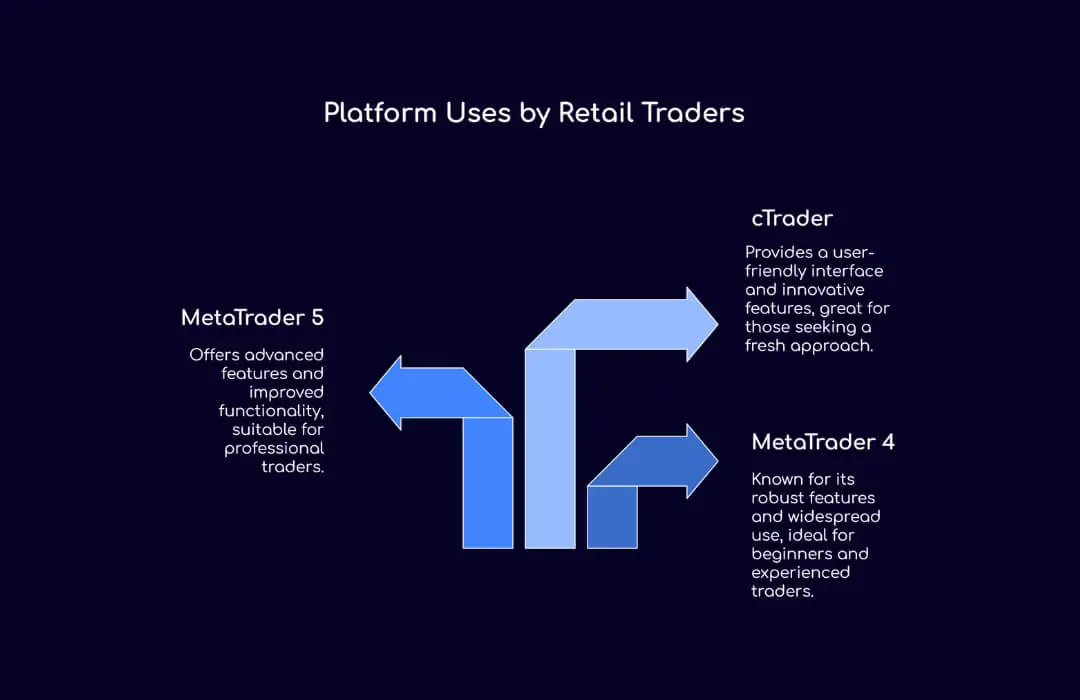
Retail traders often use platforms like:
Now that you know who’s trading, let’s look at how the forex market behaves.
Types of Market Structures
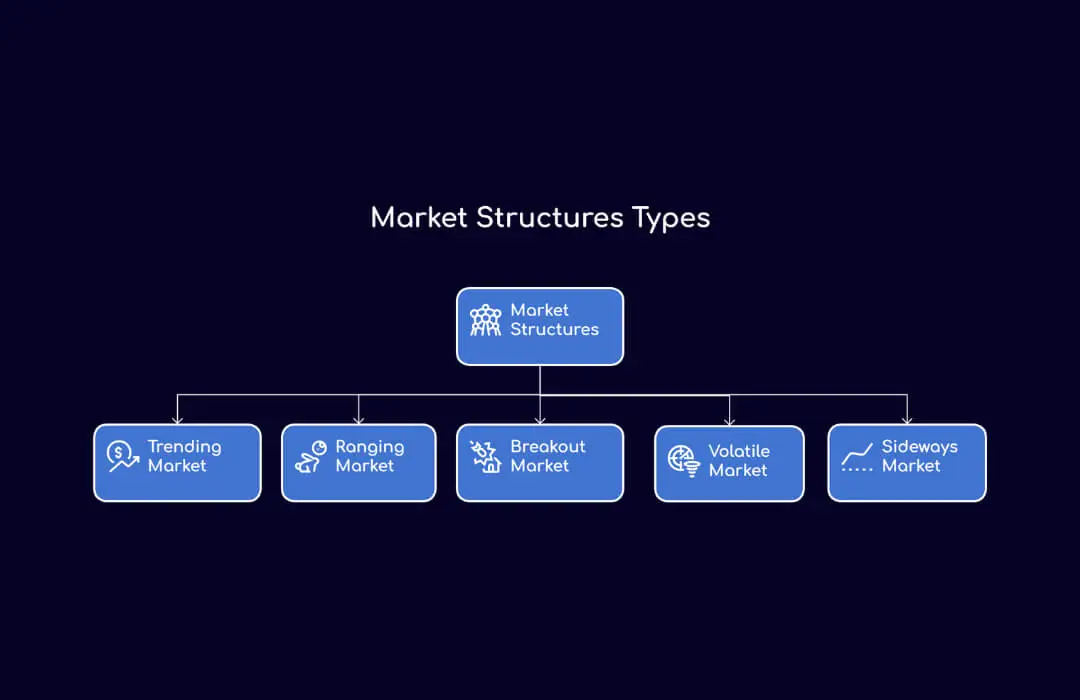
Trending Market
This is a market where the price moves strongly in one direction (upward or downward). Traders use moving averages and trendlines to ride the wave.
Learn successful day trading patterns.
For example, USD/JPY becomes a strong-uptrend currency pair if it continuously rises.
Ranging Market
The price moves sideways between support and resistance levels. Traders will buy at support and sell at resistance levels (think of it as bouncing a ball between two walls).
For example, EUR/GBP may have traded between 0.84 and 0.86 for weeks.
Breakout Market
Here, prices explode past an old support or resistance level. Traders use breakout strategies to get as much as possible from big moves.
For instance, AUD/USD breaking above a resistance level was a gearing-up for a new bullish trend.
Volatile Market
Prices swing wildly here after significant news events. The smart traders play with stop-loss orders to control risk.
I remember GBP/USD during the Brexit vote; prices went crazy.
Sideways Market
In the sideways market, the price hardly moves, and the trading is tedious. Traders use oscillators such as RSI to spot small fluctuations. For example, USD/JPY stocks being within a very tight range for weeks.
Knowing these structures in the market will allow you to choose an effective trading strategy and be able to avert losses that should be avoided.
Learn forex risk management steps.
How do central banks come into all of this? Find out.
The Role of Central Banks in Forex
Central Banks are usually in control of the supply of money within an economy, which means whatever decision they take affects the currency value. They do this using:
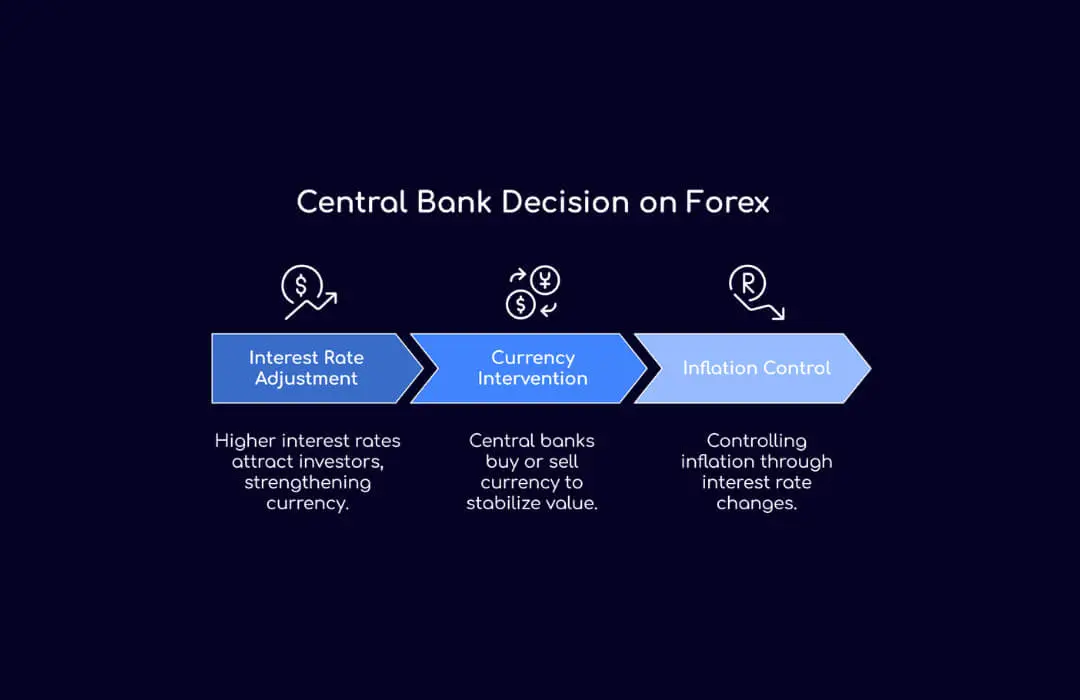
Interest Rate Decisions
When interest rates are higher, it attracts investors, which strengthens a currency.
Learn about leverage and margin.
Currency Interventions
This happens when a central bank sells or buys its currency to stabilize the value. This is usually during periods of high inflation.
Control of Inflation
When inflation reaches high levels, a central bank may also raise the interest rate, which helps strengthen the currency against other currencies.
For instance, in 2022 when the U.S. Federal Reserve raised the interest rates, the U.S. Dollar gained more value.
Learn "how central banks affect Forex?".
Concluding Insights
The Forex market is huge, fast-paced, and full of opportunities.
To trade successfully, you need to:
- Know who the key market players are and how they influence the market.
- Understand the different market structures like trending, ranging, breakout, etc.
- Be aware of the influence of central banks on currency values.
Other Helpful Resources
F. Nathan
Felix Nathan is a professional trader, market analyst, and business development executive with over a decade of experience in the forex and financial markets. Felix specializes in providing actionable market insights, trading strategies, and risk man...