 IUX
IUX
 Exness
 Vantage
 XM
XM
 ICMarkets
 LiteFinance
 Moneta
 Tickmill
 South Africa (9)
 India (9)
 Bangladesh (12)
 Germany (9)
 Thailand (10)
 Philippines (9)
 Nigeria (10)
 Vietnam (10)
 Malaysia (9)





Forex Trading Order Types Quick Reference



Share:
Share:
Education
12 min read
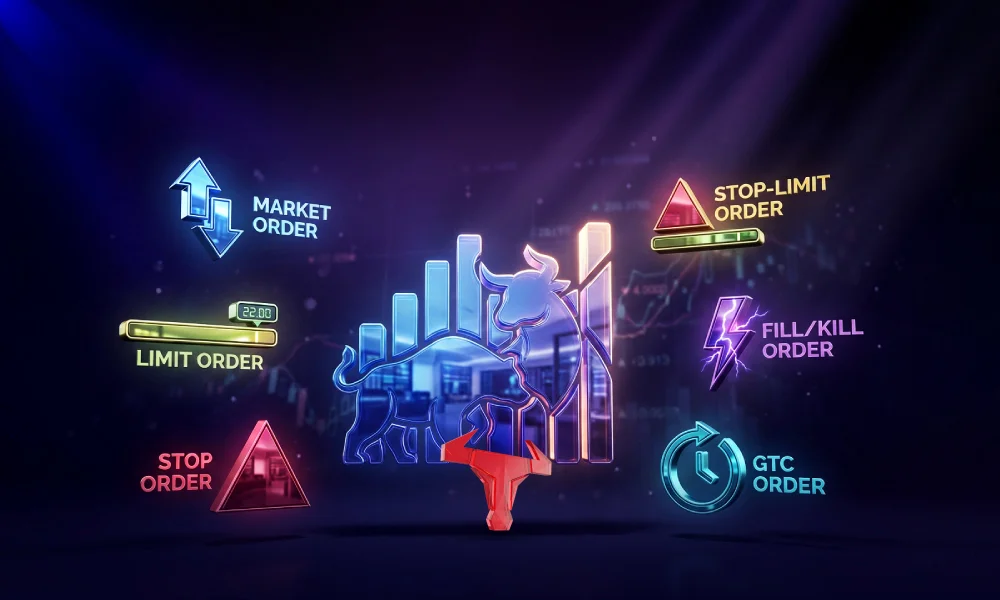
An order in forex is a command for the broker about when to enter and exit a trade.
Most of you lose money in forex trading.
Not because of your bad analysis,
But because you are not using the right forex trading order types.
And it's not your fault.
Let's be honest,
You were not given proper info about,
- What are the order types
- The positives and negatives.
- Pro tips on how to choose the right order type
That's the reason, I’ve decided to put an end to this mess,
By giving you the free access of -
Everything You Need To Know About Forex Trading Order Types.
After reading this article,
You'll have the knowledge to:
- Lock in your profits and limit losses by using advanced order strategies.
- Slash emotional decision-making and trade like a pro.
- Carry out proper risk management steps to save you from collapsing
It is gonna feel like a heavy weight has been lifted off your shoulders,
And you got the cheat codes of the game called forex trading.
So, here is an overview of what you will discover today:
| Market Orders | Pending Orders | Time in Force Orders | Conditional Orders | Trailing Orders |
|---|---|---|---|---|
| Market Order | Limit Order | Good for the Day (GFD) | One Cancels the Other (OCO) | Trailing Stop Order |
| Stop Entry Order | Good Till Cancelled (GTC) | |||
| Stop Loss Order | Immediate or Cancel (IOC) | One Triggers the Other (OTO) | ||
| Stop Limit Order | Fill or Kill (FOK) | |||
| Good Till Date (GTD) |
Don't worry, I’ll break down everything to its core,
So you can devour them like a piece of cake.
Before we explore further, Let’s assume 2 things:
- EUR/USD exchange rate is 1.0480 (chart price)
- EUR/USD bid/ask price is 1.0478/1.0482
I won't use any other currency pair as an example except EUR/USD.
This way, all confusions will be exterminated.
Whenever you see a price, know I’m mentioning EUR/USD currency pair.
Now that it is out of the way,
Let's set the ball in motion.
Market Order
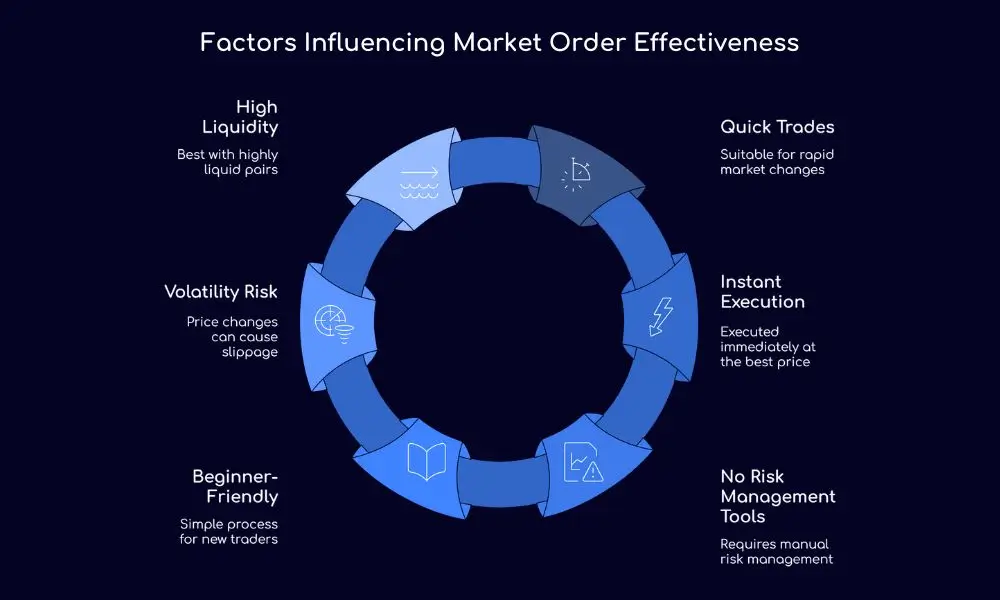
A market order allows you to buy or sell currency at the best available price,
It means your order will be filled instantly.
For example,
If you place a market buy order, it will instantly be executed at 1.0482,
And if you place a market sell order, it will instantly be executed at 1.0478
Market order is beginner friendly because of its zero complexity.
You just buy and sell immediately.
Works fine with highly liquid currency pairs.
But…
If the market is volatile,
the execution price might be different from the price you were expecting.
This is called slippage.
It means, you don't have any control over execution price.
Plus, there are no risk management tools in this order,
That's why you have to do it manually.
Pro tip: To catch sudden momentum built up by forex news or events, use market order. But don't use it in low liquidity markets and if the spread of bid/ask is too wide.
Pending Orders
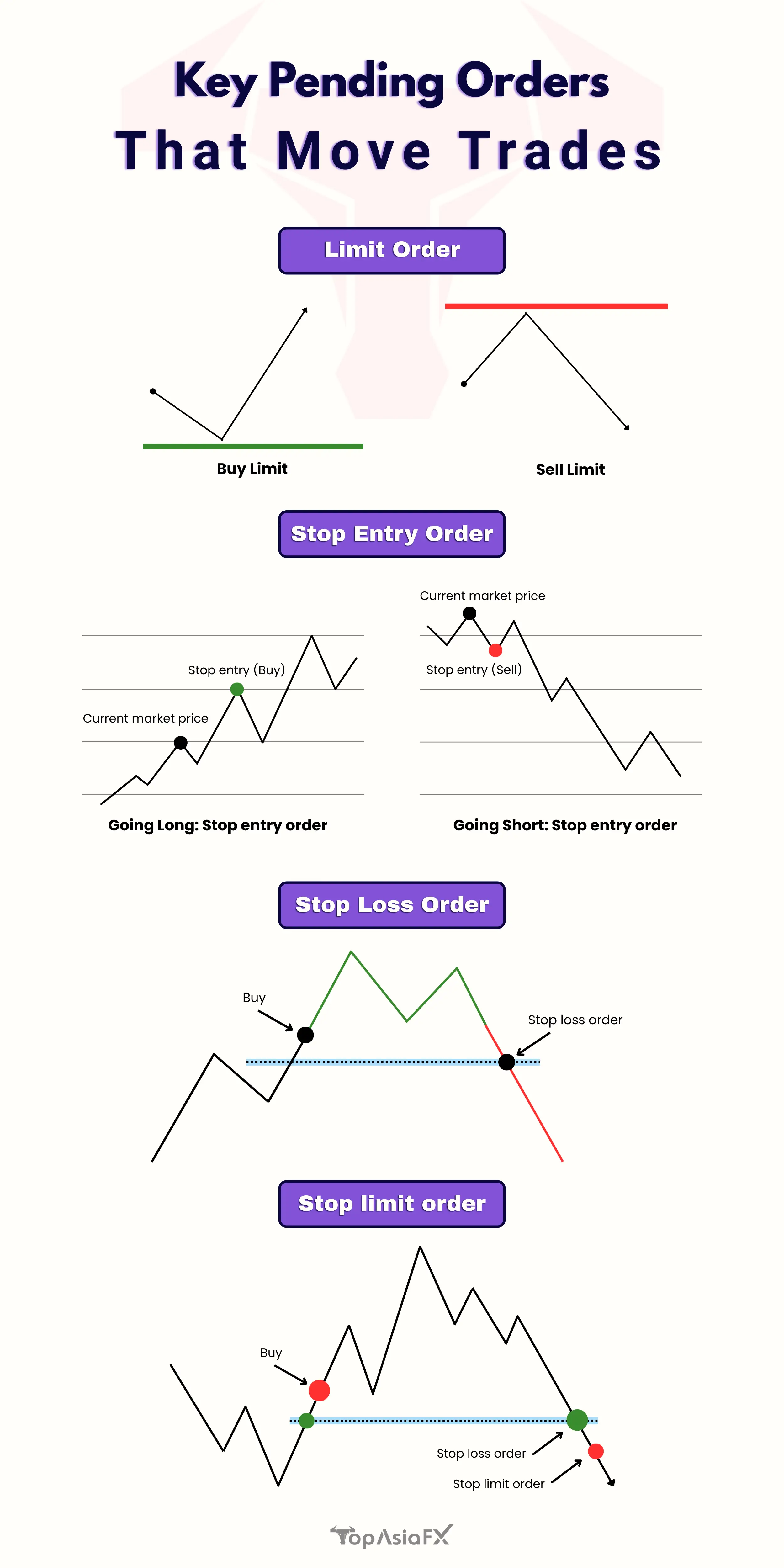
Pending orders are instructions traders use to buy or sell assets automatically when certain conditions are met. The main types include limit order, stop entry order, stop loss order, and stop limit order.
Understanding each helps you manage your trades with confidence and precision.
Limit Order
In Limit order, you set a price, If the market price reaches your price,
The order executes, Or else, it doesn't.
For instance, You place a limit buy order at 1.0475.
When the price falls down to 1.0475, your order executes.
If it never reaches 1.0475, your order never executes.
You can trade even when you're sleeping with limit order.
Just set a price and wait till the order is filled.
One thing I love about limit order is…
It has no slippage issues!
It allows you to open a trade at the price you want
But…
If you set an unrealistic price,
The market may never reach it,
And your order might never be filled.
You may even get partial fills if you're trading in a low liquid market.
While you're waiting for your order to get filled,
Bigger opportunities may pass by and you might miss them.
Stop Order
In stop order, you expect a momentum to push you through in order to follow the trend.
Below are some stop orders…
Stop Entry Order
It means, you enter a trade only if the market is predicted to move in a certain direction.
It is like following the trend.
In this case,
You buy high and sell low,
Expecting that the price may break through and continue to grow.
After analysis,
You set a stop loss at 1.0480.
It means that the price has struggled to break past this point.
If it breaks through,
Then most likely it will continue to grow.
To take advantage of it,
You place a stop entry buy order at 1.0488.
If the ask price reaches 1.0488, your order executes.
Similarly,
When selling,
You see that there is a support level at 1.0474.
It means that the price has struggled to break past this point.
If it breaks through,
Then most likely, a downward trend might start.
That's why you place a stop entry sell order at 1.0472.
If the bid price falls to 1.0488,
Your order executes, protecting you against losses.
Stop entry order allows you to foresee market trends and confirm them.
It's mostly automated and helpful for breakout strategy.
But…
If the market is highly volatile, your order may get filled at a worse price.
And if the market reverses at the last moment,
You might end up buying at the top and selling at the bottom.
Plus, if the spread is wider, then your order might execute earlier than expected.
Stop Loss Order
It limits your losses by closing the trade if the price goes against you.
Suppose,
You bought EUR/USD at 1.0482.
You expect it to rise in price.
But to protect yourself in case the market goes against you,
You set a stop loss at 1.0480.
If the price falls to 1.0480,
Your trade closes automatically,
And ensures minimal loss.
It also stops you from holding losing trades.
But…
If the stop loss order is too tight,
It may get triggered by normal market fluctuations.
In highly volatile market,
Slippage can cause even bigger losses.
So, be aware of that.
Stop Limit Order
Stop limit order is a combination of 2 orders.
Limit order and stop entry order.
Here is an example:
According to your analysis,
The sweet spot for entering the trade is between 1.0485 and 1.0490.
So, you set a stop entry buy order at 1.0485 and a limit buy order at 1.0490.
When the price reaches 1.0485, your order executes.
If the market is too volatile and the prices goes above 1.0490,
Your order doesn't execute.
Hence protecting you from slippage.
This order is flexible enough to be used in various strategies.
But…
It requires careful planning and constant monitoring.
If the market is moving too fast,
Your order won't trigger and you might miss an opportunity.
Limit Order Vs Stop Order
You might be confused between limit order and stop order.
Don't worry, it's common.
Let's fix it!
In limit order, you buy low, sell high.
Why?
Because you want a better deal.
If you wanna buy,
You wait for the price to drop.
If you wanna sell,
You wait for the price to rise.
But in stop order, you buy high, sell low.
What do I even mean by that?
Basically, you are expecting momentum.
If the price is rising, you buy to go with the flow of the trend.
If the price is falling, you sell to cut losses.
So, they aren't exactly opposites,
Rather they serve different purposes to match different trading strategies.
Pro Tip: Your stop and limit order should have enough gap in between to prevent unfilled orders. Most importantly, be realistic with your prices.
Time In Force Orders
These are like normal orders but with a time condition.
If the order does not get filled within the set time, the order gets canceled.
Below are some time in force orders…
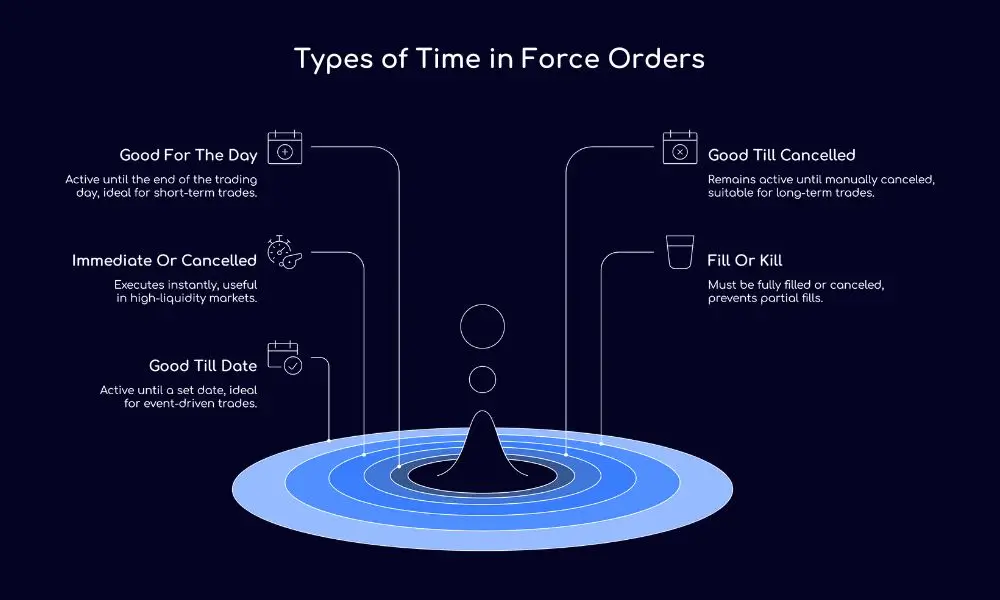
Good For The Day (GFD)
It is a pending order that stays active until the end of the trading day.
In other words,
You place a GFD limit buy order at 1.0479.
If the price drops to 1.0479 before the end of the trading session,
Your order gets executed,
If it doesn't, then the order gets canceled.
If your order is partially filled,
Then the unfilled portion gets cancelled.
But…
If your set price is reached after the day,
Then you just missed an opportunity.
Good Till Cancelled (GTC)
Your order stays active until you manually cancel it.
You wait for the right price,
Even if it takes days, weeks or months.
For instance,
You place a GTC limit sell order at 1.0485.
It's gonna stay active until you close it manually.
It's good for long term trades.
But…
You may forget about the trade,
And it may execute at the wrong market condition.
Furthermore, Some brokers may impose a time limit on how long the GTC orders can stay active.
Immediate Or Canceled (IOC)
It executes the order immediately.
But if it doesn't fill, the remaining portion is canceled.
For example,
You place an IOC order to buy €10,000 at 1.0482.
If there are only €8,000 available at 1.0482,
Then those orders execute and the rest of the €2,000 buy orders gets canceled.
But…
You may not get the quantity you wanted.
If the liquidity of a market is low,
It's more likely that the order will be partially filled
So, it requires active monitoring.
Fill Or Kill (FOK)
The placed order has to be filled 100%, or else the order will be canceled entirely.
Suppose,
You placed an order to buy €10,000 at 1.0482,
If the market does not offer the full €10,000 at 1.0482 instantly,
The entire order will be canceled.
It helps you to avoid holding incomplete amount of currency,
Which saves you from miscalculation and reduces slippage risk.
But…
The order won't execute at low liquidity markets.
And potential profits from partial fills would be missed,
As it does not allow partial fills to happen
Good Till Date (GTD)
In this case, the order has a specified date until it is active.
In other words, You placed a GTD limit order to sell €10,000 at the exchange rate of 1.0484, with an expiration date.
If the rate reaches 1.0484 before the expiration date,
The order executes, otherwise, it gets canceled on the set date.
This one is pretty useful if you place an order based on future news or events.
You have to accurately predict the price movement to get the order filled.
Pro tip: GTC is best for swing traders. If you want an order to be filled immediately or not at all, use IOC or FOK. GFD is great for short term traders.
Conditional Order
I think the name is self explanatory.
You can use different combinations of orders to set conditions.
But it is recommended to follow the proven trading strategies.
Below are some conditional orders…
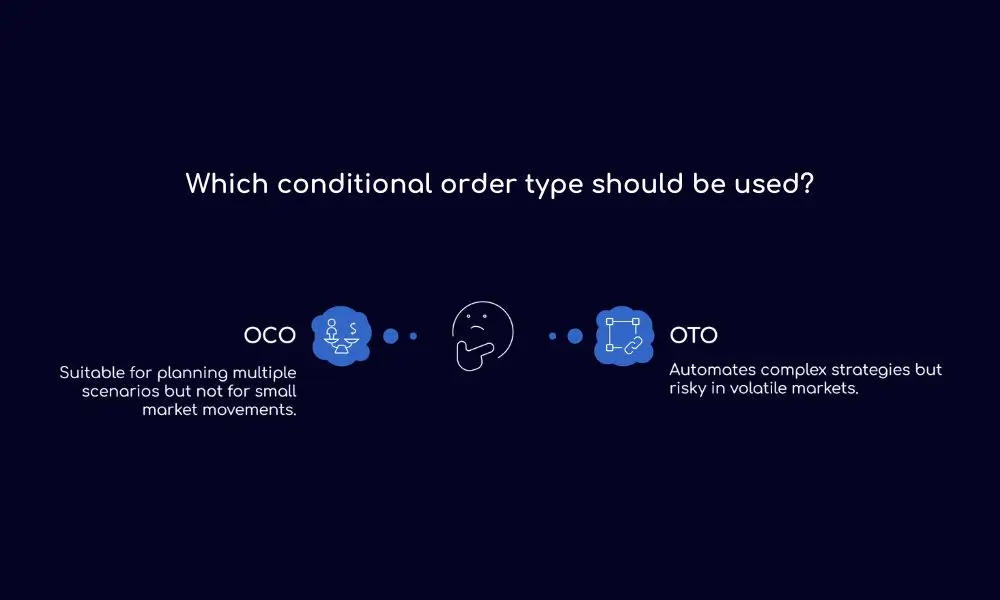
One Cancels The Other (OCO)
Execution of one order automatically cancels the other.
For example, After analysis, you believe that if the price rate hits 1.0490, it will continue to grow.
On the other hand, if the price rate falls to 1.0470, it could fall further.
So, you set OCO stop buy order at 1.0490 and OCO stop sell order at 1.0470.
Now, if the price hits 1.0490, the buy stop order is executed and the sell stop order gets canceled.
Similarly, if the price falls to 1.0470, the sell stop order is executed and the buy stop order gets canceled.
What I like about this order type is that,
It allows you to plan for different scenarios.
But…
Highly volatile market may trigger both orders at the same time.
It's not good for small market movements,
And it's complicated for beginners.
One Trigger The Other (OTO)
If the primary order is executed, Then the secondary order is triggered.
For example,
You want to buy EUR/USD when the price reaches 1.0490
And want to set a profit target at 1.0510.
So you set an OTO stop buy order at 1.0490,
Which will be your primary order.
And set an OTO limit sell order at 1.0510,
This is your secondary order which will be triggered after the primary order has been executed.
By using OTO, you can execute complex strategies automatically after the initial set up.
>But…
If the primary order isn't executed, the secondary order will never be executed.
And volatile markets can cause slippage.
Pro tip: Always check market conditions before entering. Because price skips are common in highly volatile markets. In that case, your condition may not be triggered.
Trailing Stop Order
Trailing stop order automatically adjusts the market moves which is calculated in pips.
Suppose, You bought a EUR/USD pair at 1.0400.
When selling, you set a trailing stop sell order with a 50 pip trail.
That means, if the rate goes to 1.0500, the trailing stop sell order automatically moves to 1.0450.
Then, If the price falls to 1.0450,
The sell order is executed and you get your 50 pips of profit.
If the market moves in your favour, your profits are locked in.
You don’t need to manually adjust the stop loss,
Trailing stop order is gonna do it for you on auto pilot.
But…
If the market is highly volatile,
It might trigger the sell order.
Hence, you exit too early and miss on the potential profits.
Pro Tip: You have to choose the trailing percentage according to the market condition. Not too tight or not too wide, in between will be fine.
Conclusion
So, you have the cheat code of the game called forex trading,
And you have an unfair advantage over other traders.
But if you don't apply them, these cheat codes will be worthless.
So, it's time to open a demo account to turn your knowledge into a fine tuned action.
F. Nathan
Felix Nathan is a professional trader, market analyst, and business development executive with over a decade of experience in the forex and financial markets. Felix specializes in providing actionable market insights, trading strategies, and risk man...