 IUX
IUX
 Exness
 Vantage
 XM
XM
 ICMarkets
 LiteFinance
 Moneta
 Tickmill
 South Africa (9)
 India (9)
 Bangladesh (12)
 Germany (9)
 Thailand (10)
 Philippines (9)
 Nigeria (10)
 Vietnam (10)
 Malaysia (9)





What is Used Margin?



Share:
Share:
Education
10 min read
Used margin is the sum of all the required margins for all open trades. It is also the amount of money a broker sets aside to keep a trader’s positions open.
Used margin continuously interacts with other aspects of a trader’s strategy, such as margin level, margin call, leverage, stop-out level, and free margin.
Discover more about used margin over the next few minutes.
What is Used Margin in Forex?
Used margin in forex is the total amount of a trader’s account balance they need to keep their open trades active.
Usually, their broker will set aside this amount of money from the rest of their account balance (free margin), which means that they cannot use it for anything else.
How Does Used Margin Work?
When a trade uses leverage, brokers usually do not require traders to pay the full position size upfront. What they do is ask for a fraction of it as a margin requirement.
They will then deduct the margin requirement from an account and categorize it as a used margin.
How to Calculate Used Margin in Forex?
Calculate used margin by summing up the required margins for all open trades. If only one trade is open, then the used margin is the required margin for that trade.
Required margin refers to how much of a trader’s account balance is needed to open and maintain a particular position.
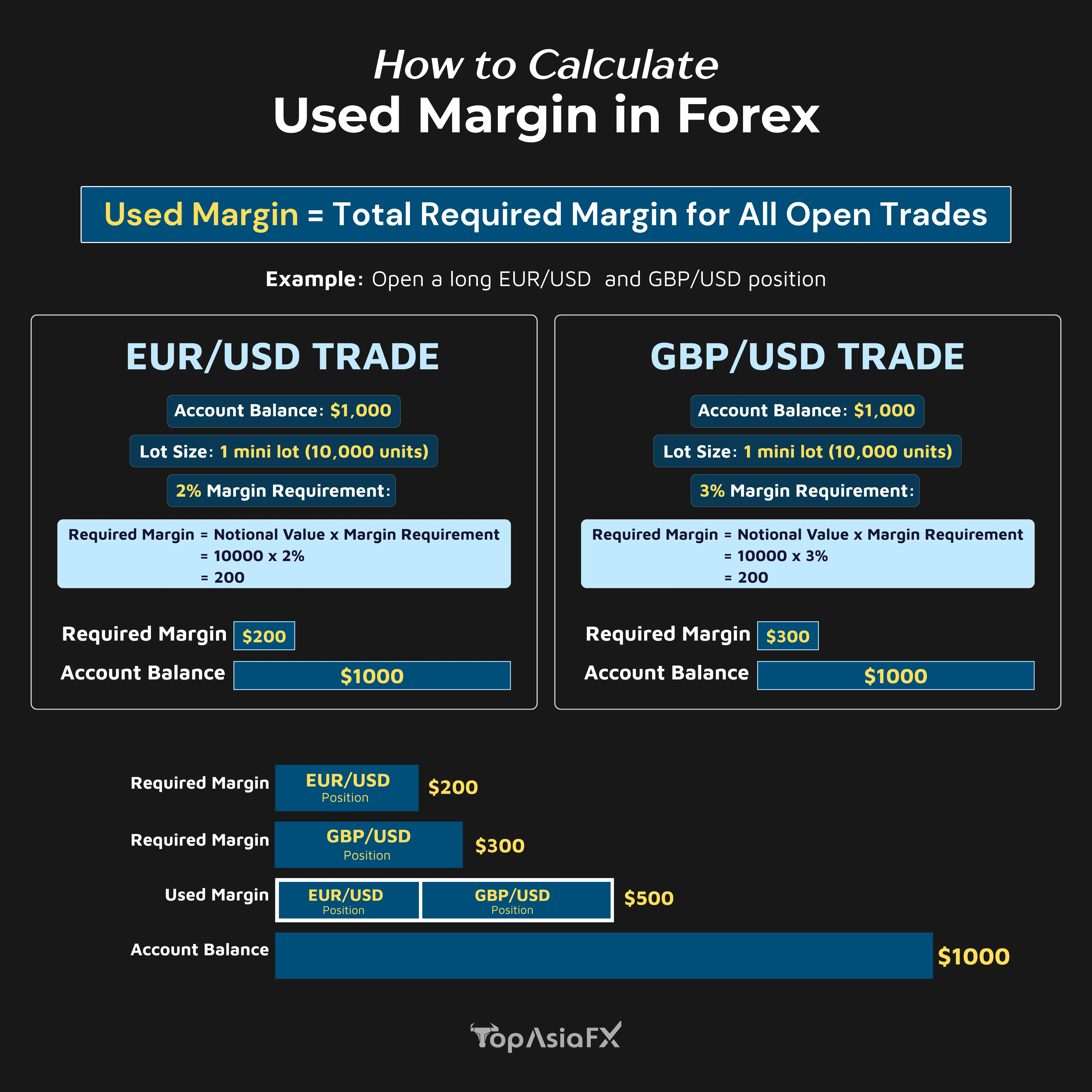
Here’s a quick example -
Let’s say Tom opens a 1 lot (100,000 units) trade on EUR/USD and his broker requires a 2% margin requirement for this trade.
The notional value of this trade is $100,000 and the required margin = 2% of $100,000 = $2,000.
If he has three open trades with the same margin requirement, the total used margin = $6,000.
Also, consider these other examples of how to calculate the used margin within another context.
Imagine Greg has $1,000 in his forex trading account, and his broker offers a leverage of 1:50. This means he can control positions up to $50,000 (because $1,000 × 50 = $50,000).
He decides to open a trade on EUR/USD with a position size of $10,000. His broker requires a margin of 2% for this trade.
The required margin for this trade is 2% of $10,000 = $200. This $200 is taken from his account and set aside as “used margin.”
If Greg decides to open another $10,000 trade, his used margin will increase by $200. His total used margin becomes $400.
Any remaining balance in his account is his free margin.
So if he has:
- $1,000 account balance
- $400 used margin
Free margin = $600
If the market condition moves against him and his trades gain losses, his free margin will decrease.
If your free margin drops too low, your broker may issue a margin call, which will ask you to deposit more funds or close some open trades.
Used Margin vs. Free Margin
Used margin is the portion of a trader’s account balance that their broker uses to keep their open trades active. Meanwhile, free margin is the portion of their account balance not tied to open trades, ie., it is free for use.
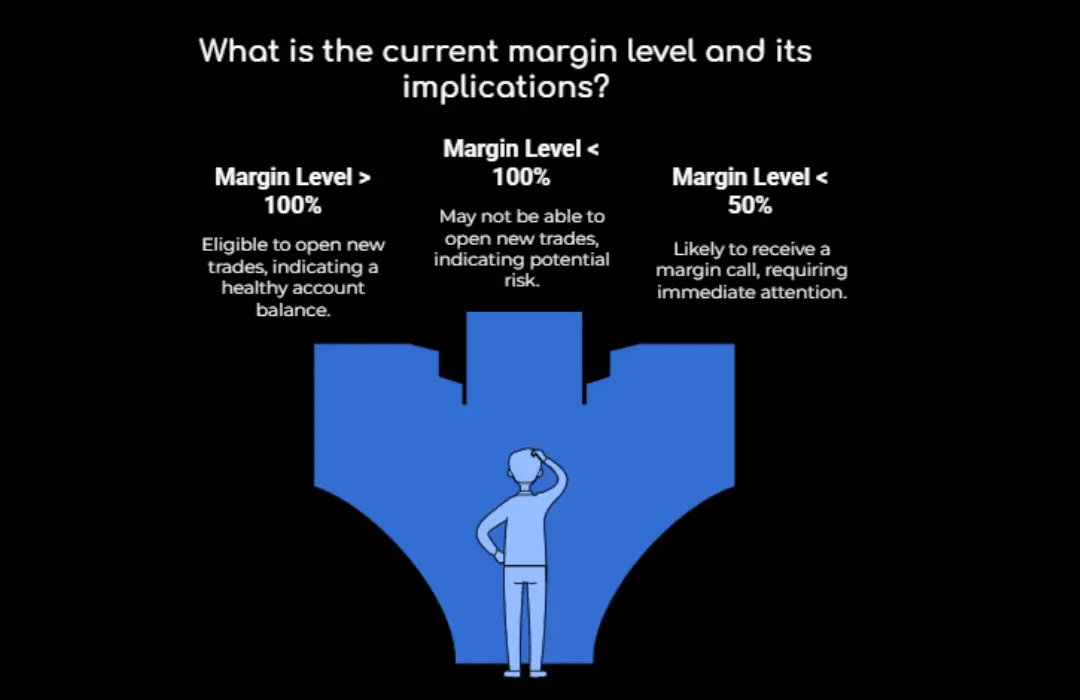
Also, margin level is correlated with used margin and free margin. Margin level is the ratio of a trader’s account’s equity to their used margin. It determines the amount of risk their account can handle.
Calculate margin level using this formula:
(Equity/Used margin) x 100%
In this case, if margin level is greater than 100%, you are eligible to open new trades. If it is less than 100%, you may not be able to open new trades.
Depending on the broker, traders may receive a margin call if it is less than 50%.
It is crucial to understand these concepts in order to navigate forex trading and manage risk effectively. So, here’s a table to help identify the differences quickly.
| Feature | Used Margin | Free Margin |
|---|---|---|
| Definition | The portion of a trader’s account balance required for open trades. | The portion of a trader’s account balance that is not currently being used in open trades. |
| Use Case | Used to maintain active trades. | Used to maintain margin level and open new trades. |
| Margin Call | Can result in a margin call if the used margin exceeds the predefined margin level. | You can receive a margin call if the free margin reaches the margin level. |
| Forced Liquidation | Using so much margin and depleting it until it drops below the margin level may cause the broker to automatically liquidate your assets. | When free margin reduces significantly to the point of the margin level, the broker will issue a margin call. This call signals the trader to either deposit more into their account or close some of their trades. If they do neither, they risk forced liquidation. |
Why is Used Margin So Important?
Used margin is vital in Forex trading because:
It Prevents Over-Leveraging
Any trader using high leverage for their trades is unknowingly putting themselves at risk for margin calls and liquidation.
Used margin acts as a safety net. It ensures traders do not open more positions than their account’s capability.
It Affects Margin Calls and Liquidation
When equity drops below used margin, the broker will send a margin call. This will signal the traders to either add more funds to their account or close some open trades.
If they fail to do either, the broker will liquidate their positions to cover losses.
It Determines Trading Flexibility
The higher the used margin is, the smaller the free margin that is available for open trades is. If free margin is low, traders are unable to make the best of new trading opportunities.
How to Effectively Manage Used Margin?
Here are some treated and trusted tips to help manage used margin effectively:
Monitor Margin Level
Always keep track of margin level in order to avoid getting margin calls from your broker or forced liquidations.
Always track margin level to avoid margin calls or forced liquidation. If used margin approaches broker-set limits (e.g., 40%), action is required.
Manage Risk Efficiently
You will be at high risk with a higher leverage ratio for trading. Instead, consider lower leverages to help maximize risk propensity.
Another way to manage risks is to not use too much of the capital in one trade. My rule of thumb is to stick to 1% or 2% of your capital per trade. This way, you don’t lose too much in case the market moves negatively.
Adjust the Sizes of Positions
Trade smaller positions, rather than big ones. By doing this, you won’t use up too much margin.
Set Stop-Loss Orders
Use stop-loss orders to protect yourself from unexpected market fluctuations that can wipe out equity.
Diversify Trades
Don’t focus on one spot only—don’t risk too much capital on a single position or currency pair.
What is a Margin Call and How to Avoid it?
A margin call is a warning signal that occurs when a trader’s margin level falls below the level their broker set. When traders get a margin call, it essentially signals that they do not have enough equity to support any open positions.
How to Avoid Getting a Margin Call
I have a three-strategy approach for doing so.
- Use stop-loss orders to limit any potential losses.
- Always monitor free margin. This way, you stay aware of available funds for new trades.
- Use a reasonable amount of leverage when trading. While this is subjective, I recommend using lower leverage because it helps manage risk.
Another related concept to understand thoroughly is the stop-out level.
What is a Stop-Out Level?
A stop-out level is a predefined point where a broker will begin closing open trades to prevent further losses.
For instance, if a trader’s margin level drops to a critical point, maybe 15%, their broker will automatically liquidate their assets.
How to Prevent Stop-Outs?
- Don’t risk all your free margin in a single trade.
- Check your account balance and equity regularly.
- Use hedging strategies to protect all open trades.
What Are the Best Hedging Strategies in This Regard?
- Direct hedging
- Cross hedging
- Currency options hedging
- Hedging with CFDs
- Pairing with commodities or indices
- Using correlated financial instruments
How Does Leverage Affect Used Margin?
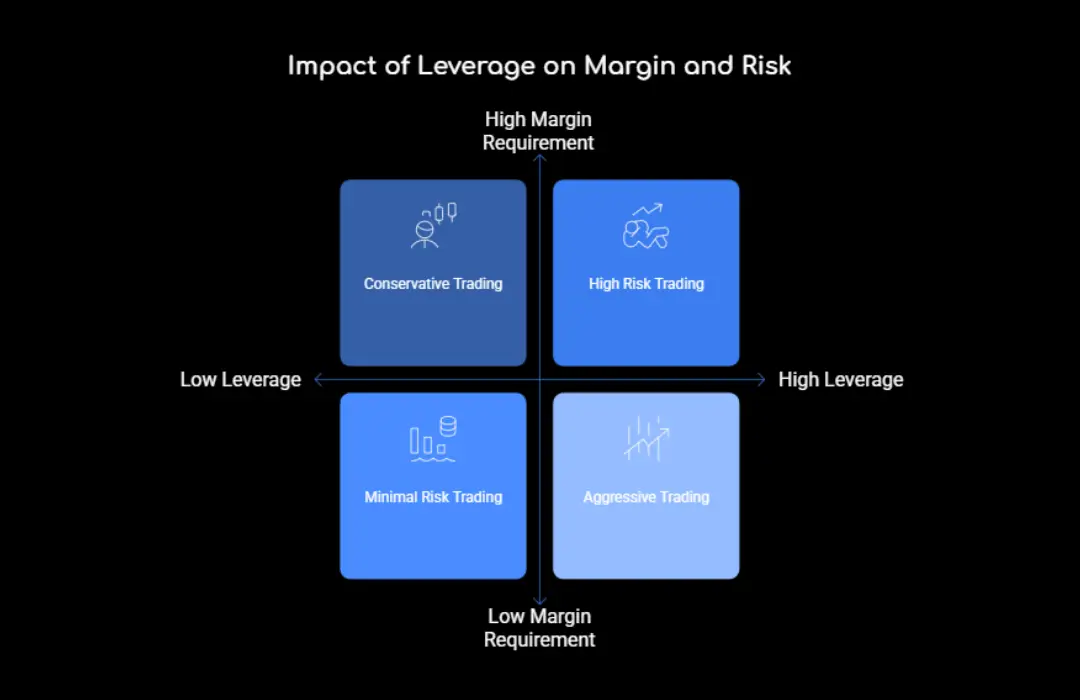
Leverage allows the control of large positions with a small deposit but it directly affects used margin.
Take a look at leverage ratios and their respective margin requirements:
| Leverage | Margin Requirement |
|---|---|
| 1:1 | 100% |
| 1:10 | 10% |
| 1:50 | 2% |
| 1:100 | 1% |
| 1:500 | 0.2% |
What this table shows is that the higher the leverage, the lower the margin requirement. This means that traders can control bigger positions with less capital.
In the same breath, higher leverage also increases risk, which also means forex traders are more likely to get a margin call and experience liquidation.
Some Common Mistakes Forex Traders Make with Used Margin
Overtrading
Opening too many positions at once can use up too much margin, which increases risk and reduces the ability to open more potentially valuable positions.
Ignoring Free Margin
Not keeping an eye on available margins can cause unexpected margin calls and stop-outs.
Misusing High Leverage
I generally do not recommend using a high leverage for trades, however, it is more risky to do so as a beginner. If you are a beginner forex trader avoid using extreme leverage ratios, such as 1:500.
Not Having a Risk Management Plan
Prepare for risks as a trader. This means setting stop-losses and managing position sizes. This is the best way to avoid rapidly depleting account equity.
How Do Margin Requirements Differ Between Futures, Stocks, and Forex in Day Trading?
Margin requirements vary across futures, stocks, and forex markets. Here are the distinct features of each:
Futures
- Initial Margin: To open a futures position, traders must deposit an initial margin that ranges from 3% to 12% of the contract’s notional value. This margin is more or less a performance bond. This ensures that both parties can fulfill their contract-based obligations.
- Maintenance Margin: Once the position is open, they must maintain a minimum account balance which is the maintenance margin.
If their account’s equity falls below this level because of adverse market conditions, their broker will issue a margin call, which requires them to take action to restore their account to the original margin level.
Stocks
- Regulation: The U.S. Federal Reserve's Regulation T allows forex traders to borrow up to 50% of the purchase price of their securities, which effectively provides them a 2:1 leverage.
- Pattern Day Trader Rule: If you’re executing four or more day trades within 5 business days, you are a pattern day trader. As a pattern day trader, you are expected to maintain a minimum of $25,000 in equity in your margin account. This allows for up to 4:1 intraday leverage, which enables you to control positions that are up to four times their account equity during the trading day.
Forex
- Leverage: Forex typically offers higher leverage compared to futures and stocks, sometimes up to 50:1 or higher depending on regulations and broker policies (learn more about leverage).
- Margin Requirements: Forex margin requirement is a percentage of the trade size. For instance, a 2% margin requirement equates to 50:1 leverage, which means that the trader in this scenario must deposit 2% of the total value as margin.
Key Differences
- Leverage Availability: Forex markets generally offer the highest leverage, followed by futures, with stocks offering the least.
- Regulatory Requirements: As a stock trader in the U.S., face specific regulatory requirements. For instance, the pattern day trader rule makes higher minimum equity levels mandatory.
- Margin Calls: In futures trading, positions are marked to market daily, which means that traders must adhere to margin calls to maintain open positions. In comparison, stock margin accounts likely offer more flexibility, but if the trader fails to meet the margin class, they may lose their open positions to liquidation.
Final Thoughts
Used margin plays a key role in forex trading. It ensures traders maintain enough funds to cover active positions.
If you’re new to trading, always start with a demo account before committing real money to trade. This way, you can get familiar with how used margin affects trades without the risk of losses.
F. Nathan
Felix Nathan is a professional trader, market analyst, and business development executive with over a decade of experience in the forex and financial markets. Felix specializes in providing actionable market insights, trading strategies, and risk man...