 IUX
IUX
 Exness
 Vantage
 XM
XM
 ICMarkets
 LiteFinance
 Moneta
 Tickmill
 South Africa (9)
 India (9)
 Bangladesh (12)
 Germany (9)
 Thailand (10)
 Philippines (9)
 Nigeria (10)
 Vietnam (10)
 Malaysia (9)





How Do You Get Started with a Forex Scalping Strategy?



Share:
Share:
Strategy
8 min read

Scalping means opening and closing trades within minutes, sometimes seconds, to grab small price movements over and over.
First, pick a broker with tight spreads and fast execution because even a 1-pip difference matters when your target is 5 to 10 pips per trade. Pairs like EUR/USD, GBP/USD, and USD/JPY work best since they're the most liquid.
Use the 1-minute or 5-minute chart and keep your indicators simple. Most scalpers rely on moving averages, Bollinger Bands, or RSI to spot quick entries. Risk management is everything here. Never risk more than 1% of your account per trade and always set a stop-loss.
You'll need to be glued to your screen during high-volume sessions like London or New York overlap. Scalping isn't for everyone. It's mentally draining and requires fast decision-making.
Forex Scalping Explained
Forex scalping is a high-speed trading strategy where traders try to profit from tiny price movements in the market, which is usually just a few pips at a time.
Instead of holding positions for hours or days like swing or position traders, scalpers prefer to jump in and out of trades within seconds or minutes.
The key idea behind scalping is to accumulate small wins throughout the day.
A scalper may place dozens or even hundreds of trades daily, within very short timeframes like the 1-minute (M1) or 5-minute (M5) chart. Because of this fast pace, scalping requires you to have quick decision-making, technical precision, and emotional control skills.
With IUX Broker’s fast execution and reliable platform, scalpers gain the speed and stability needed to maximize every move.
Unlike long-term strategies that ride large market trends, scalpers focus on micro-trends, which capitalize on short bursts of price momentum, often during high-liquidity sessions like the London or New York open.
Before building your scalping plan, don’t miss a single step or the setup will slip away. Lock in every move with this scalping cheat sheet that maps the exact filters, timing, pairs, and tools you need to trade with precision.
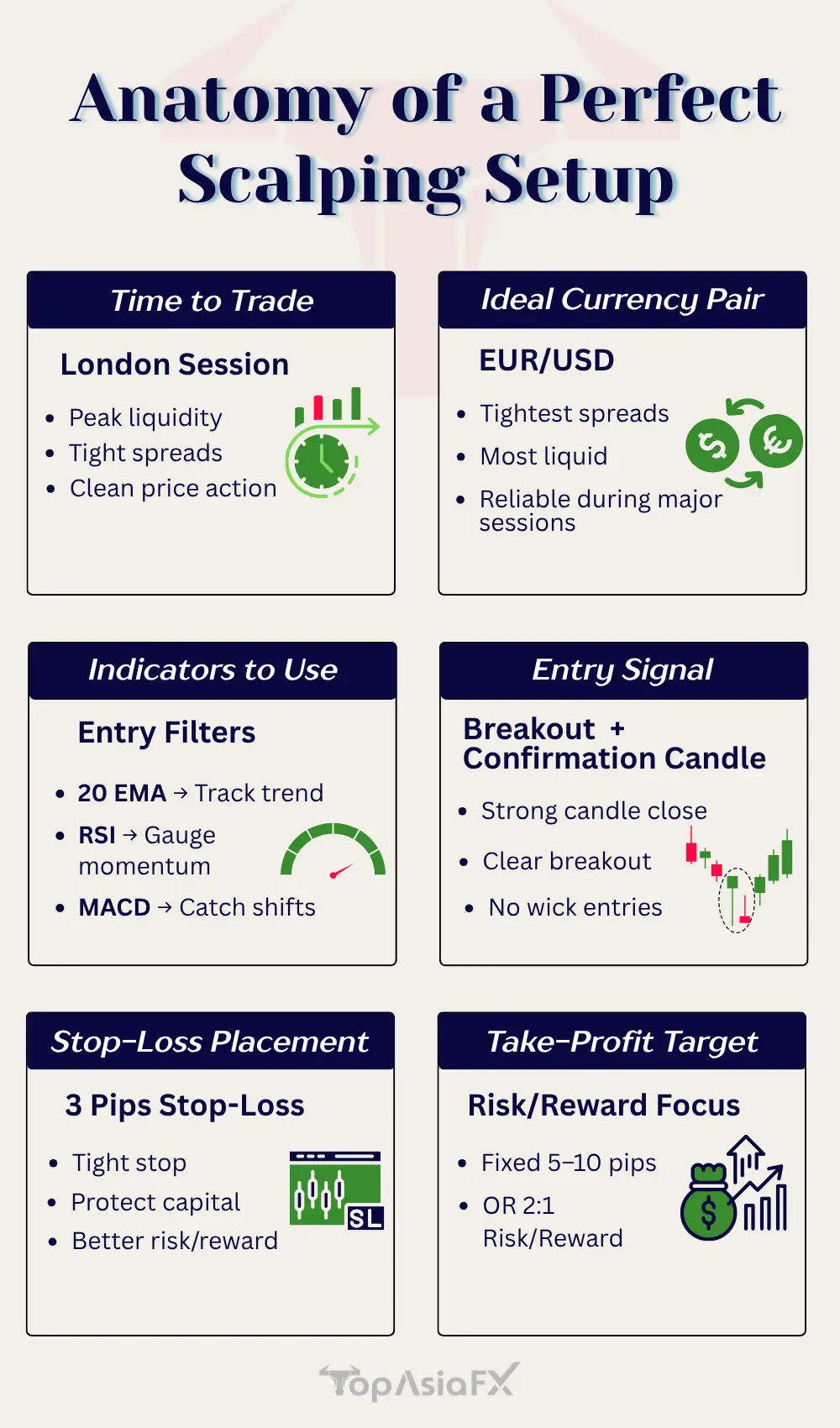
Now that you’ve seen the core structure of a high-quality scalping setup, let’s walk through how to start building your own strategy—step by step.
Features of Forex Scalping
Here are the four horsemen of scalping trading in forex:
- Scalping favors speed over duration. Trades last seconds to minutes; they are usually never overnight.
- There’s a tight focus. Scalpers monitor charts intensely for short-term opportunities.
- Small gains, many times. The goal is to stack up tiny profits that add up.
- Scalping is heavily reliant on technical analysis and tools like moving averages, RSI, MACD, and order flow data.
How to Get Started With a Forex Scalping Strategy?
Right Broker Makes All the Difference
Your broker can make or break your scalping strategy. Since you’ll be placing numerous trades in a short time, the smallest delay in execution or a slight increase in spread can eat into your profits, or worse, turn your profits into losses.
Here’s what to look for:
- Tight Spreads: Scalpers typically look for profits of just a few pips, so you need a broker who is ready to give you ultra-low spreads, especially on major currency pairs like EUR/USD or USD/JPY.
- Fast Order Execution: Delays or slippage during trade execution can ruin your scalping setup. The way out is to look for brokers with high-speed infrastructure and ECN (Electronic Communication Network) or STP (Straight Through Processing) execution models.
- Low Commission Fees: If you’re placing 20+ trades a day, the fees can quickly pile up. Find brokers that offer competitive commission structures, or even zero-commission accounts that have tight spreads.
- Strong Regulation: Make sure the broker is regulated by trusted financial authorities such as the FCA (UK), ASIC (Australia), NFA or CFTC (USA), CySEC (Europe). These bodies ensure the broker operates transparently, securely, and fairly.
- Platform Stability: Whether you’re trading on MetaTrader 4 (MT4), MetaTrader 5 (MT5), or a proprietary platform, it should run smoothly with real-time data, customizable charts, and one-click trading features.
Gear Up With the Right Tools
You’ll need a platform that’s built for speed, like MT4, cTrader, or NinjaTrader.
The platforms must have real-time charting, fast execution speeds, customizable indicators, and reliable mobile access (if you like trading on the go).
Don’t forget a solid internet connection and a quiet space. Scalping demands your full attention.
Choose a Strategy That Clicks; Do What Feels Right
Pick the right scalping strategy if you want to stay consistent and profitable with your trades. While there are many approaches, here are three popular methods that suit different trading styles and risk tolerances:
1-Minute Scalping Strategy
This ultra-short timeframe strategy is perfect for traders who thrive in fast-paced environments. You’ll focus on very quick trades, which sometimes last from seconds to a minute, to capture tiny price moves.
Tools like the Relative Strength Index (RSI) or Bollinger Bands are often used to spot when a currency pair is overbought or oversold, signaling a possible reversal or pullback.
Because price action can be noisy on this timeframe, it’s crucial to have tight stop-losses and precise entry points. The 1-minute scalping style requires intense focus and lightning-fast decision-making.
5-Minute Scalping Strategy
If the 1-minute charts feel too frantic for you, the 5-minute scalping strategy will provide a bit more breathing room while still targeting short-term price moves.
This timeframe helps you identify clearer trends and reduces some of the “market noise” present on faster charts.
You can combine trend indicators like Moving Averages with momentum tools such as the MACD or Stochastic Oscillator to confirm your entries and exits. This strategy suits traders who want fast trades but prefer slightly more time to analyze market direction.
Indicator-Based Scalping
This method revolves around using a combination of technical indicators to find the best moments to enter and exit trades. Popular indicators for scalping include:
- Moving Averages: These help identify the direction of the trend and dynamic support or resistance levels.
- Momentum Indicators (RSI, MACD): Momentum indicators show the strength or weakness of price moves and potential reversals.
- Support and Resistance Levels: These levels are critical price points where the market tends to react, which makes them prime areas for quick scalping trades.
By layering these tools together, you can build a system that reduces guesswork and increases the probability of success. You can customize indicator-based scalping to fit your risk tolerance and trading style.
Go Where the Action Is
Scalping works best with major currency pairs like EUR/USD, GBP/USD, and USD/JPY.
These pairs are highly liquid and have low spreads, which helps with the frequent trading.
Protect Your Profits
Scalping without a solid risk management plan is like skydiving without a parachute; it is risky, unpredictable, and can lead to serious losses.
Always Use Stop-Loss Orders
Never enter a trade without a stop-loss in place. Because scalping targets small price movements, even minor market swings can quickly turn against you.
A stop-loss automatically closes your trade at a preset level, limiting potential losses. Tight stop-losses just a few pips away are common in scalping to protect your account from sudden moves.
Only Risk It if You Can Afford to Lose It
Good scalpers risk only a tiny portion of their trading capital on each trade, usually 1% or less. This means if your account is $1,000, you should never risk more than $10 on any single trade. By keeping your risk small, you reduce the chance of a single loss damaging your overall portfolio.
Define Clear Profit Targets
Set realistic and consistent profit goals for each trade, typically around 5 to 10 pips. This will help you lock in gains regularly without chasing unrealistic returns. Consistency over many small wins is what makes scalping profitable in the long run.
Limit the Number of Trades You Make per Day
Scalping can be mentally and emotionally exhausting, especially when you are trading dozens of times daily. Set a maximum number of trades you’ll take each day to avoid burnout, poor decision-making, and overtrading. Quality matters more than quantity.
Test the Waters With a Demo Account First
Before going live, test your strategy with a demo account. This helps you build confidence, refine your timing, and develop discipline, without risking real money.
Most brokers offer free demo accounts that simulate real-time market conditions.
Create a Daily Trading Routine
Discipline is everything in scalping.
Build a trading routine that includes pre-market analysis, news checks (high-impact news can spike volatility), and defined trading hours (usually during major sessions like London or New York).
Forex Scalping Can Be Incredibly Rewarding
But only if you’re wired for it. It suits traders who:
- Thrive under pressure
- Can think fast and act faster
- Have time to monitor markets closely
- Stick to a disciplined plan
If that sounds like you, scalping might be your ticket to daily profits in the forex market. Just remember that quick wins require even quicker decisions, and every pip counts.
F. Nathan
Felix Nathan is a professional trader, market analyst, and business development executive with over a decade of experience in the forex and financial markets. Felix specializes in providing actionable market insights, trading strategies, and risk man...