 IUX
IUX
 Exness
 Vantage
 XM
XM
 ICMarkets
 LiteFinance
 Moneta
 Tickmill
 South Africa (9)
 India (9)
 Bangladesh (12)
 Germany (9)
 Thailand (10)
 Philippines (9)
 Nigeria (10)
 Vietnam (10)
 Malaysia (9)





Key Players in the Forex Market

Share:
Share:
Education
6 min read

With over $7.5 trillion being traded daily, Forex is the largest, most liquid financial market that currently exists.
Learn more about size and liquidity of the Forex market.
Forex does not have a centralized market like stock markets, meaning Forex is traded over the counter (OTC). It also has no physical location and trades occur worldwide across various time zones.
It also has no physical location and trades occur worldwide across various time zones.
But who are the key players behind the vast market?
From the biggest finance institutions down to individual traders, we’ll take a look at the top players in the forex market, their roles, and how they shape currency movements.
Who Are the Top Players in the Foreign Exchange Market?
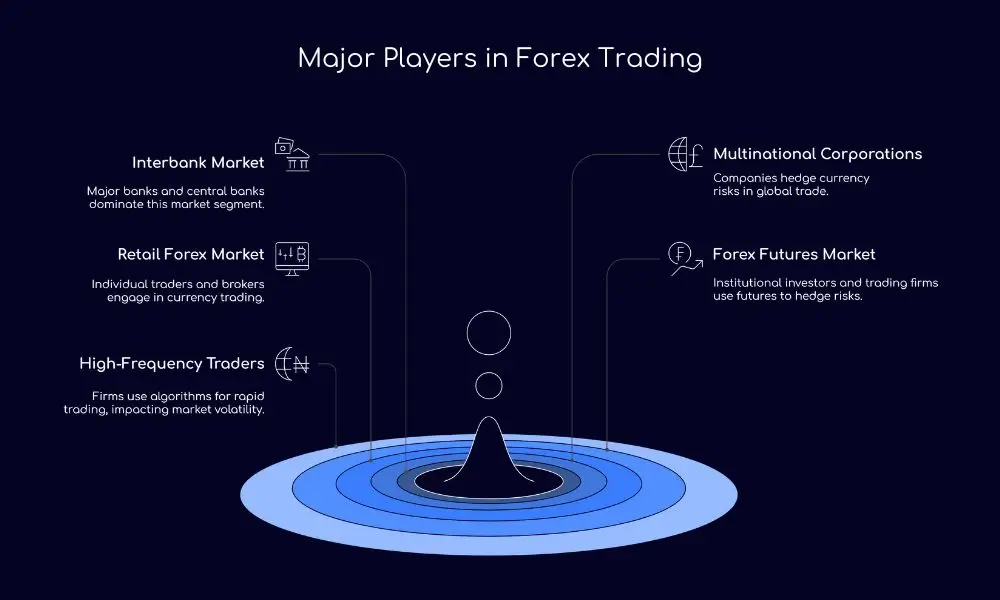
Here are the key players in the Forex market, in order of hierarchy:
The Interbank Market (The Big Dogs, Literally)
The Interbank market is where the world's largest financial institutions are at its heart, and they trade currencies between themselves.
Learn understanding the Forex market structure.
These institutions bring liquidity to the market to ensure smooth transactions.
They include:
Major Commercial and Investment Banks
These banks conduct vast Forex transactions on behalf of clients and for their proprietary trading desks.
They are also known as market makers, as they quote bid and ask prices for different currency pairs.
Learn what is a spread in Forex trading.
Some of the largest banks in Forex trading include Deutsche Bank, UBS, Citigroup, JPMorgan Chase, Goldman Sachs, HSBC, Bank of America, and Barclays.
Central Banks
Central banks exert a vital influence on Forex markets by controlling monetary policy and interest rates.
Their actions can result in major fluctuations in currency values, with some of the more influential central banks being the Federal Reserve (USA), the ECB, the Bank of England (BoE), the Bank of Japan, the People's Bank of China, and the Swiss National Bank.
Central banks usually intervene in Forex markets to create a more stable currency or achieve economic objectives.
For instance, the Bank of Japan routinely executes interventions to guide the currency lower, which makes Japanese exports more competitive.
Learn trading Forex during the Tokyo session.
Hedge Funds and Investment Funds
Hedge funds and large asset managers participate in Forex trading to profit from currency movements.
The biggest hedge funds involved in Forex include Bridgewater Associates, Renaissance Technologies, Citadel, and Soros Fund Management.
Hedge funds often practice algo trading-using high-frequency trading strategies that aim to get them a slight edge in the market.
Multinational Corporations (MNCs)
To lessen the currency risk that concerns international trade, large corporations regularly operate in the Forex market. Some of such corporations include Apple, Toyota, and Samsung,
They use actual currencies to narrow exchange rate fluctuations and turn their revenues into profit.
For instance, if Apple sees some strength in the U.S. Dollar against the Euro, it may enter into a Forex forward contract to hedge its European revenues against the possibility of a loss.
The Retail Forex Market (You and I)
Due to online platforms and brokers which enable individual participation, the retail Forex market has grown significantly.
Although retail traders still make up a small percentage of the total Forex trading volume, their impact has been increasing steadily.
Take a look at the key players within the retail Forex market:
Retail Forex Brokers
Retail traders buy and sell in the Forex markets through online intermediary brokers. These brokers help provide traders with liquidity and execution of trade.
Learn mastering Forex trading with demo accounts.
Some examples of big Forex brokers by traded volumes include:
It is normal for retail brokers to operate under two models:
Market Makers, who set their prices and take the opposite side of trades.
ECN/STP Brokers, who connect traders directly to liquidity providers for transparent pricing.
Retail Traders
Retail traders on the other hand, from beginners to professionals, participate in Forex for speculation, hedging, or investment.
Learn "Can Forex Trading Lead to Wealth?".
Among them (us), the most famous retail Forex traders include:
- George Soros, who famously "broke" the Bank of England in 1992 after shorting the British pound to the tune of more than $1 billion.
- Bill Lipschutz, who turned a $12,000 investment into hundreds of millions in Forex trading.
- Stanley Druckenmiller, who worked with Soros and made major profits in currency speculation.
Retail traders usually operate using trading platforms such as MetaTrader 4 (MT4), MetaTrader 5 (MT5), and cTrader for analysis and execution.
Forex Futures Market Traders
Most forex trading happens in an over-the-counter spot market. Learn Forex vs. Futures.
However, futures contracts on currencies trade on regulated exchanges, such as the Chicago Mercantile Exchange (CME).
Forex futures allow traders to speculate on currency prices, with a standardized contract size and expiration date.
Some key parties involved in Forex futures:
- Institutional investors, who are basically non-commercial traders who trade futures to hedge currencies.
- Proprietary trading firms that use algorithms to speculate on currency prices.
- Retail traders, speculating on currency futures through brokers giving access to the CME.
High-Frequency Traders and Algorithmic Traders
High-frequency trading (HFT) firms and algorithmic traders are now native participants in Forex markets because of how far technology has come.
Learn trading Forex during the London session.
These traders use machine learning to develop strategies to enter and exit thousands of trades within milliseconds.
Which means they realize profits from extremely small price movements.
Some notable high-frequency traders you may see in Forex are:
- Jump Trading
- XTX Markets
- Virtu Financial
- DRW Trading
High-frequency trading contributes liquidity to the market, and it has been so since time immemorial.
Some flash crashes have been caused by HFTs, like the flash crash of the USD/JPY in 2010, where the yen suddenly spiked for a brief period of minutes.
Learn understanding unrealized P/L and floating P/L.
Conclusion
The Forex market is a very dynamic and complex ecosystem, which is driven by various players with entirely different motivations.
Banks and market makers provide liquidity.
Central banks generally regulate monetary policy.
Hedge funds and big investment firms usually speculate to make vulnerable profits. Corporations hedge against currency risks.
Retail traders participate via online brokers.
Algorithmic traders and high-frequency trading firms make sure that market efficiency and liquidity occur at all times.
Whether you're a beginning or advanced trader, it is important to get the hang of these market players, which can help with your Forex trading strategy.
My suggestion is to keep an eye on what these major players are doing if you want to stay ahead in Forex.
F. Nathan
Felix Nathan is a professional trader, market analyst, and business development executive with over a decade of experience in the forex and financial markets. Felix specializes in providing actionable market insights, trading strategies, and risk man...