 IUX
IUX
 Exness
 Vantage
 XM
XM
 ICMarkets
 LiteFinance
 Moneta
 Tickmill
 South Africa (9)
 India (9)
 Bangladesh (12)
 Germany (9)
 Thailand (10)
 Philippines (9)
 Nigeria (10)
 Vietnam (10)
 Malaysia (9)





What is Unrealized P/L and Floating P/L?



Share:
Share:
Education
9 min read

What is Floating P/L in Forex Trading? And why does it matter? How can one calculate Floating P/L?
These are some of the questions I’ll answer in this read. But first, let me paint a scenario to set the tone.
Imagine Alex, a beginner in forex trading, just opening a trade. He bought EUR/USD at $1.1000, expecting it to rise. A few hours later, the price moved to $1.1050.
Excited, Alex checks his trading platform and sees a profit of $50, but he hasn't closed the trade yet. The next morning, the price drops back to $1.1990, and his profit turns into a loss of $10.
This constant fluctuation in potential profit and loss is called Floating P/L or Unrealized P/L.
As a trader or potential trader, it is a must to understand these key concepts because they will directly impact decision-making, risk management, and overall trading success.
What is Floating P/L in Forex Trading?
Floating P/L are the unrealized gains or losses from open trades.
Since the Forex market is constantly moving, the value of any open trades will fluctuate in real-time. These fluctuations affect equity but not account balance until the trader closes the trade.
In simple, summarizable terms, floating P/L is:
- Floating profit occurs when an open trade is gaining profit, based on the market conditions.
- While floating loss happens when an open trade is currently at a loss.
How to Calculate Floating P/L in Forex Trading?
Use the following formula when to calculate the floating P/L on a trading account:
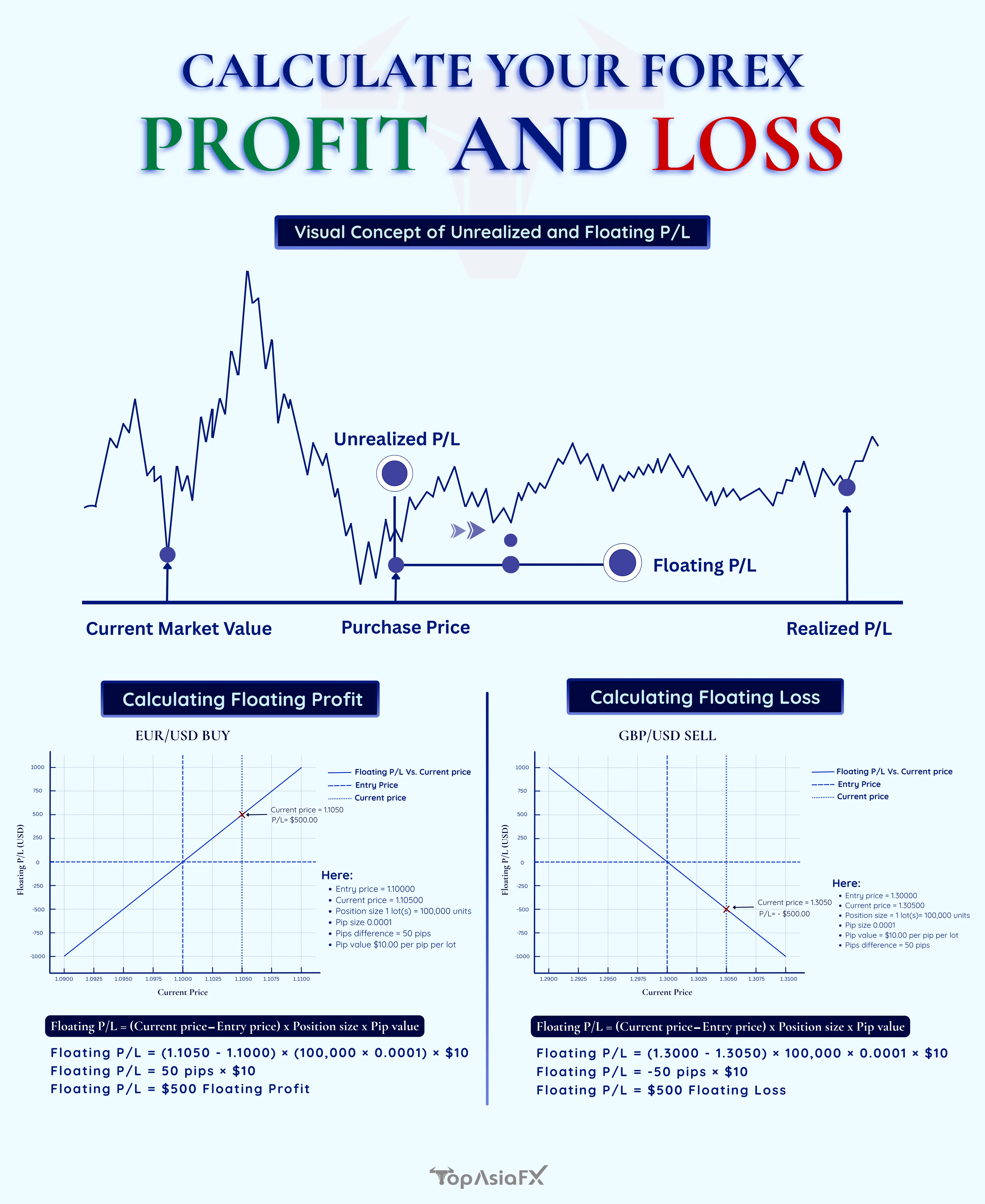
Floating P/L Formula
Floating P/L = (Current price - Entry price) x Position size x Pip value
See how this formula works in real-time.
Example 1: Calculating Floating Profit
- Trade: Buy 1 lot of EUR/USD at 1.1000
- Current Price: 1.1050
- Pip Value: $10 per pip (for 1 lot)
Floating P/L = (1.1050 - 1.1000) × 100,000 × 0.0001 × $10
Floating P/L = 50 pips × $10 = $500 Floating Profit
Example 2: Calculating Floating Loss
- Trade: Sell 1 lot of GBP/USD at 1.3000
- Current Price: 1.3050
- Pip Value: $10 per pip (for 1 lot)
Floating P/L = (1.3000 - 1.3050) × 100,000 × 0.0001 × $10
Floating P/L = -50 pips × $10 = $500 Floating Loss
Unrealized P/L vs. Realized P/L
Unrealized P/L and Realized P/L are two sides of the same coin.
On one hand, Unrealized P/L is the potential profit or loss from currently open trades. Another term for unrealized P/L is Floating P/L.
Unrealized P/L reflects in the equity but not the account balance (since you still have open trades).This concept is essential for traders working with a prop firm, where managing open positions carefully can impact their funded account performance.
On the other hand, is the final profit or loss a trader gets from a trade when they close it. Realized P/L reflects in their account balance and equity.
Consider this example.
Alex buys 1 lot of EUR/USD at 1.1000.
The price rises to 1.1050 → Floating Profit: $500.
He closes the trade → $500 becomes his Realized Profit.
If he does not close the trade and the price drops to 1.0980, his Floating P/L changes to a $200 loss.
If he closes at this point, $200 becomes a Realized Loss.
How Floating P/L Affects Trading Outcomes?
When trading, remember that many factors can influence trading performance, and floating P/L is one of them.
Discover how Unrealized P/L can affect trading efforts:
Impact on Margin
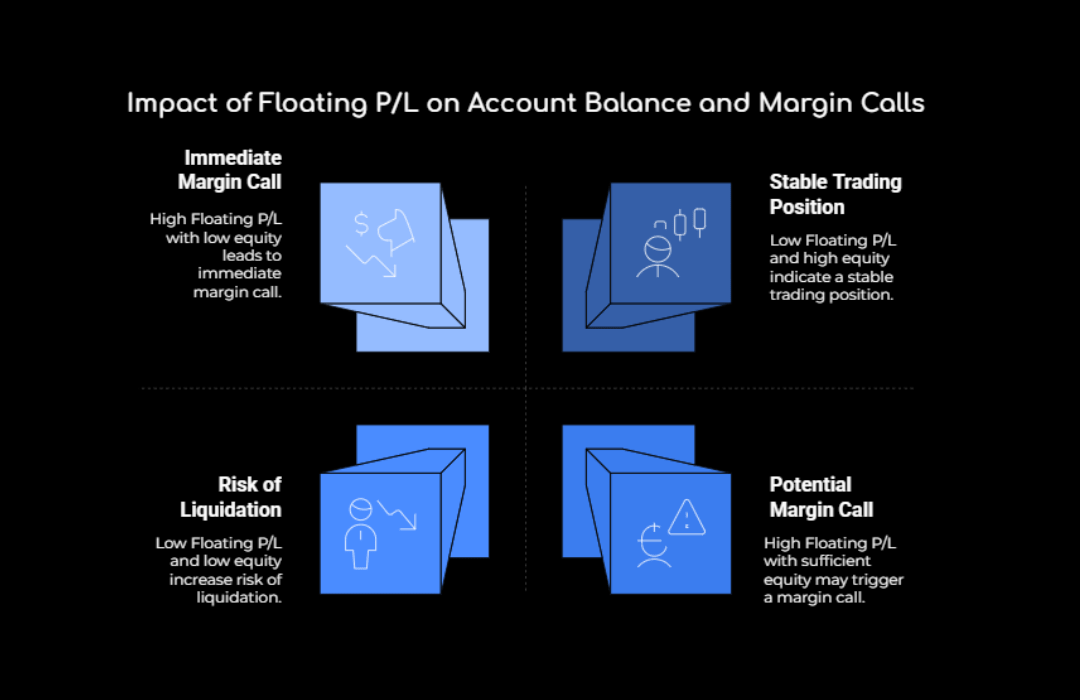
If any trades are experiencing a huge floating loss, it can affect your margin level and lead to a margin call.
Emotional Influence
For many traders, seeing a large floating loss can cause them to panic-sell and huge floating profits may move them to hold that trade greedily.
Irrespective of how the market conditions move, you should be able to make rational and calculated decisions regarding your Floating P/L.
Account Balance and Equity
Floating P/L affects equity, which refers to the total value of a trading account (account balance + unrealized profits or losses).
However, Floating P/L doesn’t affect a trader’s account balance until they close the trade.
Market Volatility
Floating P/L can fluctuate rapidly during periods of high-impact news events, which can reduce a trader’s ability to tolerate risk.
Can Floating P/L Significantly Impact My Account Balance?
Yes, Floating P/L can impact account balance when the trade closes.
Floating P/L can also affect equity, which determines when the broker will initiate a margin call.
A margin call is a warning signal that a broker issues when a trader’s margin has reached the threshold they set.
If equity falls below the broker’s required margin, they will likely close the investor’s open trades to prevent further losses.
Is Leverage Important in Floating P/L?
Leverage amplifies potential profits and losses in Forex trading. In fact, trading with higher leverage means that even small market movements can cause significant Floating P/L swings.
This is why every trader should be aware of the following risks as a trader:&
- Overleveraging or high leverage can lead to a margin call if floating losses are more than the available margin.
- Low leverage will give more stability and reduce the impact that floating losses would have otherwise had.
- If you do not adjust leverage based on the market conditions, you will have a hard time managing Floating P/L effectively.
Best Strategies to Manage Floating P/L in Forex
How can to manage Floating P/L and not cause a strain on equity and account balance?
Here’s how:
Use Stop-Loss and Take-Profit Orders
What will these two do?
Well, depending on the situation, a stop loss will help limit potential losses while a take-profit will help secure profits before the market reverses.
Manage Risk Appropriately
My favorite risk-management advice is to never risk more than 1 or 2% of your account balance per trade.
Hedge Trades
When the market condition is going against your trade, open an opposite position in a correlated pair to minimize losses.
Monitor Floating P/L Regularly
I know that checking Floating P/L too often may cause some stress, but checking it daily will help stay aware of risks.
Trade Multiple Currency Pairs
Don’t risk all in a single trade. Instead, diversify your trades across multiple promising currency pairs.
Adjust Trade Sizes Based on Market Movements
Reduce trade sizes during volatile periods. Doing this will help minimize any potential floating losses.
How Often Should You Check Floating P/L?
Depending on the kind of trading you do, here’s how often you should check floating profit or loss.
- Scalpers: Every few minutes
- Day Traders: Multiple times a day
- Swing Traders: Once or twice daily
- Position Traders: Weekly
Common Mistakes Traders Make with Floating P/L
Check out some of the most common mistakes you may have likely made with Floating P/L and why you shouldn’t make them:
Holding Losing Trades for Too Long
Do not hold losing trades for too long. I understand doing this in hopes that it will recover, but the more you hold it, the more risk of loss.
Ignoring Stop-Loss Orders
Without setting stop-loss levels, you can expose your trade to unexpected market changes that can cost you.
Overleveraging
You’d quickly wipe out your account if using high leverage without considering Floating P/L fluctuations.
I suggest using lower leverage, as it reduces the likelihood of experiencing floating losses.
Trading with Emotions
The chances of making poor trading decisions when you trade with emotions are higher. What I like to do is to think rationally while I’m trading.
It helps to eliminate any emotion-ridden decisions that may be bad for my trading strategy.
The Psychology of Floating P/L: Overcoming Emotional Bias
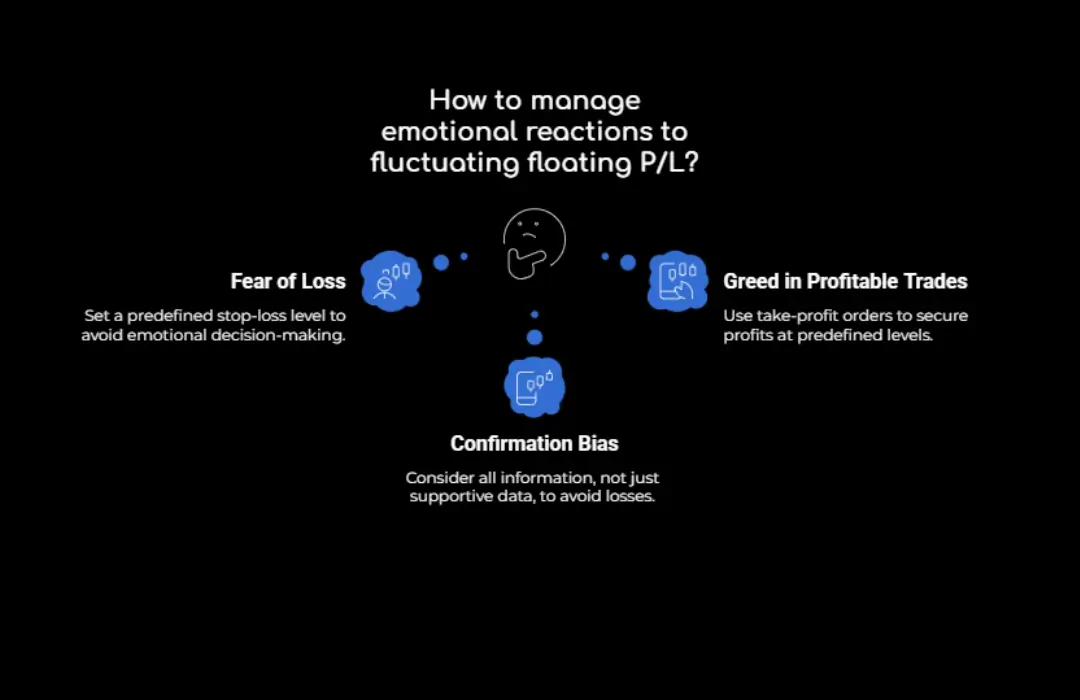
Traders may struggle with the emotional rollercoaster of seeing their floating P/L fluctuate.
What you need to do is understand these feelings first, before addressing them.
What are some common emotional reactions to a fluctuating floating P/L?
Fear of Loss
Watching a trade go into a floating loss can trigger anxiety. Predefine your stop-loss and stick to it instead of acting emotionally.
Feeling Overly Greedy in Profitable Trades
Substantial profits can tempt traders to hold trades too long. Use take-profit orders to lock gains.
Confirmation Bias
Focusing only on information supporting current trades can increase floating losses. Review fundamental and technical factors objectively
Floating P/L and Market Volatility: Why Timing is Crucial?
The market environment directly impacts Floating P/L, especially during periods of fluctuating market conditions. This is why it is essential to know and consider when and how volatility can affect your trade.
Here are some factors that can cause sudden floating P/L changes:
Economic Reports
Certain reports like Non-Farm Payrolls (NFP), Consumer Price Index (CPI), and GDP growth can trigger large price changes.
For instance, Greg, a trader, holds a long position on GBP/USD and he sees a sudden spike in his floating profit after a better-than-expected UK GDP report.
Trading Sessions
Different forex market sessions have varying volatility levels.
See what I mean:
- London & New York Overlap (8 AM – 12 PM EST): This is the most volatile session because of the high trading activities.
- Asian Session (7 PM – 4 AM EST): You will likely encounter lower volatility in this session. However, major moves may still happen in JPY and AUD pairs.
An example to illustrate all I’ve just yapped about. A trader leaves a trade open overnight during the Asian session, and they expect little movement.
Nevertheless, an unexpected Bank of Japan intervention causes a massive spike, which leads to a floating loss.
Geopolitical Events
Geopolitical factors like wars, elections, or trade disputes can disrupt the forex market.
For instance, a trader trades EUR/USD before an ECB interest rate announcement. If the ECB unexpectedly cuts rates, the euro weakens, which will result in a cost loss for them.
Final Words
Mastering the concept of Floating P/L will help you navigate the market with confidence, manage risk, control floating losses, and make better decisions.
Floating P/L is the profit or loss from all open trades. This value does not reflect in account balance until the trade closes.
If you want to calculate Floating P/L, here’s a formula to use:
Floating P/L = (Current price - Entry price) x Position size x Pip value.
F. Nathan
Felix Nathan is a professional trader, market analyst, and business development executive with over a decade of experience in the forex and financial markets. Felix specializes in providing actionable market insights, trading strategies, and risk man...