 IUX
IUX
 Exness
 Vantage
 XM
XM
 ICMarkets
 LiteFinance
 Moneta
 Tickmill
 South Africa (9)
 India (9)
 Bangladesh (12)
 Germany (9)
 Thailand (10)
 Philippines (9)
 Nigeria (10)
 Vietnam (10)
 Malaysia (9)





What is Equity?



Share:
Share:
Education
9 min read

An aspiring Forex trader, Mike, opened his first account with $1,000. After placing a couple of trades and watching his account balance fluctuate, he didn’t mind.
Along the line, his balance decreased significantly after a sudden market drop and his trades were still open; this left him confused.
Mike began to think, “If my trades are still open, why is my balance lower?”
This is when Mike learns about the meaning of equity in Forex trading, which measures the health of his account.
Like Mike, many traders only focus on their account balance, when their equity also matters.
Equity in Forex trading refers to the value of a Forex account, including any open trades.&
This is why understanding equity is vital as a Forex trader. Equity knowledge will help trade smartly and avoid margin calls.
This article will discuss what equity means in the foreign exchange market and how to use it to make smarter trading decisions.
Equity in Forex
In Forex trading, equity refers to the total value of a trading account.
It essentially represents what a trading account is worth, and it includes the account balance and& unrealized P/L or floating P/L from currently open trades.
Apart from demonstrating value, another significant quality of equity is that it determines a trader’s ability to sustain trades.
How to Calculate Equity in Forex (With Example)?
Understanding equity in action is easy and I’ll guide you through each step using a concrete example.
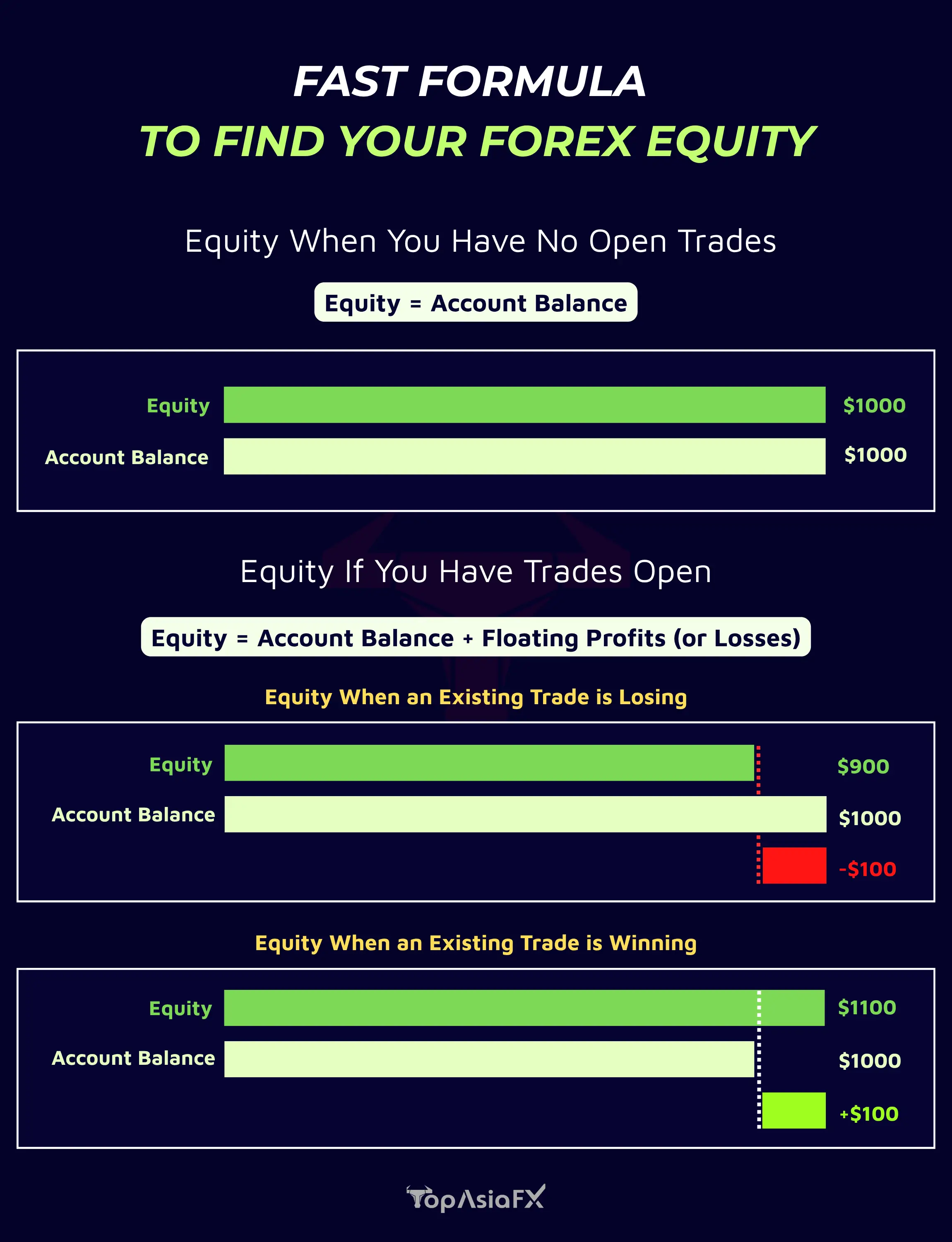
To Calculate Equity
Use this formula: Account balance + unrealized profits or losses
Consider the following changes to Forex trader Ryan’s account after she deposits $1,000.
Before Trading
Account balance = $1,000
Open positions - None
Equity = $1,000 since she has yet to gain any profits or make any losses
After Opening a Trade (In This Scenario, She is Making a Profit)
Ryan opens a trade and the market favors her.
Unrealized profit = $200
Equity = $1,000 account balance + $200 unrealized profit = $1,200
If Ryan’s broker has a margin call level of 50%, Ryan will receive a margin call warning.
After Opening a Trade (In This Scenario, She is Making a Loss)
Ryan opens a trade and the market is going against her, causing her to lose $500.
Unrealized loss = -$500
Equity = $1,000 account balance - $500 unrealized loss = $500
If Ryan’s broker has a margin call level of 50%, Ryan will receive a margin call warning.
If Ryan’s Equity Reaches the Stop-Out Level
If Ryan’s broker has set a stop-out level of 30%, they will close her open positions if her equity goes below the 30% threshold. This way, she doesn’t lose more of her balance.
What is Balance in Forex?
Forex balance is the total amount of money in a Forex account. The forex balance does not include unrealized or floating profits or losses.
This balance will only change when a trader deposits money in their account, withdraws, or closes an open trade; not when a trade is still running.
Here’s a quick example to understand it better:
Before Trading
Cameron funds his account with $500.
His balance is $500 because he has not opened any trades yet.
After Opening a Trade
After opening a trade, the market works in his favor, and he has made a $250 profit. Cameron’s balance remains $500 because this trade is still open, and the profit is floating.
However,
Cameron’s equity is $750 per our earlier formula; Account balance $500 + unrealized profit $250 = $750
After Closing the Trade
If Cameron decides to close the trade at this point, he’ll do so with a $250 profit, which will increase his balance to $750.
Balance vs. Equity: What’s the Difference?
Even though they serve different purposes, forex equity and balance are crucial concepts that every trader should understand.
What are Some Key Details About Balance in Forex Trading?
- It is the total amount of realized or non-floating funds in an account.
- It does not change with open trades.
- However, it will change with deposits/withdrawals or closed trades.
For instance, if Ben deposits $300, his balance remains $300 because he has yet to open any trades. When he opens a trade, his balance remains the same whether or not he is making a profit or loss.
Nevertheless, if he closes said trade with a $50 profit, his balance changes to $350.
How About Equity in Forex?
- Unlike balance, equity considers account balance and unrealized profits or losses.
- Equity changes constantly due to market fluctuations.
- Equity determines when a broker will implement margin calls on an account and trigger a stop-out.
For example, if Toni funds her account with $700, her equity remains $700 if she doesn't open any trades. If she does along the line and maybe gains a $300 profit, her equity becomes $1,000.
Otherwise, if the trade moves against her and she incurs a $300 loss, her equity becomes $400.
Let me go ahead and summarize all that.
| Feature | Balance | Equity |
|---|---|---|
| Definition | The total funds after closed trades. | The total value of the account. |
| Changes with? | Deposits, withdrawals, and closed trades. | Market fluctuations. |
| Includes open trades? | No | Yes |
| Affects margin calls? | No | Yes |
How Does Equity Affect Forex Trading Strategy?
From managing risk to executing a trade and sustaining an account, equity helps make a lot of sound decisions during trading.
It directly affects how much risk one can take and how long traders can ideally leave trades open.
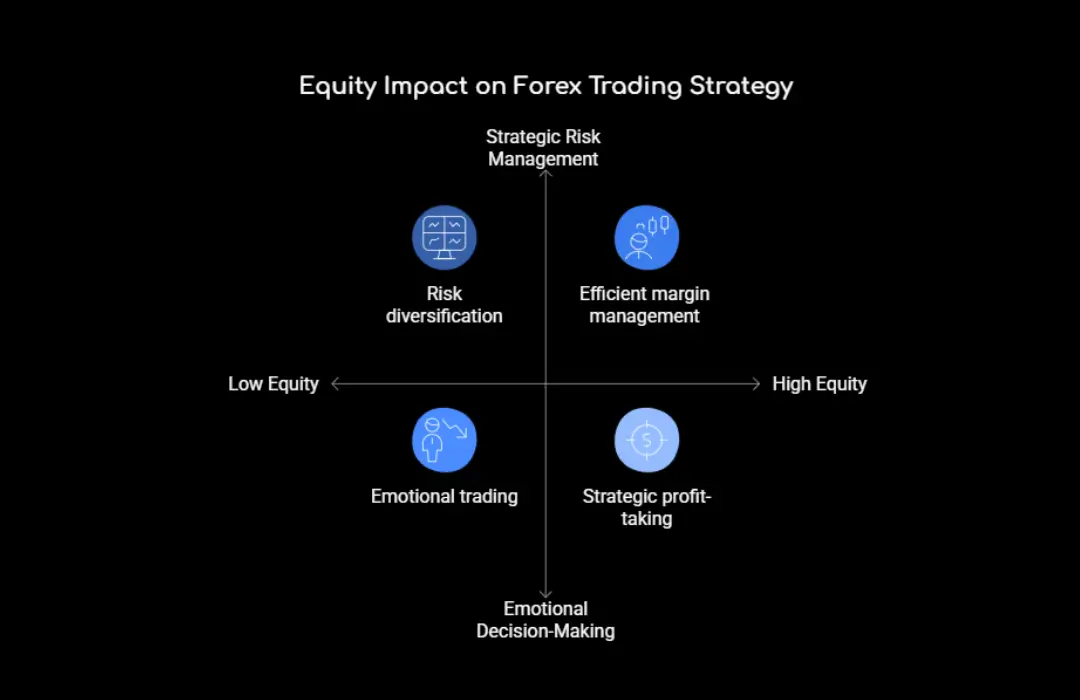
Equity can affect a trader’s forex trading strategy in the following ways:
Risk Management and Position Sizing
Higher equity allows traders to open multiple positions or larger trades. Lower equity increases the risk of margin calls and stop-outs, so smaller positions are safer.
Margin Call and Stop Out Prevention
If equity drops too low, the broker might initiate a margin call and may close active trades when equity reaches its stop-out threshold.
How to prevent this?
Keep an eye on the equity level, ensuring that it does not reach the margin call or stop-out levels. Essentially, maintain a buffer of free margin. This way, you can effectively avoid forced liquidations.
Decision Making
Watching equity fluctuate can lead you to trade with emotions, which can make you close trades too early on or take unnecessary risks.
Without a solid equity growth strategy, traders may find it hard to make more disciplined and sustainable trading choices.
My advice?
Focus on where the long-term goal for your equity rather than getting distracted by its short-term fluctuations.
Best Ways to Increase Equity in Forex Trading
You need a smart and effective strategy to grow your forex equity. Here are some of my tested and trusted tips:
Manage Risk Properly
My advice to traders is always to manage risk as much as they can. Risk at most, 1-2% of equity per each trade.
Set up stop-loss orders to protect you from unexpected market fluctuations. Finally, consider using a low leverage ratio so your equity doesn’t drop so quickly.
For instance, David deposits $5,000 in his trading account.
Instead of risking 50% of his capital on one trade, he follows the 1-2% rule, risking a maximum of $100 per trade.
Over time, he can avoid major losses and steadily grow his account.
Have a Solid Strategy
It is not enough to have a strategy. Does the strategy work?
Here are three things I like to ensure in my trading strategy:
- Have clear rules for entry and exit.
- Monitor free margin before opening new trades.
- Stick to a risk-to-reward ratio of at least 1:2 in order to maximize profits.
Imagine this. Sarah trades EUR/USD and follows a market trend strategy. This means that she only enters when the price respects a moving average and confirms with RSI.
This strategy helps her win 60% of her trades and grow her equity gradually.
Manage Your Margin Efficiently
Monitor margin level and free margin, avoid overusing margin, and maintain above 100% to prevent margin calls.
Be Strategic About Taking Profits
I know it can be exciting to gain profits, but you need to be strategic about handling it. Use trailing stop losses to lock in profits as the trade moves in your favor.
Another thing you can do is to scale out of trades to close partial positions and secure profits. Subsequently, reinvest profits smartly to grow equity over time.
Consider this. Lisa enters a GBP/USD trade and sets a take-profit target at 100 pips.
Instead of waiting for the market to reverse, she closes 50% of her position when she reaches 50 pips, securing profits while letting the rest run.
Don’t Trade with Emotions
We’re human, so it only makes sense that our emotions affect almost everything we do. Nevertheless, I like to trade with an objective and rational point of view rather than one driven by my emotions, and I think you should too.
I have three solid tips to get you going:
- Stick to your trading strategy and avoid revenge trading.
- Set realistic expectations.
- Take breaks after a series of losses so you don’t take unnecessary risks.
Here’s an example to drive my point.
Jake loses three trades in a row and is tempted to take a revenge trade. Instead, he sticks to his trading plan, reviews his mistakes, and waits for the next valid setup.
By avoiding emotional decisions, he protects his equity from further losses.
Continue to Learn and Improve
Analyze past trades, stay updated on market news, and practice on demo accounts.
Example: Emily avoids trading on Fridays after noticing market volatility impacts.
Final thoughts
Equity in Forex reflects the real-time value of a Forex account and can be calculated as Account balance + Unrealized profits/loss.
Equity ultimately determines your trading power and should be optimized to produce the best results. Learn more about equity in Forex and related margin concepts to trade smarter.
F. Nathan
Felix Nathan is a professional trader, market analyst, and business development executive with over a decade of experience in the forex and financial markets. Felix specializes in providing actionable market insights, trading strategies, and risk man...