
 IUX
IUX
 Exness
 Vantage
 XM
XM
 ICMarkets
 LiteFinance
 Moneta
 Tickmill
 South Africa (9)
 India (9)
 Bangladesh (12)
 Germany (9)
 Thailand (10)
 Philippines (9)
 Nigeria (10)
 Vietnam (10)
 Malaysia (9)





6 Key Points to Answer: Is FXCM Better Than Oanda?



Share:
Share:
Broker
11 min read

Traders often ask, Is FXCM better than Oanda?
When comparing FXCM and Oanda, you’ll find both are trustworthy and long established. FXCM was founded in 1999 and holds multiple Tier‑1 licences, while Oanda dates back to 1996 and boasts even broader regulatory coverage.
The question isn’t just which is better overall? But which is better for you, based on your cost sensitivity, account size, and trading platform needs?
In this comparison, we break down everything from account types and trading platforms to fees and mobile usability. These are helping you decide which broker fits your trading style in 2026.
Is FXCM Better Than Oanda? A Quick Overview
When it comes to regulation and safety, both FXCM and Oanda have long standing records in global forex and CFD trading. FXCM provides online foreign exchange trading, CFD trading, spread betting, and related services.
The company focuses on giving traders access to the world’s largest and most liquid markets while meeting strict financial standards. FXCM emphasizes innovation, offering mobile trading, one-click order execution, real-time chart trading, and a suite of educational courses.
The broker maintains global offices in London, New York, and Melbourne, providing 24/5 dedicated support. Its goal is to deliver transparent execution, quality pricing, and advanced trading technology. All are designed to help traders navigate financial markets safely and efficiently.
Oanda is regulated across multiple jurisdictions, offering robust safety and compliance standards. In the United States, it is a registered Futures Commission Merchant and Retail Foreign Exchange Dealer with the Commodity Futures Trading Commission.
Also a member of the National Futures Association (NFA No. 0325821), with its New York office at 17 State Street, Suite 300.
For crypto trading, Oanda Coinpass Limited is registered under the UK Money Laundering regulations as a UK crypto asset firm (FCA No. 921481). Oanda also operates Oanda Business Information and Services Inc. in Delaware, providing FX data services.
Each entity ensures client funds protection, regulatory compliance, and operational transparency. These are allowing traders to trade confidently under strict legal standards worldwide.
Both FXCM and Oanda demonstrate a strong commitment to regulation and safety. FXCM focuses on delivering secure trading with advanced technology and global support. Oanda offers multi-jurisdictional regulatory coverage and comprehensive legal compliance.
Who Saves You More?
FXCM offers competitive spreads, with the EUR/USD pair averaging around 1.13 pips in standard accounts. GBP/USD spreads hover near 1.70 pips, while other major pairs average approximately 1.47 pips.
FXCM also provides tiered pricing for high volume traders, reducing costs further for those trading larger lots. Additional features, such as one click order execution and mobile trading, streamline trade management, helping minimize slippage and execution delays. It can impact overall trading costs.
Oanda, on the other hand, provides transparent and competitive spreads across its accounts. EUR/USD spreads can be as low as 0.90 pips, and GBP/USD averages near 1.50 pips in standard accounts. Oanda does not charge commissions on most standard accounts, and swaps are applied consistently across overnight positions.
Its multiple regulatory entities ensure that spreads and fees are calculated fairly and transparently, which can prevent unexpected costs for traders in different regions. Oanda’s easy account setup and low minimum deposit options also allow smaller traders to start trading.
Comparing both brokers, FXCM tends to save active and high volume traders slightly more due to aggregated lower spreads on multiple pairs and tiered pricing. Oanda may be more cost efficient for beginners or casual traders.
Best Trading Platform: FXCM vs Oanda
When comparing FXCM and Oanda, the platform experience plays a central role in defining trader satisfaction and performance. Both brokers provide advanced technology, flexible access, and tools designed for modern trading.
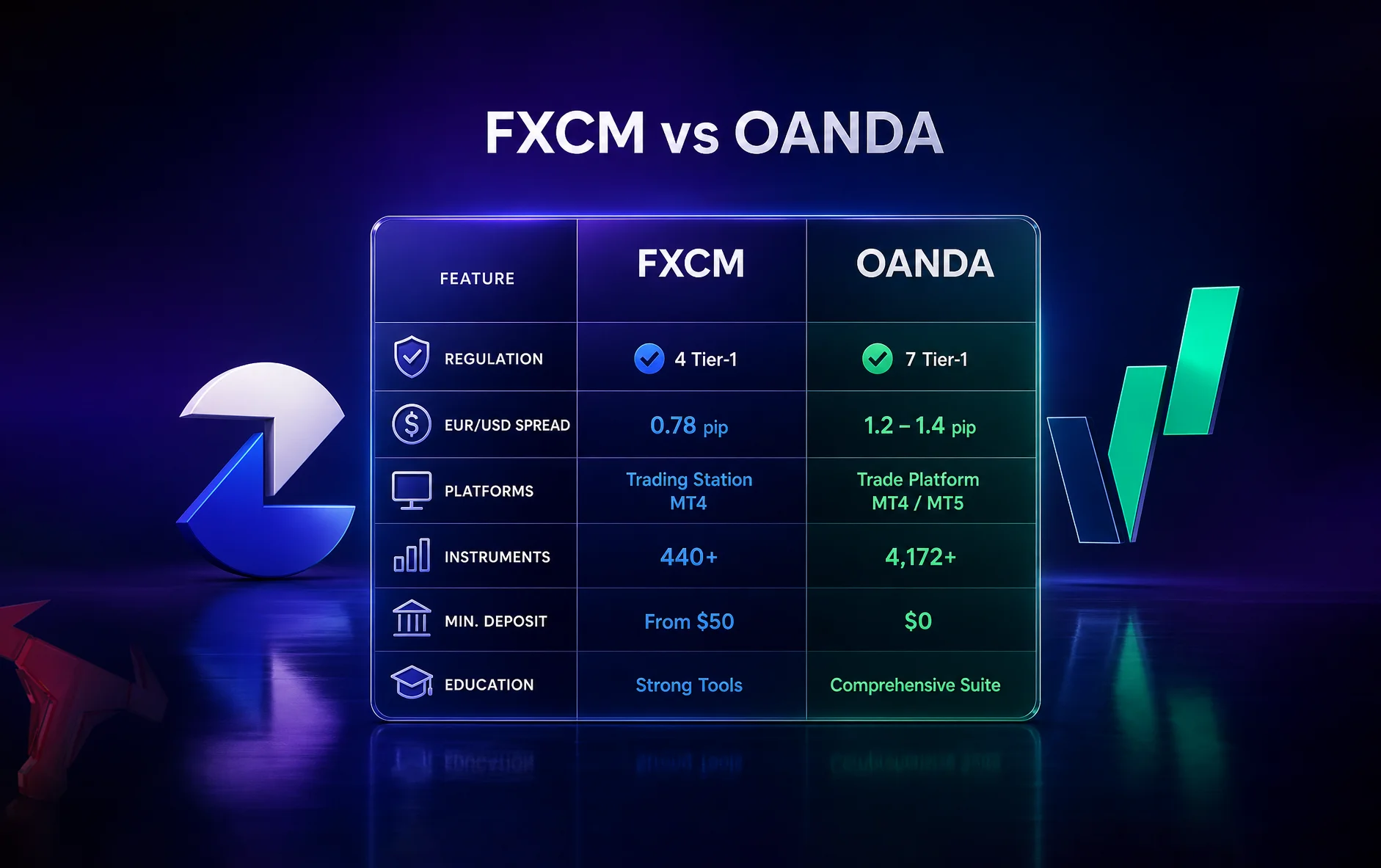
Yet, each offers a distinct ecosystem shaped by its design philosophy and trader audience.
FXCM’s Platform Ecosystem
FXCM gives traders a choice between MetaTrader 4 (MT4) and its proprietary Trading Station platform. Both are known for their depth, speed, and reliability. MetaTrader 4, launched by MetaQuotes Software in 2005.
It remains one of the most widely used platforms in global financial markets, with over one million users by 2013. It supports forex, CFDs, and futures trading through a suite of advanced tools.
MT4 offers three types of order execution, instant or timed entries, and risk controls such as profit target, stop loss, and trailing stop. Its technical analysis package includes 30 built-in indicators, over 2,000 free custom indicators, and 700 premium ones.
Traders can also access the MetaTrader Market. It hosts more than 1,700 trading robots and 2,100 technical indicators for purchase.
Automation is another MT4 strength. Through the MQL4 programming language, traders can create and run custom trading algorithms directly from the platform. MT4 is available on Android devices and offers alerts, real-time news feeds, and multilingual support in 38 languages.
With over 750 global broker connections, it remains a universal tool for active traders seeking familiarity and customization.
FXCM also developed its own platform suite, Trading Station Desktop, Web 3.0, and Mobile. Trading Station Desktop gives professional traders access to customizable charts, advanced analytics, strategy backtesting, and optimization tools.
It allows automated trading strategies and lets users trade directly from charts with one-click functionality.
Oanda’s Platform Ecosystem
Oanda offers traders a diverse platform selection, prioritizing transparency, accessibility, and flexibility. The broker supports MetaTrader 4, MetaTrader 5, and its proprietary Oanda Trade platform. These are available on the web, desktop, and mobile.
Oanda’s version of MT4 includes integrated market data, advanced charting tools, and automated strategy execution. MT5 builds on this with more order types, additional indicators, and improved backtesting features for multi-asset trading.
The Oanda Trade platform, previously known as fxTrade, stands out for its clean design and ease of use. It allows traders to create custom layouts, set up advanced order types, and access real-time pricing directly from Oanda’s liquidity pool.
Charting is powered by TradingView, offering over 80 technical indicators, drawing tools, and cross-asset comparisons. Traders can also access built-in performance analytics, economic calendars, and live market sentiment data.
Which Platform Is Better?
FXCM provides a more advanced and technical platform ecosystem, while Oanda delivers a more user friendly and data integrated environment. For algorithmic traders and professionals, FXCM’s combination of MT4 and Trading Station Desktop may offer more control and performance optimization.
For casual or mobile first traders, Oanda’s streamlined Trade platform and TradingView integration provide an easier path to consistent execution.
Account Types & Features
At FXCM, you’ll find a Standard account with a low minimum deposit (around US $50) and access to forex pairs and CFDs. For high volume or professional traders, FXCM offers an Active Trader account with tighter spreads, personalized support, and cash rebates.
FXCM advertises spreads starting from 0.78 pips on EUR/USD for the Standard account. Leverage varies by region; for example, it can be as high as 1:400 in some non-UK/non-EU entities. FXCM also supports a demo account option so you can practise with virtual funds before going live.
On the Oanda side, their account types are clearly laid out. For example, under its Global Markets division, Oanda offers a Standard account with no minimum deposit requirement in many regions. This Standard account has spreads starting from about 0.6 pips for key instruments.
Then Oanda offers Premium and Premium Plus accounts for more serious traders: the Premium account often requires high volume or deposit (for example, US$10,000 or trading volume criteria) and provides tighter spreads and extra features. Oanda’s account structure also supports sub-accounts (v20, v20 MT4, Oanda One), which differ by platform support and available instruments.
If you’re starting with limited capital, Oanda’s Standard account with no minimum deposit offers a very accessible entry point. FXCM’s Standard account also has a low entry threshold (~US$50). But its best value often comes when you upgrade or trade larger volumes in their Active Trader tier.
If you trade large volumes, seek advanced features like API access or deeper liquidity, FXCM’s Active Trader account may align better. Meanwhile, Oanda’s Premium type accounts deliver perks for high volume clients. But you’ll need to meet higher criteria.
Education & Research Tools
FXCM offers a strong set of resources. On its Learn to Trade page, FXCM states: With FXCM, education isn’t an additional expense: it is part of your investment. FXCM provides live daily webinars such as The Crypto Minute every Wednesday at 08:00 UTC and Morning Market Review every weekday at 07:40 UTC.
Oanda, meanwhile, delivers a wide ranging education hub in its Oanda Labs / Learn section. Oanda publishes dozens of articles on technical analysis, trading strategies, and instrument tutorials.
Oanda also offers multiple tools to accompany that education: a Currency Strength tool, a Volatility Chart, a Correlation Tool, and a Value at Risk tool.
In comparing the two, FXCM stands out for structured live education and market insight research. Oanda excels with its depth of articles and specialised tools to support strategy development.
Customer Service
Customer service is a key factor when choosing a broker, as fast and reliable support can directly impact trading efficiency. FXCM provides dedicated customer support 24 hours a day and five days a week.
Traders can contact FXCM via live chat, phone, or email. Also, the broker offers multilingual support to accommodate global clients. Response times are generally under a few minutes for live chat inquiries, while email requests are typically answered within 24 hours.
Oanda also offers robust customer service across its global offices. In the United States, Canada, the UK, Australia, and Singapore, Oanda provides live chat, phone, and email support.
Oanda emphasizes fast response times, with live chat responses often under 3 minutes and email inquiries resolved within one business day. Its multilingual support covers major regions. The company maintains a large knowledge base, including detailed FAQs, platform tutorials, and trading guides.
In addition, Oanda offers dedicated technical support for its proprietary fxTrade platform and MT4/MT5 integration. This ensures that both beginner and advanced traders can access prompt solutions.
Comparing the two, FXCM may be more suitable for traders who value 24/5 global coverage with immediate assistance. Oanda excels in structured regional support and comprehensive self-help resources. It benefits traders who prefer guided tutorials and platform documentation.
Which Broker Makes Deposits & Withdrawals Easier?
FXCM and Oanda offer multiple deposit and withdrawal methods designed for convenience and transparency. FXCM allows deposits via bank wire, credit/debit cards, and online payment platforms.
Deposits are usually processed instantly for cards and within one to three business days for bank wires. FXCM does not charge deposit fees, though intermediary bank charges may apply for wire transfers.
Withdrawals can be requested online by selecting the preferred method, and processing times range from one to three business days for most methods. Bank wire withdrawals may incur a small fee, while FXCM ensures all withdrawals go to accounts in the trader’s name.
The broker also maintains strict verification procedures to secure client funds, making both deposits and withdrawals safe and compliant with regulatory standards.
Oanda also supports multiple funding options, including PayPal, debit cards, and domestic or international bank transfers. Deposits via PayPal or debit cards are free, though banks may charge service fees.
Domestic wire transfers typically take one to three business days, while international transfers can take up to five business days.
Withdrawals to PayPal accounts are free, but bank transfers may carry variable fees depending on the account currency and monthly withdrawal count. Oanda does not impose minimum or maximum deposit limits, making it accessible for traders of all sizes.
Additionally, currency conversion fees apply when trading instruments in currencies different from the account base currency, ensuring transparency in all fund movements.
Comparing both brokers, FXCM provides slightly faster withdrawals for card-based deposits and a well-structured online withdrawal interface.
Oanda, however, offers more flexibility with deposit amounts and a wider range of payment options like PayPal, which can be beneficial for smaller or casual traders.
Final Words
So, is FXCM better than Oanda? The short answer: sometimes yes, sometimes no. FXCM often wins on raw cost (spreads) and tools for advanced users; Oanda often wins on accessibility, regulation breadth, and beginner friendliness.
You’ll get the most benefit by matching their strengths to your own trading profile, not just picking the broker with the highest star rating. Use these facts to decide with confidence.
F. Nathan
Felix Nathan is a professional trader, market analyst, and business development executive with over a decade of experience in the forex and financial markets. Felix specializes in providing actionable market insights, trading strategies, and risk man...