 IUX
IUX
 Exness
 Vantage
 XM
XM
 ICMarkets
 LiteFinance
 Moneta
 Tickmill
 South Africa (9)
 India (9)
 Bangladesh (12)
 Germany (9)
 Thailand (10)
 Philippines (9)
 Nigeria (10)
 Vietnam (10)
 Malaysia (9)




Is Forex Trading Halal? A Muslim Trader’s Guide



Share:
Share:
Markets
4 min read
Many Muslim traders grapple with the question of whether forex trading is halal or haram the moment they enter the currency markets.
The fast-paced world of forex can look thrilling from the outside, but for Muslims who want to stay within the bounds of Shariah law, the lines between permissible and forbidden can feel a bit blurry.
So, is forex trading allowed in Islam?
Find out.
To understand if forex is halal, you need to get the hang of what it is about first.
Quick Forex 101, So You Know How It All Begins
Forex, short for foreign exchange, is the global marketplace for buying and selling currencies.
It operates 24 hours a day and facilitates more than $6 trillion in daily trades, making it the most liquid financial market in the world.
Traders aim to profit from fluctuations in exchange rates by speculating on the value of currency pairs like EUR/USD, GBP/JPY, or USD/NGN.
For example, if you believe the euro will strengthen against the U.S. dollar, you might "go long" on EUR/USD. If you think it will weaken, you "short" it instead.
The mechanics may seem simple: buy low, sell high (or vice versa), but things get more complex when you consider different trading styles, platforms, and financial instruments involved.
>And for Muslim traders, there’s another layer to navigate: the question of whether forex trading aligns with Islamic principles. That’s where the concept of halal (permissible) and haram (forbidden) comes in, especially when it comes to interest (riba), speculation (gharar), and ethical intent.
There are many views about forex in the Muslim community, but not all of them are based on facts. Here's a look at common myths and what’s actually true.
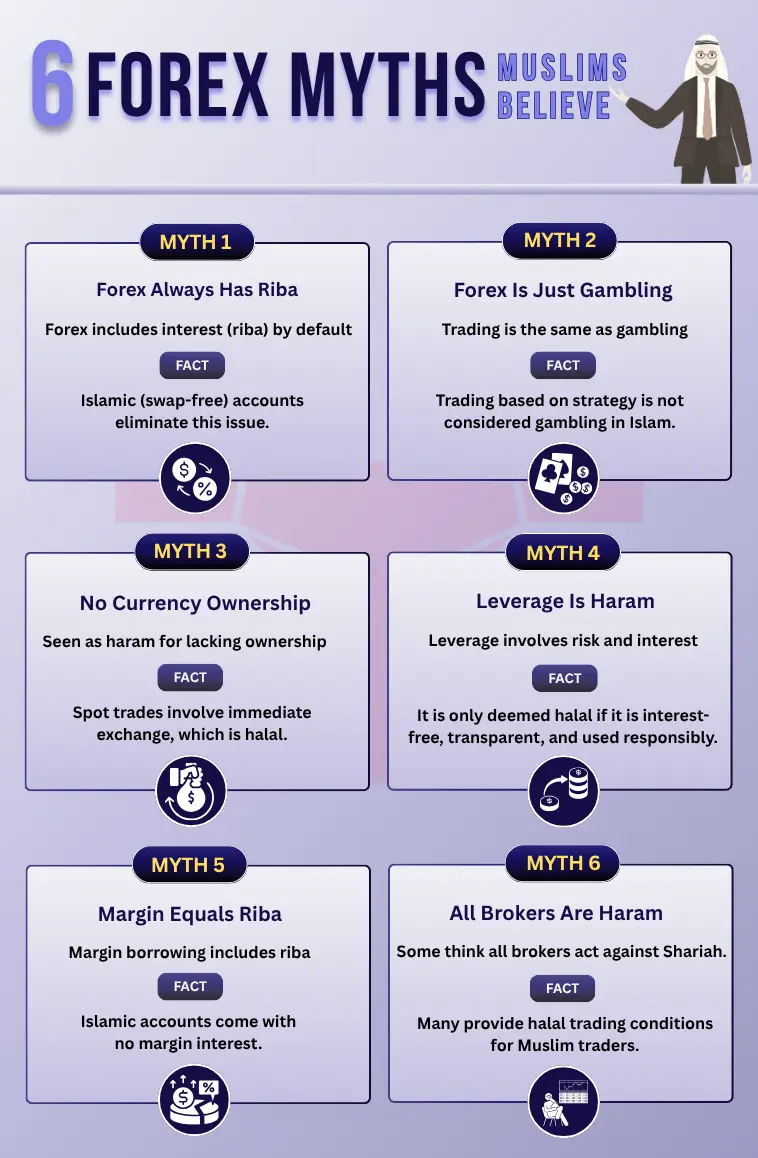
In the next section, we’ll unpack how forex is viewed through an Islamic lens and what makes a trading account Shariah-compliant.
Yes, Forex Trading Can Be Halal, but Only if You Do It Right
But only when it’s practiced under specific Islamic guidelines.
In Islamic finance, three main principles must be respected for any financial activity to be considered halal:
No Riba (Interest)
One of the most critical issues is riba, or interest.
Regular forex accounts often involve overnight swap or rollover fees, which are essentially interest payments for holding a position open past a certain time.
Since interest is strictly prohibited in Islam, any involvement in such transactions makes the activity haram.
You can fix this with a Shariah-compliant or Islamic trading account to avoid these fees entirely, making the process interest-free.
No Maysir (Gambling)
Forex should not be treated like a game of chance. Trading based purely on speculation, luck, or emotional decision-making is considered maysir, a form of gambling, which is forbidden in Islam.
Instead, a halal approach to forex involves strategy, knowledge, and analysis, rather than guesswork or high-risk "bets."
No Gharar (Excessive Uncertainty)
Gharar refers to undue uncertainty or ambiguity in a contract. In forex, this could relate to unclear terms, highly volatile assets, or manipulative practices.
Transparent broker terms, real-time pricing, and clear execution methods help eliminate this uncertainty and align trading with Islamic principles. So, only go with brokers and trading platforms that are clear on their terms from the start.
Forex Is Only Halal if It Ticks These Boxes
- Immediate settlement of trades (spot trading).
- No interest charges, such as swap fees on overnight positions.
- Real ownership and no excessive risk or speculation.
- Transparent trading with no deception or hidden terms.
Forex Becomes Haram When It Has
- Riba (Interest): Most conventional forex brokers charge swap fees, which are interest-based.
- Gharar (Uncertainty): This includes highly speculative trades or trades without clear terms.
- Maysir (Gambling): This means over-leveraged or high-risk positions with no strategy.
Here’s How Islamic Forex Accounts Keep It Halal
To bridge the gap between Islamic law and trading, many brokers now offer Islamic forex accounts, also known as swap-free accounts. These accounts:
- Eliminate interest-based fees (Swap/Riba).
- Follow Shariah principles.
- Often charge a fixed administrative fee instead of overnight interest.
It’s important to read the fine print; some brokers label their accounts “Islamic” but sneak in disguised interest. Stick with regulated, Shariah-compliant brokers vetted by Islamic scholars.
So, You See, Forex Trading Can Be Halal
Yes, forex trading can be halal, but only under specific conditions that remove interest, excessive risk, and gambling-like behavior.
The key is using an Islamic forex account and working with reputable halal brokers. Always prioritize compliance with Shariah principles over chasing quick profits.
Remember: In Islam, your intentions and methods matter as much as the outcome. So if you're serious about trading, do it the right way.
F. Nathan
Felix Nathan is a professional trader, market analyst, and business development executive with over a decade of experience in the forex and financial markets. Felix specializes in providing actionable market insights, trading strategies, and risk man...