 IUX
IUX
 Exness
 Vantage
 XM
XM
 ICMarkets
 LiteFinance
 Moneta
 Tickmill
 South Africa (9)
 India (9)
 Bangladesh (12)
 Germany (9)
 Thailand (10)
 Philippines (9)
 Nigeria (10)
 Vietnam (10)
 Malaysia (9)





Tax Free Countries for Forex Trading: Maximize Your Trading Profits Legally in 2026

Share:
Share:
Markets
10 min read
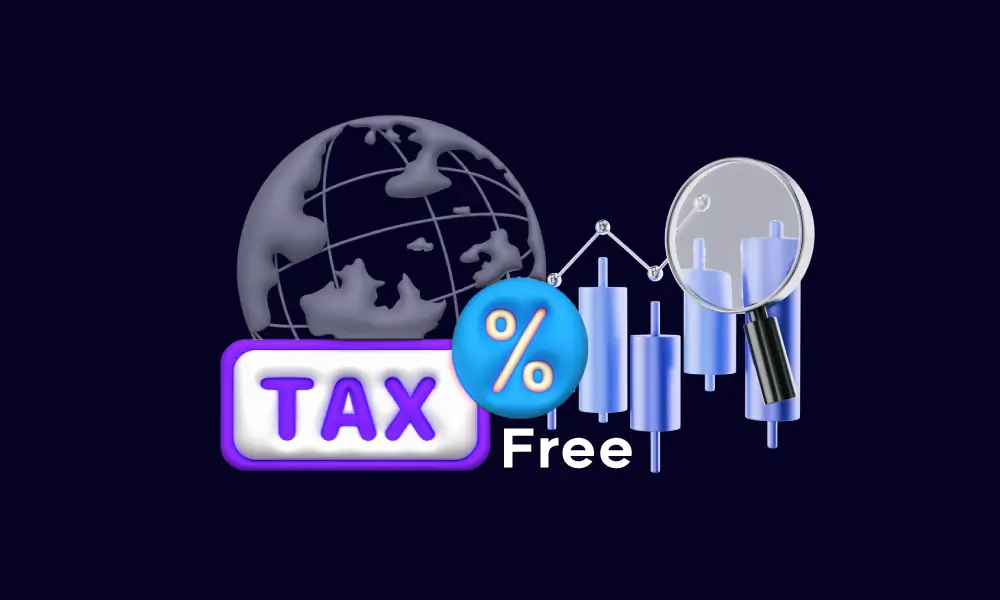
Taxes on forex trading are a real pain.
For example, in the U.S., certain traders under Section 1256 treat 60% of gains as long-term (taxed at 20%) and 40% as short-term (taxed at up to 37%). Day traders may face rates ranging from 10% to 37%.
These high tax burdens have led many traders. That has every reason to be. Because those taxes can take up to 50% of your trading income! But luckily, there are some tax free countries for Forex Trading & among them, the most suitable ones are:
- Hong Kong
- Singapore
- Oman
- Switzerland
How do they offer tax-free forex? How does the trading work there? Let’s figure out those Countries with no forex tax.
Key Takeaways:
- Some countries offer 0% tax on foreign exchange (forex) profits, including the UAE, Monaco, and Seychelles.
- Tax residency usually requires staying 183+ days or meeting financial or legal criteria.
- Legal residency and tax residency are not the same.
- Countries like Singapore and Switzerland offer tax advantages based on trader classification.
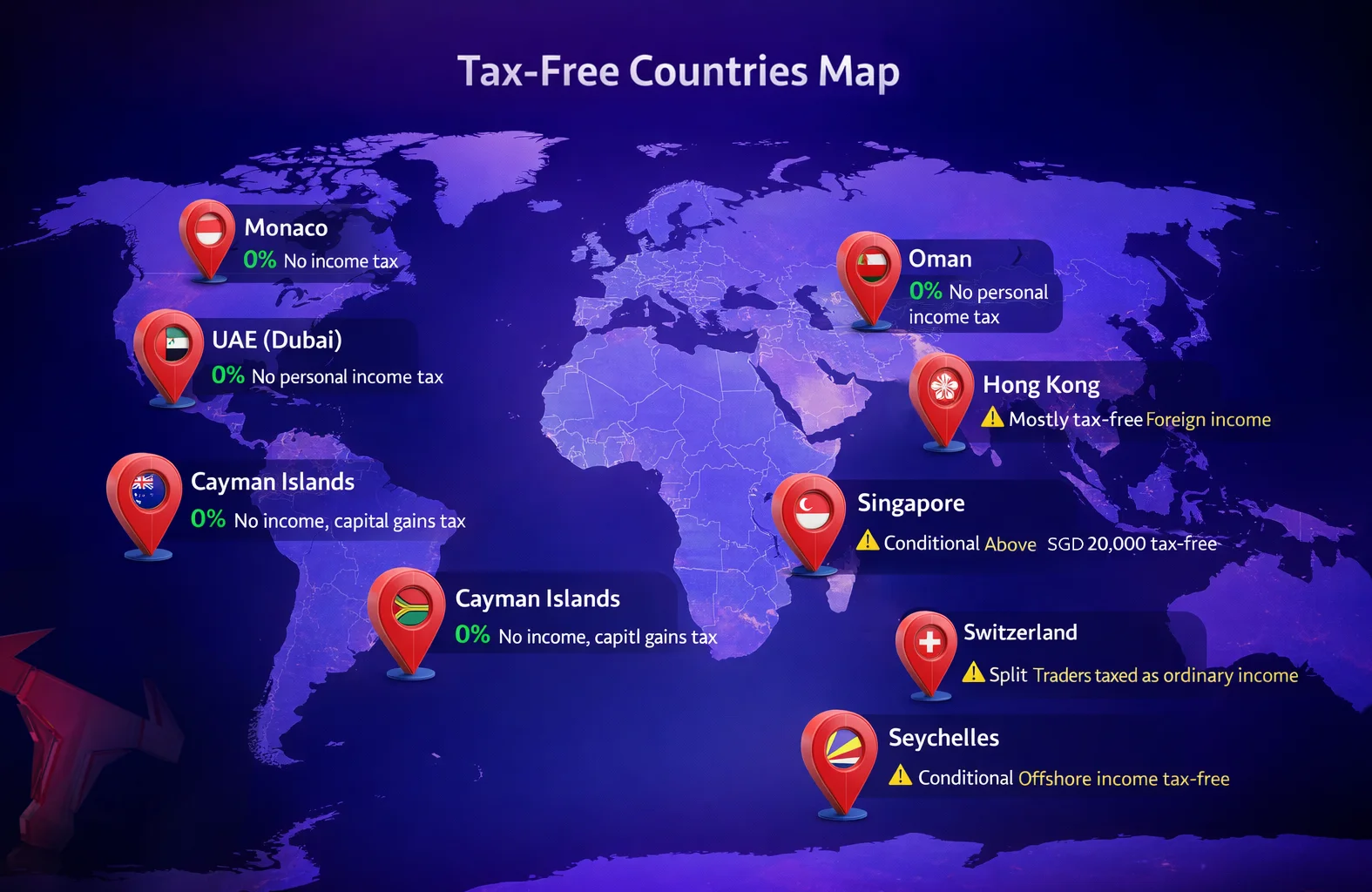
Top 9 Tax Free Countries For Forex Trading
Zero tax countries for traders seem like a dream. But it is true. We found a few countries that not only tax tax-free but also give great leverage.
Tier 1: Complete Tax Exemption
Monaco
Since 1869, Monaco has not charged a personal income tax on its residents. That’s also applied to forex trading. Forex trading profits are not taxed if you are a legal resident of Monaco and not a French citizen.
This includes gains from spot forex, CFDs, and leveraged trading. It is provided that trading is done in a personal capacity. Monaco does not have its own financial regulatory authority for brokers.
Instead, Traders typically use EU-regulated brokers (CySEC, FCA) or offshore brokers. Leverage depends on the broker’s jurisdiction.
So it’s kinda tricky on the leverage angle. But you can’t have everything set on the plate, right?
United Arab Emirates
Dubai is the talk of the forex town because of Dubai forex tax benefits. It offers no personal income tax applies to forex trading profits. That applies no matter whether they earn from foreign exchange or other trading activities.
That is why it is a legitimate tax optimization strategies for forex traders. Also, this country is home to the Dubai International Financial Centre (DIFC).
It provides traders with access to numerous trusted local and international brokers. While the city offers tax benefits, forex trading is still closely monitored by regulators like the Dubai Financial Services Authority (DFSA) and the UAE Central Bank.
This helps create a safe and well-regulated environment for trading. This city isn’t just about 0% tax. It also ensures safety.
Cayman Islands
The Cayman Islands is another no capital gains tax forex. There is no personal income tax, capital gains tax, or corporate tax. It allows individual traders and financial entities to operate in a tax-efficient environment.
Forex trading is legally recognized and regulated under the Cayman Islands Monetary Authority (CIMA). But one thing is that the Cayman Islands does not impose specific leverage limits for retail forex trading.
Leverage is typically determined by the broker’s own risk management policy and the license they hold. So traders get the flexibility here.
Tier 2: Favorable Tax Regimes
Hong Kong
Yes, Hong Kong is one of the zero tax countries for traders. Hong Kong follows a territorial basis of taxation. Only income that arises in or is derived from Hong Kong is taxable.
Foreign-sourced income, even if remitted, is not subject to local taxes. This is particularly advantageous for traders who operate internationally or through offshore brokerages.
That’s why it is the 2nd largest in Asia & the 4th largest in the world forex market. Another best part is the leverage. Locally regulated brokers, under the supervision of the Securities and Futures Commission (SFC).
It is perfect for retail forex clients, in line with global standards for client protection.
Singapore
If your forex trading activity does not meet the IRAS’s “Badges of Trade” criteria, then your profits are considered capital gains and are not taxable.
However, even if your trading income is classified as taxable under the “Badges of Trade,” you may still not owe any tax if your total annual income is below SGD 20,000, as this falls under Singapore’s tax exemption threshold.
But there is a catch, you need to have legal residency requirements for tax efficient trading.
To enjoy Singapore trader tax advantages, you typically need to be a Singapore tax resident. It generally means spending 183 days or more in the country per year. Non-residents may face withholding tax on certain income, but capital gains are exempt.
Once you pass that, you can enjoy the Monetary Authority of Singapore (MAS) limits, which allow forex trading leverage for retail investors at 20:1. However, “accredited investors” may access higher leverage up to 50:1.
Switzerland
Switzerland is also known for its tax haven laws for forex. If you’re a private investor, your capital gains from forex trading are tax-free.
However, if you’re classified as a professional trader, your profits may be taxed as income and could also be subject to social security contributions.
But still, this city is a hot place to trade. According to the Bank for International Settlements (BIS), foreign exchange (forex) trading in Switzerland reached an average daily turnover of $350 billion.
Forex trading in Switzerland is strictly regulated by the Swiss Financial Market Supervisory Authority (FINMA).
This ensures that all trading activities are conducted with fairness, transparency, and security.
Tier 3: Competitive Tax Rates
Seychelles
There is no capital gains tax forex in Seychelles. If you register a business as an International Business Company (IBC), you don’t have to pay Capital Gains Tax, Corporate Tax, or Withholding Tax on profits from forex trading done outside Seychelles.
Forex trading in Seychelles is regulated by the Financial Services Authority (FSA) under the FSA Act of 2013. Seychelles uses a territorial tax system. This means you only pay tax on income earned inside Seychelles.
If your forex income comes from another country, it’s not taxed, even if you live in Seychelles. But to be a tax resident in Seychelles, you must meet one of these:
- Have a permanent home in the country.
- Stay in Seychelles for at least 183 days in a year.
- Have your main personal or business ties (center of life) in Seychelles.
Vanuatu
The country offers zero personal income tax, capital gains tax, or corporate tax on offshore earnings. It is highly attractive for both individual traders and forex brokerages. Forex trading activities are regulated by the Vanuatu Financial Services Commission (VFSC). While the regulatory standards are not as strict as in Tier-1 jurisdictions.
Vanuatu still provides a legal and recognized framework for forex businesses to operate. The VFSC has recently tightened its licensing process. It enhances transparency and oversight.
This combination of light regulation, fast setup, and no tax on foreign earnings makes Vanuatu a popular choice for setting up forex operations or trading offshore.
Oman
Oman does charge corporate income tax, but there is no personal income tax on residents, including on capital gains or trading profits. However, businesses and professional trading firms may still be subject to standard corporate tax (currently 15%).
Forex traders residing in Oman benefit from tax-free gains on personal trades. I provided that they’re not operating as a formally registered business.
As always, traders should consult with a tax advisor to stay compliant with local regulations and international reporting obligations.
Residency Requirements and Compliance
Tax free countries sound tempting, but you can’t just pop up there and enjoy leverage. It's important to understand the residency rules. Different countries have different requirements.
Most countries determine tax residency based on the number of days you spend there. 183-Day Rule: Common standard stay over 183 days, and you're usually a tax resident.
UAE, for example, uses shorter periods if other ties exist.
But remember, Tax Residency ≠ Legal Residency.
It means you might legally live in a country but not owe taxes or vice versa. Keep records like leases, bank statements, or entry/exit stamps.
Some countries need proof that you can support yourself or invest. For that need,
- Minimum Investment
- Bank Deposits
- Property Ownership
- Income Proof
After completing all the necessary steps, it’s time to get into legal residency requirements for tax-efficient trading. You need to apply for residency, which includes paperwork and planning.
- Visa or Permit
- Documents
If everything overwhelms you, then hire a professional tax advice for international traders. He will do that work for you. You just need to wait 1 or 2 months to get the things done.
Tax Planning Strategies for International Traders
If you trade internationally, smart International trader tax planning can save you a lot. However, it must be legal, structured, and documented. It’s not just about trading personally. There are better options depending on your goals:
- Personal Account
- Offshore Company
- Professional Trader Status
In some countries, being classified as a pro trader gives you access to deductions and tax benefits. But, even if you move offshore, your home country may still want a piece of your profits.
- Home Tax Rules: Check if your country taxes you on worldwide income.
- Double Tax Treaties: These can help you avoid paying tax in two places.
- CRS (Common Reporting Standard): Banks in 100+ countries share account info with tax authorities. So, keep things clean.
- Ongoing Advice: Tax laws change. Hiring a pro helps you stay compliant and up-to-date.
- Use a legitimate setup, keep accurate records, and avoid trying to outsmart the system. It’ll cost you more in the long run.
Broker Selection in Tax-Favorable Jurisdictions
Choosing the right broker is just as important as choosing the right country. Even in tax-free places, your broker must meet strict regulatory and security standards. Let’s break it down:
Local Regulation Matters
Some countries, such as Switzerland or Singapore, have robust local regulators. If you're using a local broker, ensure they're licensed and regulated.
Access to International Brokers
Not every country has top-tier brokers. In many cases, traders prefer to work with well-known international platforms. Just ensure they’re permitted in your new jurisdiction.
Segregated Account Protection
Reputable brokers hold your money in separate accounts (not mixed with company funds). This keeps your funds safer in the event that the broker faces financial difficulties.
Deposit Insurance & Investor Protection
Look for brokers that offer coverage under investor compensation schemes. Some regions (like the EU or UK) offer up to €20,000 or £85,000 in protection.
If your broker matches everything above, then you are good to trade in those countries and enjoy your trading income 100%.
Conclusion
Trading in a tax-free country isn't just about lower taxes. It’s about understanding the rules, securing proper residency, and choosing the right broker. So don’t just jump at seeing tax free banner. Jump with the right setup, you can trade smarter, safer, and more profitably across borders.
FAQs
Which countries offer the best tax advantages for forex traders?
Countries like the UAE, Singapore, Monaco, Vanuatu, and Seychelles are popular due to their zero or low capital gains tax and flexible residency options.
What are the residency requirements for tax-free trading?
Most countries use the 183-day rule, but others have flexible paths through investment, property ownership, or financial ties. Always check the local tax authority's rules.
How do I legally optimize my forex trading taxes?
Utilize strategies such as relocating to tax-friendly jurisdictions, qualifying for non-domicile status, or structuring your trades through legal entities. Always with the guidance of professional tax advice.
How does TopAsiaFX help with international broker selection?
We evaluate brokers based on regulation, protection policies, leverage, and access in tax-friendly zones. So you can trade confidently and compliantly.
F. Nathan
Felix Nathan is a professional trader, market analyst, and business development executive with over a decade of experience in the forex and financial markets. Felix specializes in providing actionable market insights, trading strategies, and risk man...