 IUX
IUX
 Exness
 Vantage
 XM
XM
 ICMarkets
 LiteFinance
 Moneta
 Tickmill
 South Africa (9)
 India (9)
 Bangladesh (12)
 Germany (9)
 Thailand (10)
 Philippines (9)
 Nigeria (10)
 Vietnam (10)
 Malaysia (9)





What is a Forex Trading Account?



Share:
Share:
Education
11 min read
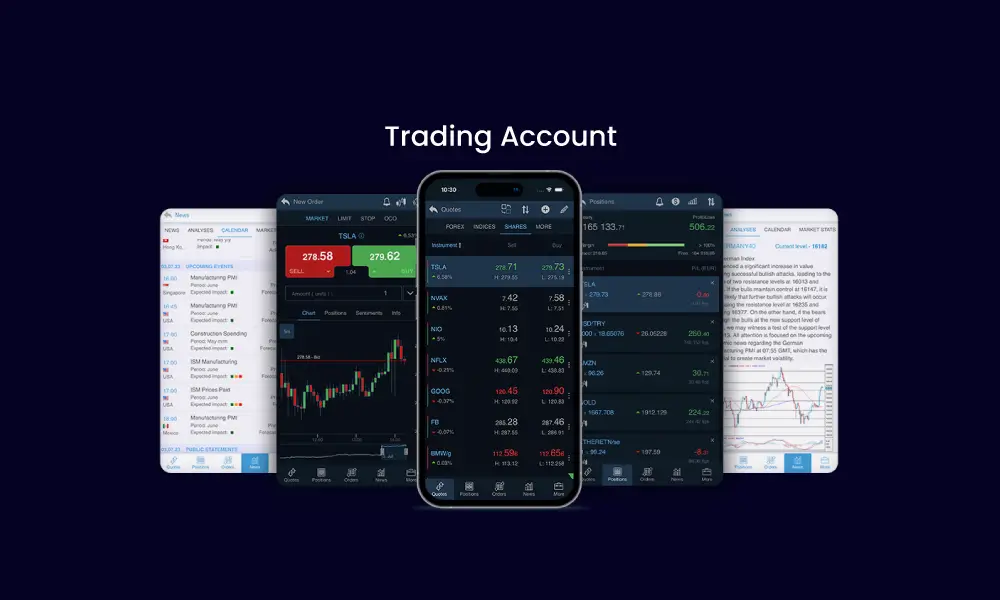
A Forex trading account is a specialized online account that gives you access to the global foreign exchange (forex) market. It's where you deposit funds, manage trades, and track profits or losses, all in real time.
This account enables you to buy and sell currency pairs (like EUR/USD, GBP/JPY, or USD/NGN) to profit from exchange rate changes.
It doesn’t matter if you're a beginner testing the waters or a seasoned trader executing complex strategies, your trading account is the operational base for everything you do in forex.
Explore more: How to Create Forex Trading Account?
Think of It Like a Bank Account, But Smarter
Unlike a regular bank account, which holds money for saving or spending, a forex trading account is dynamic and transactional. It lets you actively engage in the largest financial market in the world, with over $6 trillion in daily volume.
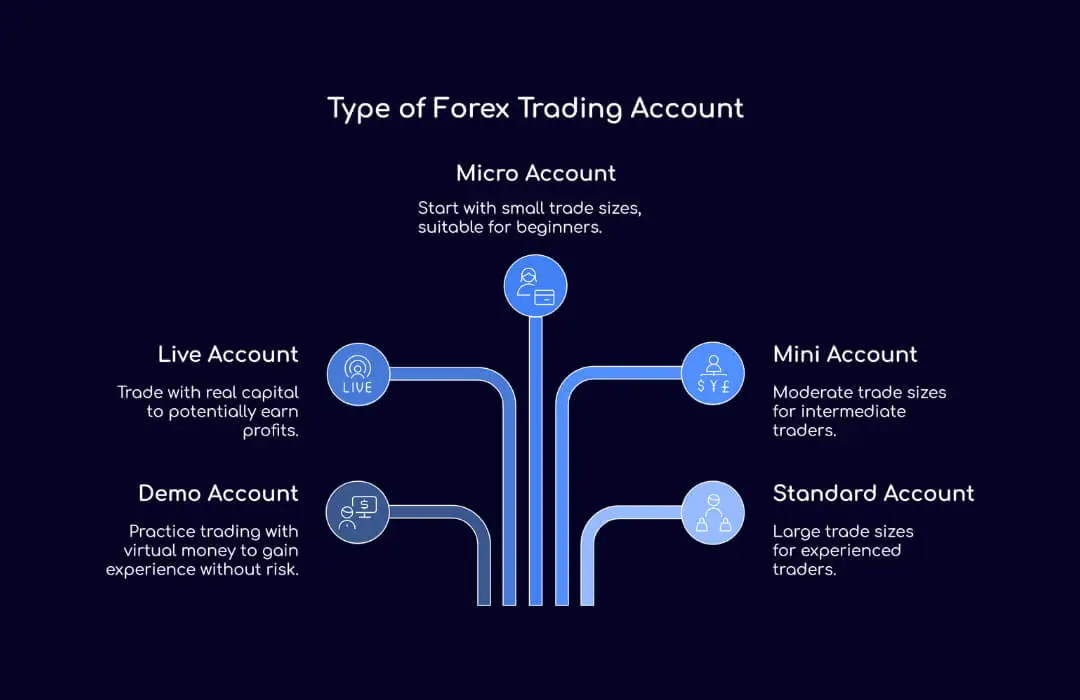
Plus, depending on your broker and account type, you can choose from:
- Demo accounts (you get to practice with virtual money)
- Live accounts (you can trade with real capital)
- Micro, mini, or standard accounts (these are account tiers based on trade size and experience level)
A Forex Account Lets You Enjoy These Perks
- It connects you to the live currency market through a trading platform (like MT4, MT5, or cTrader).
- You can easily place different types of trades (market, limit, stop-loss) depending on your strategy.
- It is easy to deposit and withdraw funds, monitor account balance, margin levels, and available equity.
- There’s real-time tracking where you can keep tabs on currency prices, open positions, and trading performance.
- Traders can use the built-in risk-management features, like stop-loss orders and leverage settings, to manage their risk.
Imagine trying to run a business without a bank account.
You’d have nowhere to send or receive money, right? A forex trading account works the same way for traders. It’s the platform where you:
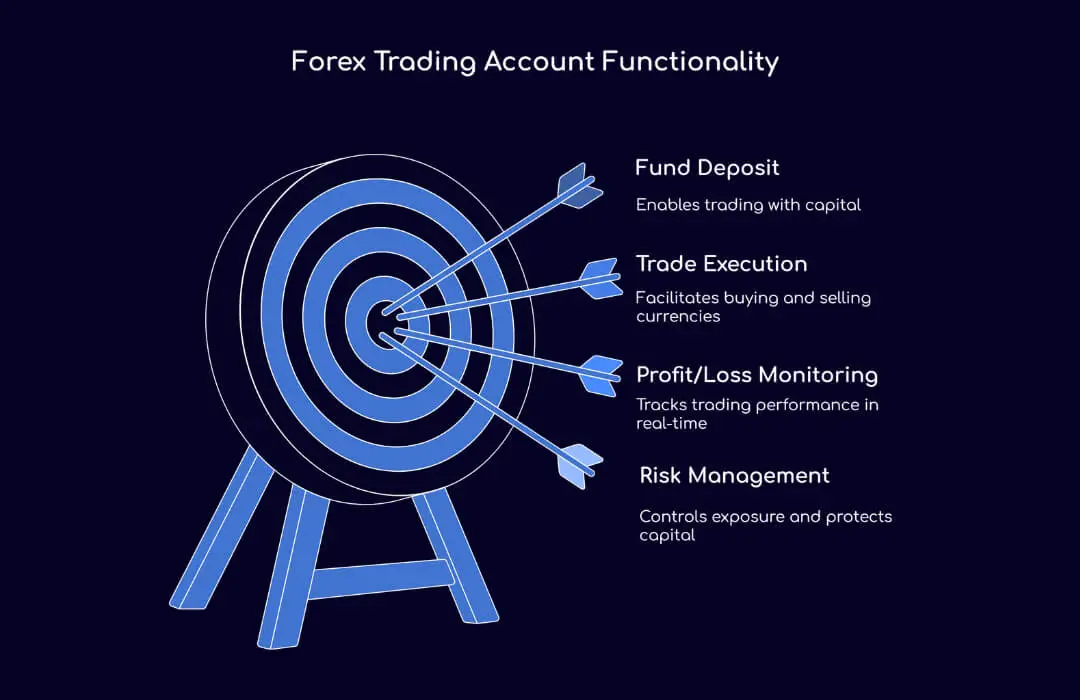
Deposit Funds to Start Trading
Before you can buy or sell any currency pairs, you need capital. A trading account lets you securely deposit money via bank transfer, card payments, or digital wallets, so you're ready to trade when opportunity knocks.
Open and Close Trades
Once you fund your account, it connects to a platform like MT4, MT5, or cTrader.
From there, you can buy EUR/USD when you expect the euro to strengthen, sell GBP/JPY if you think the British pound will weaken, and execute trades manually or automatically using trading bots or Expert Advisors (EAs).
Monitor Profits and Losses in Real-Time
Your trading account updates instantly as the market moves. You’ll see live floating profit/loss on open trades, updated account balance, equity, and available margin, and historical trade logs for performance tracking.
This transparency helps you make informed decisions quickly.
Manage Risk Efficiently
Forex trading involves risk, and your account provides built-in tools to control it.
For instance, stop-loss and take-profit orders to automatically exit trades, while margin and leverage settings adjust how much you risk per trade, and position sizing calculators to avoid overexposure.
A Forex Trading Account Acts As Your Bridge to the Currency Market
It connects you to real-time prices and trade execution through a broker’s platform. Here’s how it works, step-by-step:
To Get Started, You’ll Need to Register With a Forex Broker
Companies like IG, OANDA, Exness, or Forex.com. These brokers provide you with the tools and access needed to place trades, manage risk, and track performance.
A good broker is regulated by a financial authority, offers tight spreads and competitive fees, and provides platforms like MetaTrader 4 (MT4), MetaTrader 5 (MT5), or cTrader.
Most Brokers Offer Different Account Options. Choose One
Most brokers offer different account options depending on your experience level and capital.
- The standard account which is ideally the best for intermediate and advanced traders. It supports full lot sizes and offers standard market conditions.
- The micro or cent account is much more ideal for beginners with smaller balances. You trade with micro lots and lower risk exposure
- The demo account is a risk-free way to practice using virtual funds. It is perfect for testing strategies before going live.
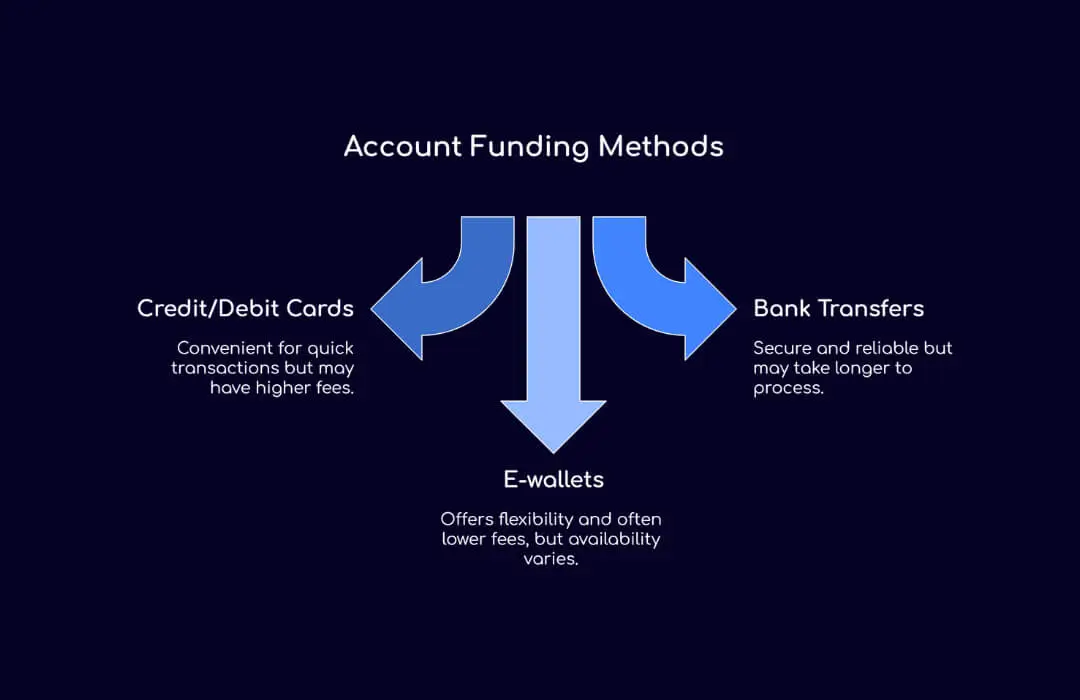
Once your account is verified, you fund it using:
- Credit/debit cards
- Bank transfers
- E-wallets (like Skrill or Neteller).
Minimum deposit requirements vary; some brokers let you start with as little as $10, while others may require $100 or more.
You’ll Now Have Access to the Live Forex Market. To Place a Trade, Simply:
Pick a currency pair (e.g., EUR/USD, GBP/JPY, USD/ZAR) ➜ Decide Buy (if you think base currency will rise) or Sell (if you think it’ll fall) ➜ Choose a lot size. Standard, mini, or micro ➜ Set your stop-loss and take-profit levels ➜ Hit Buy or Sell and your trade goes live.
As Trades Run, Your Account Dashboard Will Display Live Metrics:
Balance, which is your total deposited capital, excluding active trades.
Equity, which equals balance + profit/loss from open trades.
Margin, which describes how much of your account is used to support current positions.
Free Margin, which ideally talks about what’s left of your margin for new trades.
Margin Level, a critical ratio that brokers use to issue margin calls
These metrics help you make smart decisions, adjust your strategy as you go, and avoid costly mistakes like overleveraging or margin calls.
Here’s a Quick Look At the Most Common Types of Forex Accounts
| Account Type | Best For | Key Features |
|---|---|---|
| Demo Account | Beginners and practice | There’s no real money involved; risk-free learning |
| Micro Account | Low-risk traders | Small trade sizes (0.01 lot), low capital needed |
| Standard Account | Intermediate traders | Standard lot size, more profit potential |
| ECN Account | Advanced traders | Direct market access, tighter spreads |
| Managed Account | Passive investors | Pros trade for you; fees usually apply, though |
Other Forex Account Related Information You must know
Account Verification Process
Getting Your Account Approved
After registration, you'll need to verify your identity by uploading a government-issued ID (passport or driver's license), proof of address (utility bill or bank statement from the last 3 months), and sometimes a bank statement.
Most brokers complete verification within 24-48 hours, though some may take up to 5 business days. This KYC (Know Your Customer) process is mandatory for regulatory compliance and protects both you and the broker from fraud.
Tax Implications
Understanding Your Tax Obligations
Forex profits are generally taxable in most countries. In the US, forex gains are treated as ordinary income and taxed at your regular tax rate. Keep detailed records of all trades, including dates, amounts, and profit/loss figures.
Some countries offer trader tax status for frequent traders, providing better tax treatment. Consult a tax professional familiar with forex trading in your jurisdiction, as tax laws vary significantly by country and can change frequently.
Account Security Features
Protecting Your Trading Capital
Enable two-factor authentication (2FA) using SMS or authenticator apps for enhanced security. Use strong, unique passwords and never share login credentials. Most reputable brokers offer account segregation (keeping client funds separate from company funds), SSL encryption, and negative balance protection.
If you suspect unauthorized access, immediately contact your broker's support team, change your password, and review recent account activity.
Withdrawal Process Details
Getting Your Money Out
Withdrawals typically mirror your deposit methods for anti-money laundering compliance. Bank transfers take 2-5 business days, while e-wallets like Skrill or PayPal process within 24 hours. Minimum withdrawal amounts vary from $10-$100 depending on the broker.
Some brokers charge withdrawal fees ($10-$25), while others offer free withdrawals. First-time withdrawals may require additional verification and take longer to process.
Advanced Account Features
Premium Trading Tools
Many brokers offer copy trading platforms where you can automatically replicate successful traders' strategies. VPS (Virtual Private Server) hosting ensures your trading robots run 24/7 without interruption, typically costing $20-$50 monthly.
Premium accounts may include dedicated account managers, advanced analytical tools, exclusive market insights, and priority customer support. Islamic accounts are available for Muslim traders, offering swap-free trading to comply with Sharia law.
Broker Comparison Criteria
Choosing the Right Broker
Look for regulation by reputable authorities: FCA (UK), ASIC (Australia), CySEC (Cyprus), or CFTC/NFA (US). Check spreads, commissions, and overnight fees. Avoid brokers offering unrealistic bonuses, those with poor customer reviews, or unregulated entities.
Verify client fund segregation, negative balance protection, and transparent fee structures. Test their customer support response times and ensure they offer your preferred trading platforms.
Account Maintenance
Keeping Your Account Active
Most brokers charge inactivity fees ($10-$50 monthly) after 3-12 months of no trading activity. To close your account, withdraw all funds first, then submit a written closure request. Some brokers allow account transfers to other regulated brokers while maintaining your trading history.
Dormant accounts may be automatically closed after extended inactivity, with remaining funds returned via your original deposit method after deducting applicable fees.
Understanding Account Balance in Forex Trading: What is It & How Does It Work?
A Forex account balance is similar to a regular bank account balance. It refers to the amount of funds a trader has in their account at a given period.
Consider this. Brent just opened a Forex account and deposited $2,500 into it. This amount makes up his account balance at this given time (given that he has yet to open any trades).
In another scenario, Ryan opens a trade that requires $500 off her balance. Her new account balance becomes $2,000. However, her equity is $2,500.
Under What Circumstances Can An Account Balance Change?
An account balance can change when certain things occur in the Forex account. These things include:
- Leaving trade(s) open over the night and getting a swap fee.
- Adding more money to your account.
- Closing active trades, may result in a loss or profit.
What is a Swap Fee?
Also known as a rollover fee, a swap is a fee that traders give or receive after leaving a trade overnight.
Investors will required to pay cash if a swap is charged to them and vice versa.
Not to worry though. Swap fees are usually quite small unless you open large position sizes.
What’s the Difference Between Equity and Account Balance?
Because these two are very related, I can see why many traders tend to mix them up.
I think it’ll be best to define both first and then consider contextual examples to explain further.
An account balance is the total amount of funds a person has at any given time in their forex account. The account balance does not include the funds tied in open trades or any unrealized profits or losses.
Meanwhile, an account equity talks about the total value of an account. This is inclusive of the account balance, funds tied to open trades, and unrealized profits or losses.
Consider this example.
A person deposits $3,000 into their account and is yet to open any trades. The account balance and equity at this stage are $3,000 each. They decide to open a trade that requires a $1,000 margin.
The account balance is $2,000. The equity is still $3,000. The trade makes an unrealized profit of $400.
The account balance is $2,000 still. However, their equity is $2,000 + $1,000 + $400 = $3,400. They decide to close the trade at this point. Their account balance and equity are $3,400, respectively.
If you want to know more about the value of your forex account, here's detail about equity.
There’s No One-Size-Fits-All Deposit Amount For Forex Trading Accounts
For Micro or Cent Accounts
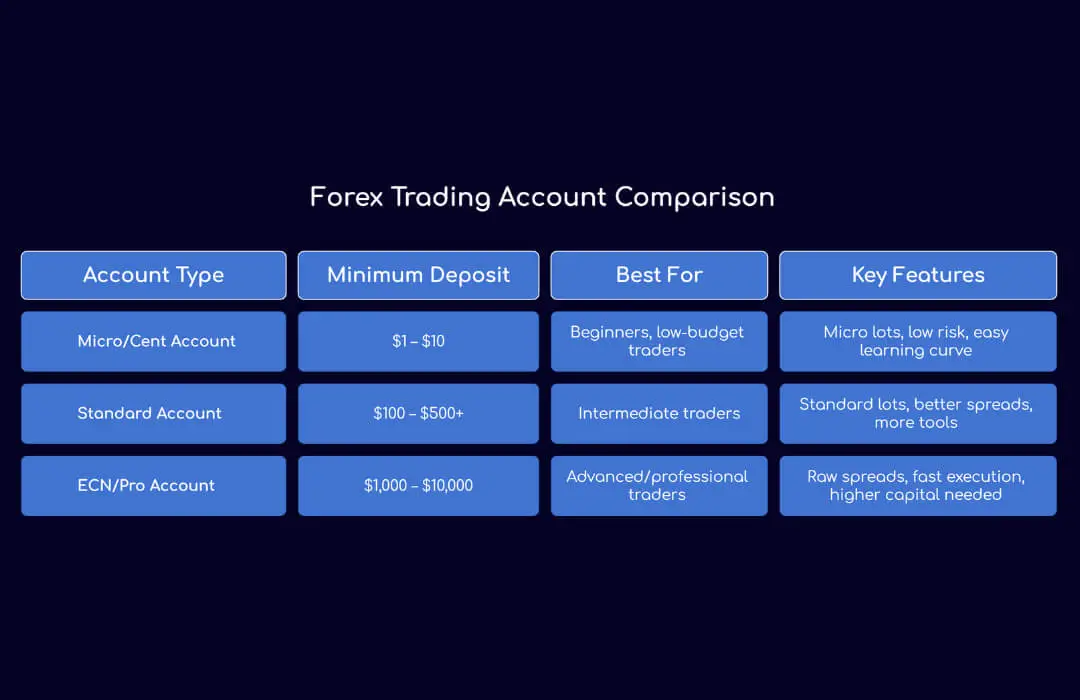
These are beginner-friendly accounts designed for low-capital traders. Some brokers allow you to start with as little as $1 to $10.
They offer micro lot sizes and lower risk exposure. This is ideal for learning without putting much money on the line.
For Standard Accounts
If you want access to standard lot sizes, better spreads, and more advanced features, you’ll typically need to deposit $100 to $500 or more.
These accounts are better suited for traders with some experience and a more developed strategy.
For ECN or Professional Accounts
For experienced traders or institutions looking for raw spreads and faster execution, ECN accounts may require a minimum of $1,000 to $10,000. These are not ideal for beginners.
Conclusion
A forex trading account is more than just a gateway to currency markets—it's your command center for building wealth through strategic currency trading. Whether you're starting with a $10 micro account to learn the ropes or diving in with a standard account to execute serious strategies, the key is choosing the right account type that matches your experience level, risk tolerance, and financial goals.
F. Nathan
Felix Nathan is a professional trader, market analyst, and business development executive with over a decade of experience in the forex and financial markets. Felix specializes in providing actionable market insights, trading strategies, and risk man...