 IUX
IUX
 Exness
 Vantage
 XM
XM
 ICMarkets
 LiteFinance
 Moneta
 Tickmill
 South Africa (9)
 India (9)
 Bangladesh (12)
 Germany (9)
 Thailand (10)
 Philippines (9)
 Nigeria (10)
 Vietnam (10)
 Malaysia (9)





Beginner’s Guide to Forex Scalping: When and How to Start Safely?



Share:
Share:
Strategy
16 min read
Beginners can start practicing scalping on a demo account from day one, but they should not jump into live scalping until they have built a solid foundation. Scalping is one of the most demanding forex strategies because it requires split-second decision-making, intense focus, and strong emotional control.
Most experts recommend that new traders first spend time learning core concepts like price action, support and resistance, and risk management through slower styles like swing or position trading.
Once you are comfortable reading charts, placing orders quickly, and managing your emotions under pressure, you can transition to scalping practice on a demo account.
What is Forex Scalping?
Instead of holding trading positions for hours, scalping involves making profit from the smaller price moves of the currency pairs. Here, scalpers go with multiple short trades to make small but more frequent profit.
Let’s say a currency pair moves just 5-10 pips within a few minutes, if not seconds. Now one thing is certain and that is the move often seems insufficient for long-term traders. But, you can find an opportunity here as a scalper.
Now what scalpers do is quickly enter the market. And then, don’t feel shy capturing those few small pips and exit the trade very first.
As they repeat this process several times a day, those small gains can accumulate into a meaningful overall profit for sure.
Let’s be more practical this time!
If a trader makes 10 trades in a day and pulls 5 pips from each, that’s 50 pips by the close. Five pips doesn’t feel like much at the moment. It’s not the kind of trade that makes you lean back in your chair. But stack it ten times and the picture changes.
That’s why the partner you trade with actually matters more than most people admit. You can have a solid strategy, but if your spreads are wide, your entries slip, or the platform freezes at the wrong moment, those small gains disappear fast.
When you take the time to compare spreads, execution speed, commissions, and platform stability, you will definitely find the best Forex broker for scalping. One that supports your strategy instead of slowing it down.
Is Scalping Good for Beginners?
I will not give a one word answer to this question. Look, whether a trading strategy fits a trade depends on many things. The core thing is how skilled the trader is. So what I can say is that scalping is not automatically good for a beginner. Their experience, discipline and understanding of risk matter at the end.
Yes, scalping can potentially bring quick profits. And that’s what drives a good number of beginner traders out there to go with this trading strategy. But remembered what I said?
Making decisions out of emotion most often doesn’t bring any results.
Wait!
I’m not demotivating you.
You can still make the most of scalping as a beginner.
If you are someone who has mastered the basics of Forex, then it is Okay. Also, if you have logged consistent results trading with demo accounts, scalping might be the option for you.
I know newbies who have a proper idea on risk-reward ratio and positioning sizing. Scalping trading strategy can also be a good move for them.
When Beginners Should Avoid Scalping?
I think this is a good question. You already know what scalping is. But when you are a beginner, it is important to know the time to step up from the scalping game.
Avoid this if you are not well aware of the scalping risk management. Now as a beginner, chances are you are unsure about how to calculate pip value. In this kind of scenario, it would be a wise move to avoid scalping.
And don’t forget about the fact that scalping produces frequent small losses. Yes, the opposite can also happen. So, if you are someone who struggles with emotional control, scalping might be expensive. And can also ruin your trading strategy.
You can also have limited capital. And in case you don’t know, Small accounts combined with high expectations create risk-taking behavior.
Also know whether something below matches your current condition:
- You have no tested trading plan.
- You haven’t proven demo consistency.
- You can’t commit focus screen time.
Sometimes, low spread brokers can help you avoid minor risks. But in the end, it is your understanding about scalping which can save you.
Realistic Profit Expectations of Scalping Trading Strategy
You will love this section. There are so many misconceptions that you can make a faster and massive amount of money through scalping.
But in reality?
What would you really expect from the trading strategy?
Look, how successful you can become in trading depends on your skills and experience. And that’s the reason why traders aim for strategies that seem to fit them the best.
So, how much do scalpers actually make?
Even though there is no fixed return, yes, most retail traders don't achieve consistent monthly profitability. You will also find traders who struggle with overtrading and risk management.
But there's hope.
Now if you are a disciplined beginner scalper, you can expect 0.5%–2% per week under controlled risk. Or, it can also be 3%–8% per month in strong performance periods.
Then again, profit potential is directly linked to account size and risk per trade.
Example:
Account: $1,000
Risk per trade: 1% ($10)
Average net gain per winning trade: 1%
Even with consistent performance, income grows gradually. Scalping is not a shortcut to replacing a full-time salary — especially for beginners with small accounts.
Trying to accelerate growth through higher leverage usually increases drawdown risk.
The Scalping Readiness Checklist
You need miserable readiness before going through Forex scalping strategy. Do remember one very important thing and that is you need more than motivation to be a successful trader.
Now it would be a lot better if you ask yourself some valid questions to actually understand whether your trading strategy really fits scalping. If you answer ‘no’ to multiple points, try to focus on the areas you lack before attempting scalping.
Technical Knowledge Readiness
You must be able to confidently answer:
- How currency pairs interact and what causes volatility
- What pip value is and how to calculate it
- How bid-ask spreads affect profitability
- Difference between market, limit, and stop orders
- How leverage multiplies both profit and loss
If you can’t describe the effect of a 2-pip spread on a 5-pip target, you are not ready to scalp live markets.
Execution Speed & Platform Proficiency
You must be able to:
- Make trades without pause
- Operate your trading platform (MT4, MT5, cTrader) automatically
- Enter stop-loss and take-profit orders instantly
- Understand execution types (ECN vs market maker)
A few seconds of lag on a 1-minute chart will ruin a trade setup.
Demo Consistency Proof
Before trading real money, you must prove:
At least 4–6 weeks of consistent demo trading
- A scalping trading strategy
- A positive risk-to-reward ratio
- Managed drawdowns
Consistency trumps win rate. A 55% win rate with proper risk management can beat an inconsistent 75% system.
If your demo equity curve is a mess, your live trading account will be the same.
Cost Awareness & Break-Even Math
Many new traders underestimate trading costs.
You need to know:
- The spread effect per trade
- Commission details
- Slippage risk in volatile markets
- How many pips you need to break even
Example:
- Target: 4 pips
- Spread: 1.5 pips
- Slippage: 0.5 pips
Net potential profit = 2 pips
This means 50% of the trade is wiped out by trading costs. Without understanding trading costs, scalping is mathematically against you.
Psychological Stability Under Pressure
Scalping will test your psychological stability more than any other trading method.
Ask yourself:
- Do I chase losses after a losing trade?
- Do I overtrade during boredom?
- Can I accept small losses without revenge trading?
- Can I stop trading after hitting my daily loss limit?
Because scalping involves risk management with very tight stop-losses, you will have many small losses. Lack of psychological stability will turn small losses into big losses.
Capital & Risk Management Preparedness
You must:
- Risk no more than 1–2% per trade
- Have enough capital to absorb consecutive losses
- Use fixed position sizing rules
- Not over-leverage your trading
Scalping with too little capital means increased pressure and oversized positions – one of the biggest reasons new traders fail.
Spread, Slippage, and Transaction Costs Explained
Don’t treat transaction costs with minor details. Now if you are unsure about this, especially when you choose scalping, you will end up losing your profit. And more interestingly, you may not even know where your money goes.
If you know, then good. Skip to the next section.
But you should have a pretty clear idea on spread, slippage and commissions in Forex trading.
What Is the Spread?
This comes under the core basics of Forex trading. Spread in Forex is all about the difference between the bid and ask price. To be more exact, spread is the difference between the price you can purchase a currency and the price you sell it.
What happens here is when you enter a trade, you immediately start at a small loss equal to the spread.
You need to aim for somewhat between 3-8 pips when you are a scalper. Why?
Because your profit target is small, and the spread takes a portion of it right from the beginning.
For example, if the spread on a currency pair is 2 pips and your target is 5 pips, nearly 40% of your potential profit is already consumed by the spread. And you know what? That leaves very little room for error.
If the spread is too high, it becomes much harder to achieve consistent gains.
What Is Slippage?
Slippage is something you will want to experience as a trader, especially as a beginner.
But what exactly is it?
When slippage occurs when your order is executed at a slightly different price than expected.
There are many reasons why the slippage in order execution often takes place.
Sometimes this happens during high-volatility. Apart from this, you may also experience this around economic news releases.
Your broker can also be responsible for this.
Yes, you have heard it right. If your broker comparatively takes a long time to trade, slippage can also occur. And here comes the importance of choosing fast execution Forex brokers.
Commission and Hidden Fees
Before choosing any broker, what I often suggest is that you take your time to have a clear idea on commission rates and know whether there are any hidden fees included.
You will find a good number of brokers offer spread only accounts. Now this means the brokers will make money from spread without charging you any commissions nor hidden fees.
But on the flip side, there are brokers that offer raw spread and commissions accounts.
In case you don’t know, on raw accounts, spread might be zero. But this type of account often comes with hidden fees based on per lot traded. And then this happens, instead of paying through a wider spread, you pay through a direct transaction fee.
At the end, you should always calculate whether the total trading cost fits your pip target.
Capital Requirements for Forex Scalping Strategy
Just like any other financial market, the Forex market is full of misconceptions. But what is scalping for beginners?
Well, one of the biggest misconceptions out there is you can start trading with a very small amount of capital. And still, you can generate meaningful profits.
But in reality, this is not always like what is said.
Look, it is technically possible to scalp with a small amount of capital which you can also do going with other trading strategies. Then again, capital size and what broker you choose contribute much to determine whether strategy will provide you with a long term value.
Now comes the question; how much capital do you really need for scalping timeframes?
To be honest, there is no fixed minimum.
But if I assume realistically, this stands something like:
- Under $100 → Extremely difficult due to spread impact and risk limits.
- $500–$1,000 → More practical for controlled micro-lot scalping.
- $2,000+ → Greater flexibility in position sizing and drawdown tolerance.
Since scalping involves trading on small price changes (usually 3–10 pips), it has always been important to actually use proper position sizing. When risking 1% of a $500 account, for example, the risk amount per trade is $5.
However, with tight stop-losses (such as 5 pips), it is necessary to size positions properly to prevent over-risking. Small accounts and high leverage can cause new traders to overtrade or over-size positions, which eventually can result in quick drawdowns.
Best Forex Brokers for Scalping
A broker can make or break your trading journey. And that’s the reason why you should take your time to choose the regulated brokers. In terms of Forex scalping strategy, the scenario remains the same.
Here you can have a glimpse of the regulated brokers who are good for scalping. You can also read in-depth reviews to discover more about them.
| Broker | Scalping | Minimum Deposit | Trustpilot Rating | Founded | Regulated By | Spreads | Commissions | Trading Platforms |
|---|---|---|---|---|---|---|---|---|
| Exness | Yes | $10 | 4.8 | 2008 | CY & CySEC | 0.0–0.3 Pips | $0–$3.5 | MT4, MT5 |
| AssetsFX | Yes | $10 | 4.7 | 2013 | FSC | 0.0–1.0 Pips | $0–$3 | MT4, MT5, Web |
| LiteFinance | Yes | $50 | 4.0 | 2005 | SVG & CySEC | 0.0–3.0 Pips | $0–$0.25 | MT4, MT5, MobileTrader |
| Trader'sWay | Yes | $10 | 4.3 | 2011 | No | 0.0–0.7 Pips | $0 | MT4, MT5, Web Terminal |
| OctaFX | Yes | $25 | 4.2 | 2011 | FCA & CySEC | 0.1–0.6 Pips | $0 | MT4, MT5, OctaTrader |
| XM | Yes | $5 | 3.9 | 2009 | CySEC & ASIC | 0.0–1.6 Pips | $0 | MT4, MT5, XM App |
Step-by-Step Beginner Scalping Plan
What’s more special about scalping trading is that it requires a structured, rule-based and repeatable approach. If you don’t follow the right plan or strategy, just like any other form of trading, scalping will not work in your favour.
Select the Right Currency Pairs
Even if you go with automated trading, you can’t avoid the fact of proper analysis of the Forex market. Now if you want me to be more exact, you should spend a good amount of time knowing and researching what currency pairs you need to choose to make the most of scalping.
And you know what?
Not all the currency pairs out there are good for scalping.
So, what should you do?
As a beginner, you need to pick highly liquid currency pairs based on the Forex market you are in. For example, you can go with major currency pairs like EUR/USD, GBP/USD, USD/JPY, or USD/CHF.
Beyond that, you should also focus on the pairs that are good for constantly tight bid-ask spread.
One more suggestion, as you know the market scenarios can change any time, you should also go with the currency pairs that have strong movement during active trading sessions.
Timeframes
Timing in scalping matters a lot. And that’s why you need to be very careful while placing your trade.
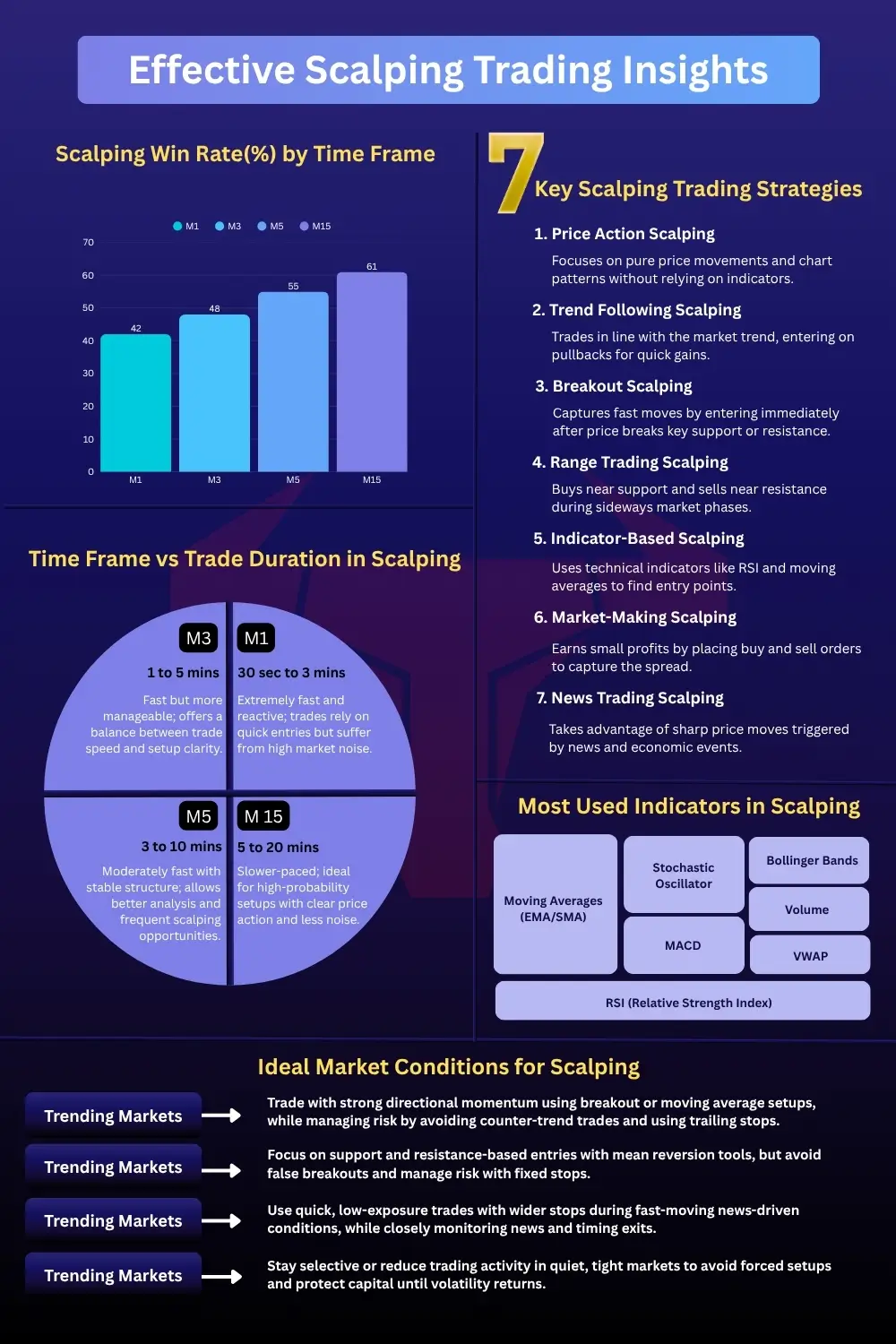
Most scalpers operate on the 1-minute (M1) chart for timing their entries, while using the 5-minute (M5) chart to understand the short-term direction. That small layer of context makes a big difference.
Now if you are a beginner, you need to avoid dropping below 1-minute (M1) as this may cause potential risk. Price starts reacting to micro fluctuations rather than meaningful movement, and that can quickly lead to impulsive decisions.
A practical structure is simple. Use the M5 chart to identify the short-term trend – is price making higher highs and higher lows, or vice versa?
Then proceed to the M1 chart and wait for confirmation before entering. The chart will keep you in sync with the trend rather than against it.
Indicators
You have to make the most of indicators when it comes to decision making. But make sure they never overwhelm you. Why I’m saying this is because most of the beginner traders make a massive mess here.
To track the short-term trend direction, you will find Moving Averages (e.g., 20 EMA, 50 EMA) most helpful. But this is not the end.
In the majority of the cases, you need to keep a close eye on momentum and overbought/oversold signals. And in this case, indicators like RSI (Relative Strength Index) are supposed to play a crucial role.
Final Words
Now you are supposed to have in-depth knowledge on Forex scalping for beginners. So, before getting started, make sure you are quite capable of making things happen. Then again, experience and expertise matter in trading. The broker you choose also has a prominent role to play.
Best wishes!
FAQs
Is Forex Scalping Profitable for Beginners?
Yes, Forex scalping can be profitable for the beginner. But yes, there are some conditions. You should have a strong discipline on trading. Also, you need to have a precise idea on trading costs, and consistent risk management. Most importantly, profitability depends more on execution quality and cost control than strategy complexity or high win rates.
How much money do you need to start scalping?
Start with at least 500 to 1000 dollars if you want stable risk control. With 1000 dollars and 1 percent risk, you risk 10 dollars per trade. This supports controlled position sizing. Smaller accounts increase pressure and overleveraging. Adequate capital protects your account during losing streaks.
What timeframe is best for scalping?
Most scalpers trade the 1 minute and 5 minute charts. Use the 5 minute chart to define short term direction. Use the 1 minute chart for entries. Lower timeframes increase noise and false signals. Focus on one structure and track performance over at least 50 trades.
Which brokers allow scalping?
Many regulated brokers allow scalping, but conditions differ. Look for low spreads, fast execution, and no minimum holding time. Check if the broker offers raw spreads below 1 pip on major pairs. Review the terms section. Test execution speed on a demo before funding.
Is scalping risky?
Scalping carries risk because you place many trades and target small moves. Costs and slippage reduce your margin for error. If you risk 1 percent per trade and lose five trades in a row, you drop 5 percent. Strict stop losses and daily loss limits control exposure.
Can you scalp with 100 dollars?
You can trade micro lots with 100 dollars, but risk control becomes tight. At 1 percent risk, you risk 1 dollar per trade. Spreads consume a large share of potential profit. One losing streak damages confidence and capital. A larger account reduces pressure.
Is scalping better than day trading?
Scalping suits traders who focus for long periods and execute fast. Day trading allows more analysis time and fewer trades. If you prefer quick decisions and strict rules, scalping fits. If you prefer patience and broader moves, day trading fits. Choose based on behavior and discipline.
F. Nathan
Felix Nathan is a professional trader, market analyst, and business development executive with over a decade of experience in the forex and financial markets. Felix specializes in providing actionable market insights, trading strategies, and risk man...